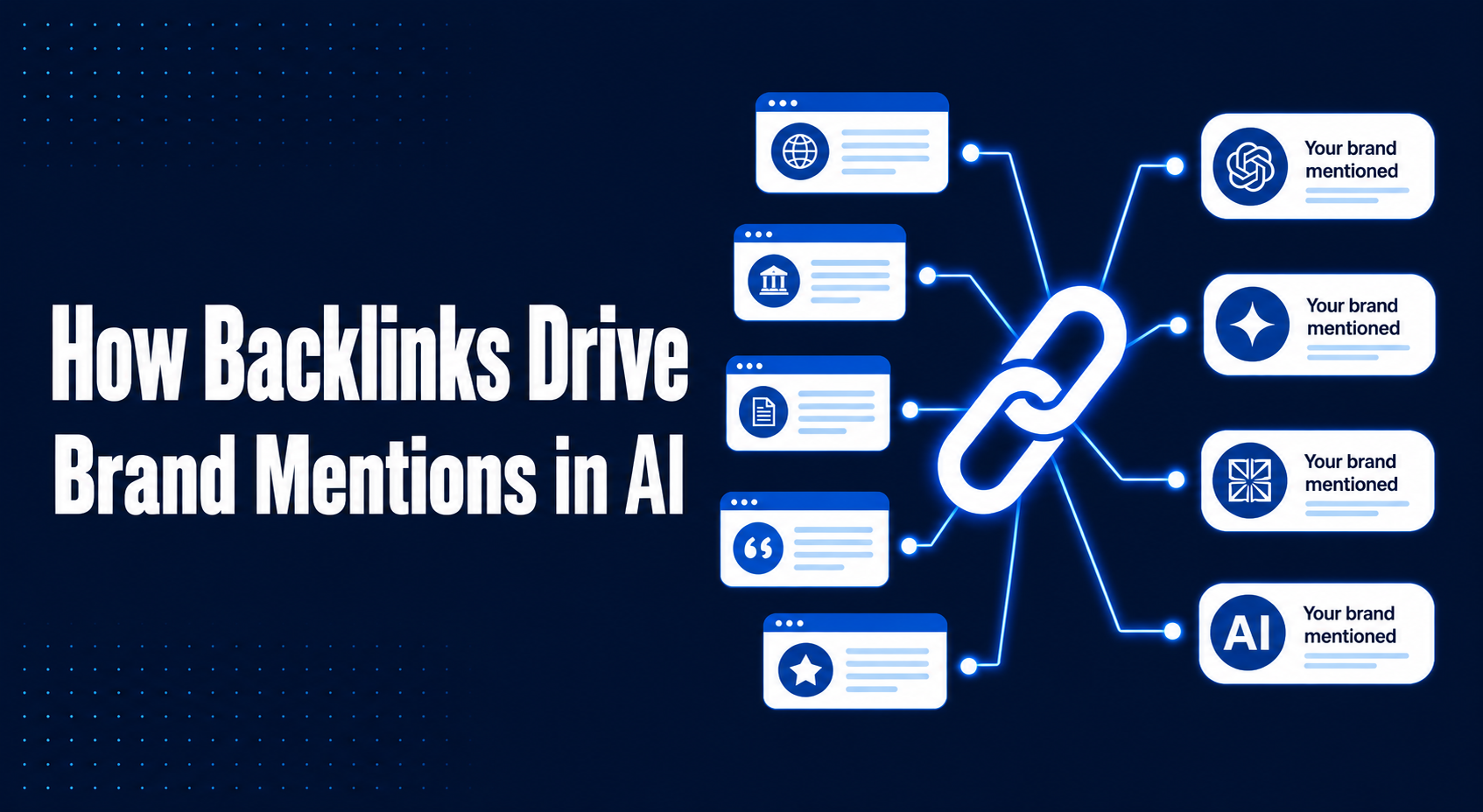
.webp)
Generative Engine Optimization (GEO) is the practice of structuring content so AI platforms ChatGPT, Perplexity, Google AI Overviews, Claude cite your brand in generated answers. Search Engine Optimization (SEO) focuses on ranking in traditional search results to earn clicks. B2B marketers need both: SEO drives organic traffic, GEO builds AI citation authority and together, paired with conversion rate optimization, they fuel qualified pipeline.
What Is Generative Engine Optimization (GEO)?
Generative Engine Optimization (GEO) is the practice of optimizing your content on AI-powered platforms including ChatGPT, Perplexity, Google AI Overviews, and Claude select, reference, and cite your brand when generating answers to user queries. Unlike traditional SEO, which aims to earn a position on a search results page, GEO aims to become the source AI engines trust when synthesizing responses.
The mechanism behind GEO is Retrieval-Augmented Generation (RAG). When a user asks an AI platform a question, the system retrieves relevant content from its index, evaluates it for authority, factual density, and semantic clarity, then synthesizes an answer with inline citations. Your content either makes the cut or it doesn't exist to that buyer.
The growth signals are hard to ignore. According to Previsible's 2025 AI Traffic Report (via Search Engine Land), AI-referred sessions surged 527% between January and May 2025 across 19 tracked GA4 properties. That's not a forecast. That's measured traffic, doubling and tripling across verticals like SaaS, legal, and finance.
The market is responding accordingly. The GEO services market was valued at $848 million in 2025 and is projected to reach $33.7 billion by 2034, growing at a 50.5% CAGR, according to Dimension Market Research (via Superlines). For B2B SaaS companies, this means a new discovery channel is forming one that rewards structured, authoritative content over keyword volume.
But here's what most GEO guides miss: AI visibility without a conversion path is a vanity metric. If ChatGPT mentions your brand but your landing pages don't convert that interest into a demo request, you've earned a citation, not a customer. That's why GEO must be paired with conversion rate optimization strategies from the start.
What Is SEO and Why Does It Still Matter for B2B?
Search Engine Optimization (SEO) is the practice of optimizing web content, site architecture, and technical infrastructure to rank higher in traditional search engine results pages (SERPs) and earn organic click-through traffic. For B2B SaaS companies, SEO remains the single largest source of qualified organic traffic and the foundation on which GEO is built.
The scale difference is still massive. According to SparkToro and Datos research, Google still drives dramatically more referral traffic than all AI platforms combined. While AI referral traffic is growing fast, it accounts for approximately 1.08% of total website traffic, per Conductor's 2026 State of AI Search benchmark data (via Superlines). Traditional organic search still delivers the volume B2B pipelines depend on.
For B2B SaaS specifically, SEO feeds the top and middle of the funnel capturing buyers who are researching categories, comparing solutions, and evaluating vendors. A 6sense Buyer Experience Report (2025) found that 95% of the time, the winning vendor is already on the buyer's "Day 1" shortlist. SEO is how you earn a spot on that list before a sales conversation ever begins.
But SEO without conversion optimization is an expensive traffic report. Ranking first for "enterprise cybersecurity platform" means nothing if that traffic lands on a page with no clear path to a demo request. This is the gap LeadWalnut's integrated SEO and CRO approach is designed to close connecting search visibility directly to pipeline generation.
How Do GEO and SEO Differ? A Side-by-Side Comparison
GEO and SEO share a common goal making your brand discoverable when buyers search for answers but they operate through fundamentally different mechanisms. Understanding these differences is essential for B2B marketers who need to allocate budget and resources across both channels.
Gartner predicted that traditional search engine volume would drop 25% by 2026 due to AI chatbots and virtual agents. Whether or not that specific number holds, the directional shift is clear: buyers are splitting their research between traditional search and AI platforms. Your content strategy must account for both.
The key insight from this comparison: the two channels reward different content behaviors, but they share a common foundation. Authoritative, well-structured, factually dense content performs well in both traditional search and AI-generated answers. The difference is in how that content is surfaced and how the resulting buyer engagement converts downstream.
Why Do B2B SaaS Companies Need Both GEO and SEO?
B2B SaaS companies need both GEO and SEO because their buyers now research across multiple platforms toggling between traditional search engines and AI assistants before ever contacting a vendor. Optimizing for only one channel means you're invisible during critical stages of a buying journey that increasingly spans both.
The data confirms this shift is already underway. According to Forrester's Buyers' Journey Survey, 2024, 89% of B2B buyers have adopted generative AI, naming it one of the top sources of self-guided information in every phase of their buying process. This isn't a future trend, it's current buyer behavior.
The adoption is even more concentrated in technology purchasing. Responsive's "Inside the Buyer's Mind" report (2025) found that 80% of tech industry buyers use GenAI at least as much as traditional search when researching vendors, 21 percentage points higher than other industries. More than half of tech buyers (56%) report using AI chatbots as a top source to discover new vendors entirely.
What this means in practice: your B2B SaaS buyer might start their vendor evaluation by asking ChatGPT for a comparison of enterprise security platforms. The AI generates an answer, cites three brands, and your company isn't among them. That buyer narrows their shortlist before they ever type a query into Google. Your SEO rankings are irrelevant because the buyer already eliminated you during AI-assisted research.
The reverse is also true. A buyer who discovers your brand through an AI citation will likely verify your credibility through a traditional Google search. If you rank well for branded and category terms, you reinforce the trust the AI mentions. If you don't, you lose the advantage.
This is why an integrated approach matters. SEO provides the discoverability foundation technical health, domain authority, content depth. GEO extends that foundation into AI-powered discovery. And CRO ensures that both traffic sources convert into qualified pipelines rather than bounce.
Consider a scenario: A VP of Marketing at a $200M cybersecurity SaaS company asks Perplexity, "What agency specializes in SEO and CRO for B2B SaaS enterprises?" If your agency is cited in that answer with supporting context from multiple authoritative sources, you've just entered the consideration set at zero cost-per-click. But that citation only generates a pipeline if your website which the VP visits next clearly communicates your expertise and provides a frictionless path to a strategy conversation.
What GEO Tactics Actually Improve AI Visibility?
GEO tactics that improve AI visibility focus on making your content easier for AI systems to retrieve, evaluate, and cite with confidence. Research from Princeton University and Georgia Tech provides the most rigorous evidence on which tactics work and the results are specific and actionable.
The Princeton/Georgia Tech GEO research paper, which analyzed over 10,000 search queries across diverse domains, found that three content optimization methods consistently outperformed all others. Statistics Addition, Quotation Addition, and Cite Sources each achieved 30-40% relative improvement in AI visibility. Notably, traditional SEO tactics like keyword stuffing performed poorly in generative engines, sometimes decreasing visibility.
Here are the five GEO tactics with the strongest evidence for B2B SaaS content:
1. Direct Answer Blocks
Open every major section with a 2-3 sentence answer that makes sense in isolation. AI engines extract and cite self-contained passages. If your paragraph requires context from previous sections to make sense, it won't be selected.
2. Fact Density with Source Attribution
Maintain a ratio of approximately one cited statistic per 150-200 words. AI systems prioritize content they can verify against known data. Name the source explicitly in your text, not just as a hyperlink. Write "According to Forrester's 2024 Buyers' Journey Survey" rather than embedding a generic link.
3. Schema Markup
Implement Article, FAQPage, and HowTo schema on every relevant content page. According to research compiled by Superlines, content with proper schema markup shows 30-40% higher AI visibility than unstructured equivalents. Schema gives AI systems machine-readable context about your content's purpose and structure.
4. Expert Quotations and Authority Signals
Include attributed expert quotes with credentials. The Princeton/Georgia Tech study identified quotation addition as a top-three optimization tactic. AI systems recognize quoted material as established expert opinions and treat them as authoritative statements worth citing.
5. Freshness and Recency Signals
Update content regularly and signal that recency through visible dates, "Last Updated" timestamps, and current-year data. Superlines' research on AI se9arch statistics found that pages updated within 2 months earn 28% more AI citations than older content.
The critical point for B2B marketers: these tactics improve both AI visibility and traditional SEO performance. Fact-dense, well-sourced, clearly structured content ranks better in Google and gets cited more by AI engines. You're not choosing between two optimization paths you're reinforcing both.
But visibility alone doesn't generate pipeline. Every GEO-optimized page should include a clear conversion path. If ChatGPT cites your content and a buyer visits your site, what happens next? That's where your CRO strategy for enterprise conversions determines whether a citation becomes a customer.
🎥 Recommended viewing: For a deeper look at how AI search is reshaping content strategy, watch Google's Search is About to Change Forever (Google I/O) which demonstrates how AI Overviews and Gemini are transforming how Google surfaces and cites content. Consider implementing VideoObject schema if embedding this or similar videos on the published page.
How Should B2B Marketers Measure GEO vs SEO Performance?
B2B marketers should measure GEO and SEO through separate but connected dashboards tracking traditional search metrics alongside AI citation metrics, then tying both to pipeline contribution. Without this dual measurement approach, you're flying blind on at least half of your buyer's research journey.
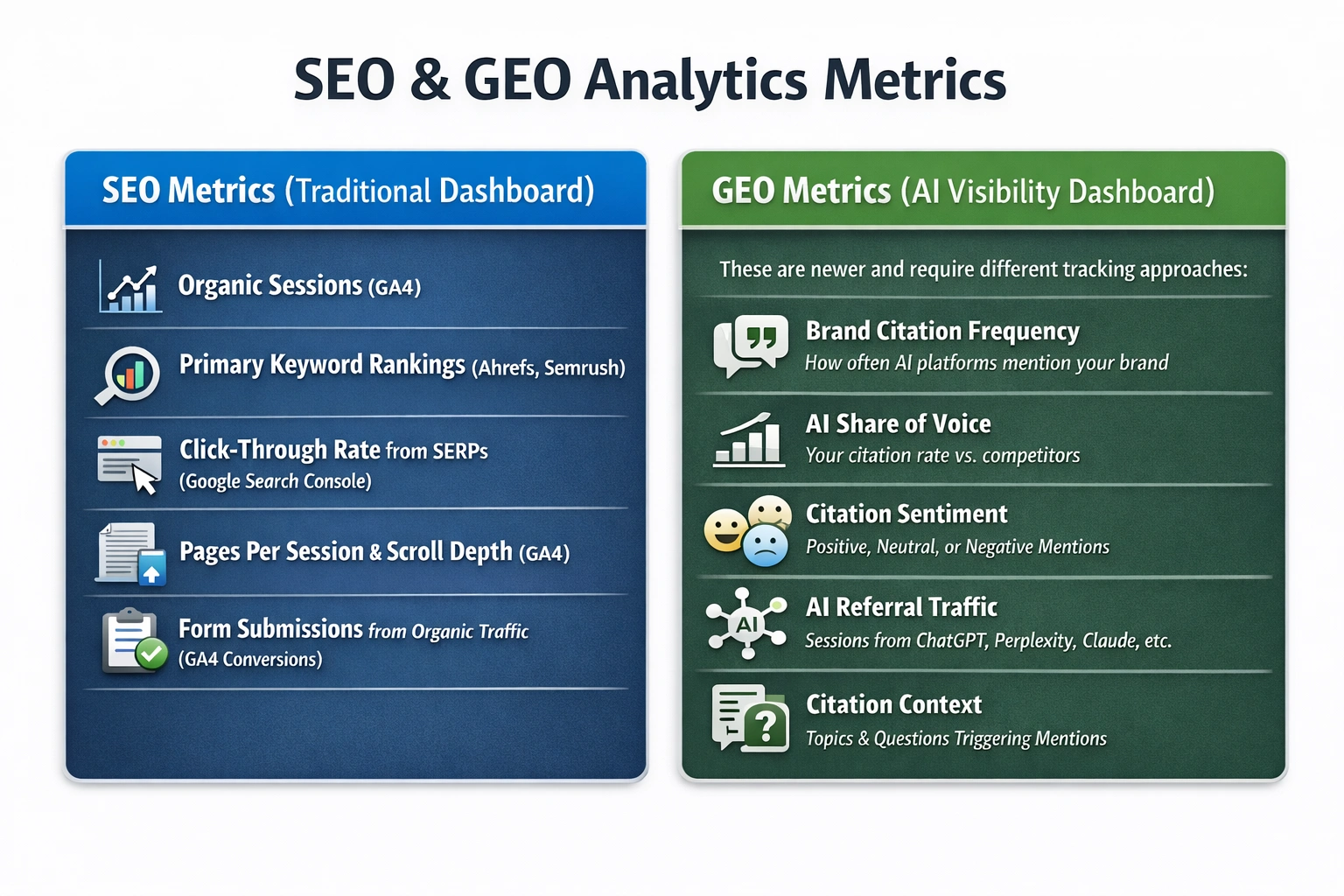
The measurement gap is significant. According to Semrush data reported via Superlines, approximately 93% of AI search sessions end without the user visiting a website. This means traditional analytics platforms like GA4 capture only a fraction of your actual AI-driven brand exposure. You need purpose-built tools like Semrush's Enterprise AIO, Otterly, or manual prompt auditing to track the full picture.
The Pipeline Connection
Neither set of metrics matters unless you connect them to revenue. For every article, track:
- CTA clicks by position (soft, mid, end using UTM parameters)
- Form submissions attributed to the article (GA4 conversion tracking)
- AI citation appearances for the article's target queries (manual + tool-based tracking)
The formula: Article Pipeline Value = (Form submissions from article) × (Average deal value) × (Close rate)
This is the number that proves content ROI to your CMO and board. Traffic metrics and citation counts are leading indicators. Pipeline contribution is the only metric that justifies budget.
What Does an Integrated GEO+SEO+CRO Strategy Look Like?
An integrated GEO+SEO+CRO strategy treats search visibility (SEO), AI citation authority (GEO), and conversion optimization (CRO) as three connected stages of a single pipeline-generation system. Most B2B teams operate these as separate workstreams. The companies that win treat them as one.
Here's the framework:
The Visibility → Citation → Conversion Pipeline
Stage 1: SEO Foundation (Visibility) Build the technical and content infrastructure that makes your site discoverable. This includes site architecture, keyword-targeted content, internal linking, page speed, and domain authority development. Strong SEO ensures AI engines can find and index your content in the first place. 76.1% of AI Overview citations also rank in Google's top 10, according to research cited by Dataslayer's GEO guide.
Stage 2: GEO Optimization (Citation) Layer B2B SaaS GEO optimization tactics on top of your SEO foundation. Structure content with direct answer blocks, maintain fact density, implement schema markup, include expert quotations, and define entities clearly. This stage extends your visibility from SERPs into AI-generated answers where a growing share of B2B purchase research now happens.
Stage 3: CRO Integration (Conversion) Ensure every page that earns visibility through rankings or AI citations has a clear conversion path. This means strategically placed CTAs, frictionless form experiences, social proof elements, and landing page optimization. Without CRO, stages 1 and 2 generate awareness but not pipeline.
5-Step Implementation Roadmap
Step 1: Audit your current state across all three dimensions. Where do you rank? Where are you cited? Where do visitors convert or drop off? Use GA4, Ahrefs, and manual AI prompt testing to build a baseline.
Step 2: Identify your highest-intent content. Which pages target bottom-of-funnel queries where buyers are comparing solutions or evaluating vendors? These pages should receive GEO optimization first, because they're closest to pipeline generation.
Step 3: Apply GEO tactics to priority pages. Add sourced statistics, expert quotations, schema markup, and direct answer blocks. Restructure content so each section is self-contained and citable in isolation.
Step 4: Align CRO with each content type. Top-of-funnel content should offer low-commitment CTAs (audit, checklist, newsletter). Mid-funnel content should offer medium-commitment CTAs (strategy call, assessment). Bottom-of-funnel content should offer high-commitment CTAs (consultation, pricing, proposal request).
Step 5: Measure and iterate monthly. Track SEO metrics, AI citation metrics, and pipeline metrics together. Identify which articles generate AI citations but no clicks (brand awareness value). Identify which articles generate clicks but no conversions (CRO opportunity). Optimize accordingly.
The critical takeaway for B2B SaaS marketing leaders: GEO is not a separate initiative from SEO. It's an extension of the same content strategy, applied through a different optimization lens, and measured through additional metrics. The companies that treat these as one integrated system will capture pipeline from both the traditional search and the AI-powered research that increasingly precedes it.
LeadWalnut's keyword-to-revenue mapping methodology is built on exactly this principle connecting every piece of content to a measurable revenue outcome, regardless of whether the buyer found you through Google, ChatGPT, or both.
FAQ
Is GEO replacing SEO?
No. GEO is not replacing SEO it's extending it into a new discovery channel. Traditional search still drives the vast majority of website referral traffic. AI referral traffic represents approximately 1.08% of total website traffic according to Conductor's 2026 benchmarks, while Google remains the dominant discovery platform. However, AI-referred traffic is growing rapidly (527% year-over-year increase in early 2025), and its influence on B2B buying decisions is outsized relative to its traffic share because AI platforms shape shortlists before buyers ever visit your site.
Can you do GEO without SEO?
Technically, yes but you'd be building on a weak foundation. Research shows that 76.1% of content cited in Google's AI Overviews also ranks in Google's traditional top 10. Strong SEO signals (domain authority, backlink profile, content depth) directly influence whether AI systems consider your content trustworthy enough to cite. For B2B SaaS companies, the most efficient approach is to build strong SEO fundamentals first, then layer GEO optimizations entity clarity, schema, fact density, expert quotations on top.
How long does GEO take to show results?
Initial AI visibility can appear within 2-4 weeks, faster than traditional SEO's typical 3-6 month timeline. AI models update their knowledge more frequently than search engines recrawl the web. However, building sustained citation authority takes longer external mentions, brand presence across multiple platforms, and consistent content quality compound over time. For B2B SaaS companies, expect meaningful AI visibility shifts within 60-90 days of implementing GEO tactics at scale.
Which AI platforms matter most for B2B SaaS?
Focus on three primary platforms: Google AI Overviews (largest reach at 1.5 billion monthly users), ChatGPT (800+ million weekly active users and the dominant AI referral source at 87.4% of AI referral traffic per Conductor), and Perplexity (fastest-growing AI search platform with strong B2B research use cases). Microsoft Copilot is also gaining traction in enterprise environments because it's embedded in the Microsoft Office tools your buyers already use daily.
How do you track AI citations?
Use a three-pronged approach: (1) Manual prompt auditing regularly query ChatGPT, Perplexity, and Google AI Overviews with your target questions and document when your brand appears. (2) Specialized GEO tracking tools platforms like Semrush Enterprise AIO, Otterly, and Superlines monitor brand mentions across AI platforms at scale. (3) GA4 AI referral tracking configure GA4 to segment traffic from AI sources (chat.openai.com, perplexity.ai, etc.) so you can measure click-through behavior from AI platforms.
What's the ROI of GEO for B2B SaaS?
GEO ROI should be measured the same way you measure content marketing ROI: by pipeline contribution. Track which AI citations lead to website visits (GA4), which visits lead to form fills (conversion tracking), and which form fills lead to qualified opportunities (CRM). The ROI formula is: (Pipeline value attributed to AI-sourced traffic) ÷ (Investment in GEO optimization). Early adopters have a significant advantage because AI citation share is still being established the competitive moat deepens the earlier you start, and costs increase as more brands invest in GEO optimization.



How can LeadWalnut help?

Related Articles
Which AI Writing Tools Earn a Citation in 2026?
How to Earn Citations from High-Authority Publications