AI SEO is the practice of optimizing content to rank in both traditional search engines like Google and AI-powered platforms like ChatGPT, Perplexity, Google AI Overviews, and Claude. For B2B companies, AI SEO combines conventional search optimization with entity-first content architecture, structured data, and citation-building strategies that drive both visibility and qualified pipeline. Companies that treat these as separate disciplines are losing ground on both fronts.
What Is AI SEO and Why Does It Matter for B2B Companies?
AI SEO is the convergence of traditional search engine optimization and AI search optimization, the unified discipline of making your content discoverable, extractable, and citable across every platform where B2B buyers research solutions. This includes Google's organic results, Google AI Overviews, ChatGPT, Perplexity, Claude, and Gemini.
The urgency is real and accelerating. According to Gartner's February 2024 prediction, traditional search engine volume will drop 25% by 2026 as AI chatbots and virtual agents replace conventional queries. Whether that number proves precise or directional, the shift is already measurable. Previsible's 2025 AI Traffic Report, cited via Search Engine Land, found AI-sourced website traffic surged 527% year-over-year between January and May 2025.
But here's what makes this more than a visibility story. According to Semrush's analysis of 500+ high-value topics, the average LLM visitor converts at 4.4x the rate of a traditional organic search visitor. For SaaS specifically, Ahrefs' internal analysis found AI search visitors generated 12.1% of total signups despite accounting for only 0.5% of traffic, a 23x conversion multiplier.
The conversion advantage exists because AI search pre-qualifies buyers. A B2B decision-maker who asks ChatGPT "What's the best approach to enterprise SEO for cybersecurity SaaS?" has already moved past awareness. When that AI cites your brand and the buyer clicks through, they arrive with clearer intent and convert faster.
For B2B companies with long sales cycles and complex buying committees, this matters enormously. AI search doesn't just shift where buyers discover you it shifts when in the buying journey they arrive at your site. That changes everything about how you design landing pages, position CTAs, and measure pipeline attribution.
How Do AI Search Engines Decide What to Cite?
AI search platforms use a fundamentally different process than Google's PageRank-based algorithm to select which sources appear in generated answers. Understanding this process is the foundation of any AI SEO strategy for B2B companies.
Large language models operate through two knowledge systems. Parametric knowledge represents everything the model absorbed during training information baked into its neural weights.
Retrieved knowledge comes through Retrieval-Augmented Generation (RAG), where the model searches the web in real time to supplement its training data. According to a 2025 AI Visibility Report by The Digital Bloom, 60% of ChatGPT queries are answered purely from parametric knowledge without triggering a web search. The remaining 40% trigger retrieval and that's where optimization creates opportunity.
When retrieval is triggered, the AI system converts the query into vector embeddings, searches across indexed content, retrieves the most relevant passages, then generates an answer citing those sources. The factors that determine which sources get selected differ sharply from traditional ranking signals.
According to SE Ranking's November 2025 study, sites with over 32,000 referring domains are 3.5x more likely to be cited by ChatGPT than those with under 200. But domain authority alone isn't sufficient. Domains with millions of brand mentions on platforms like Quora and Reddit have roughly 4x higher citation chances. And domains with profiles on review platforms like G2, Capterra, and Trustpilot have 3x higher chances of being selected as a source.
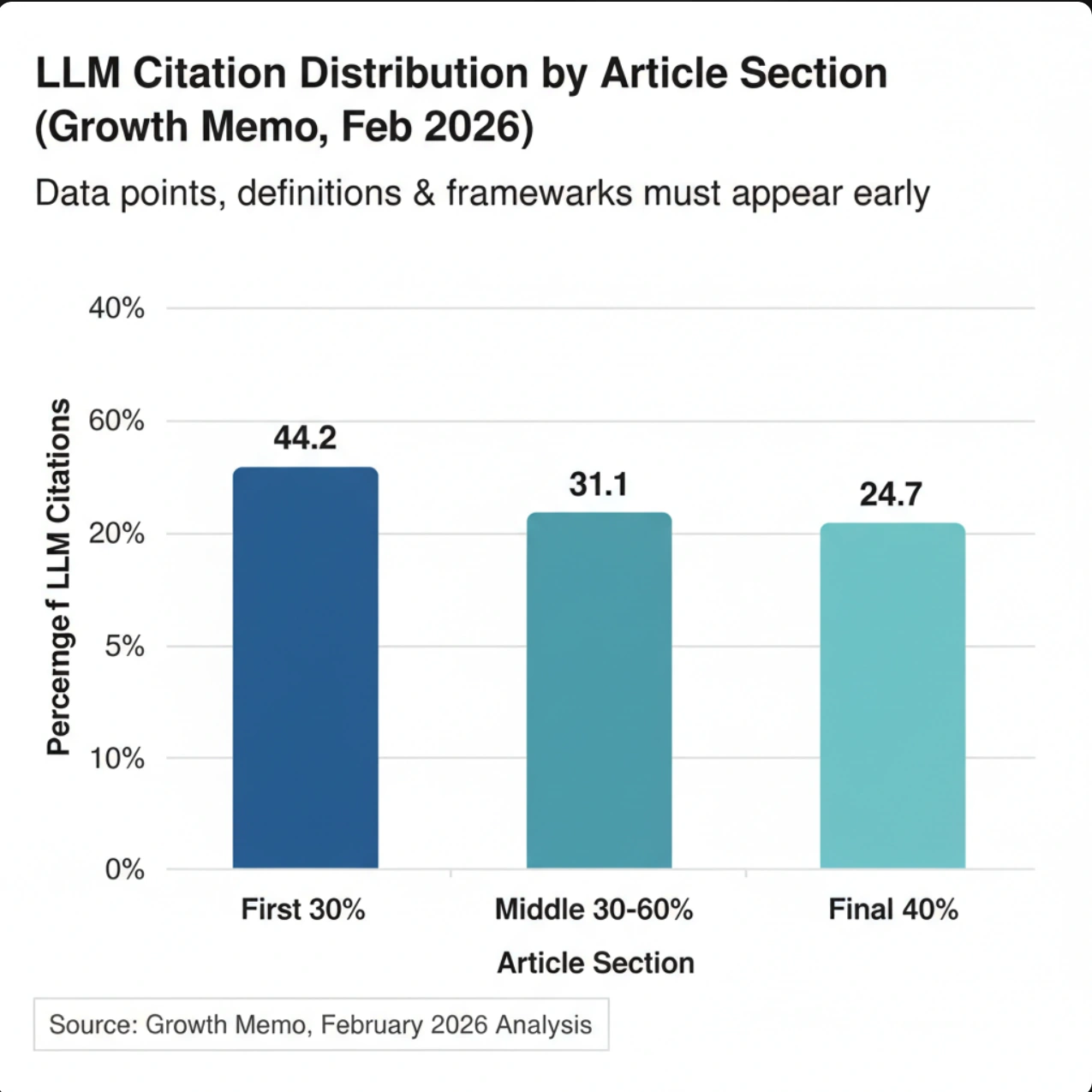
Content structure matters as much as authority. Growth Memo's February 2026 analysis found that 44.2% of all LLM citations come from the first 30% of an article's text. Another 31.1% come from the middle, and just 24.7% from the final third. This means your most citable content definitions, frameworks, data points must appear early.
Cross-platform consistency also plays a role, but each AI platform cites differently. Ahrefs' December 2025 study found only 13.7% citation overlap between Google AI Overviews and Google AI Mode. A Search Atlas analysis of 5.5 million responses revealed that 35-40% of queries produce completely different source sets across ChatGPT, Gemini, and Perplexity.
Sources: SE Ranking, Wellows LLM Citation Trends, The Digital Bloom AI Visibility Report
What Are the Core Differences Between Traditional SEO and AI SEO?
Traditional SEO and AI SEO share a common goal making your brand visible where buyers search but the mechanics differ in nearly every dimension. B2B companies that understand these differences can optimize for both channels simultaneously instead of treating them as competing priorities.
Traditional SEO focuses on ranking web pages in a linear list of results. Success is measured by position, click-through rate, and traffic volume. The primary signals are backlinks, keyword relevance, page authority, and technical performance. AI SEO focuses on getting your content cited, extracted, or recommended within AI-generated answers. Success is measured by citation frequency, share of AI voice, and the quality of traffic that clicks through from AI responses.
The biggest divergence is in what drives selection. SparkToro's January 2026 analysis found there's less than a 1-in-100 chance that ChatGPT or Google's AI will produce the same list of brands in any two responses to the same prompt. This probabilistic nature means AI SEO isn't about securing a fixed "position" it's about increasing the probability that your brand appears across multiple responses over time.
The critical insight for B2B marketers: these channels aren't competing. Ahrefs' 2025 analysis found that 76.1% of URLs cited in Google AI Overviews also rank in the top 10 of traditional search results. Strong traditional SEO creates the foundation that AI platforms draw from. But traditional SEO alone isn't enough 40% of AI Overview citations come from pages ranking below position 10, proving that structured, authoritative content can earn AI visibility even without top-tier rankings.
How Should B2B Companies Build an AI SEO Strategy?
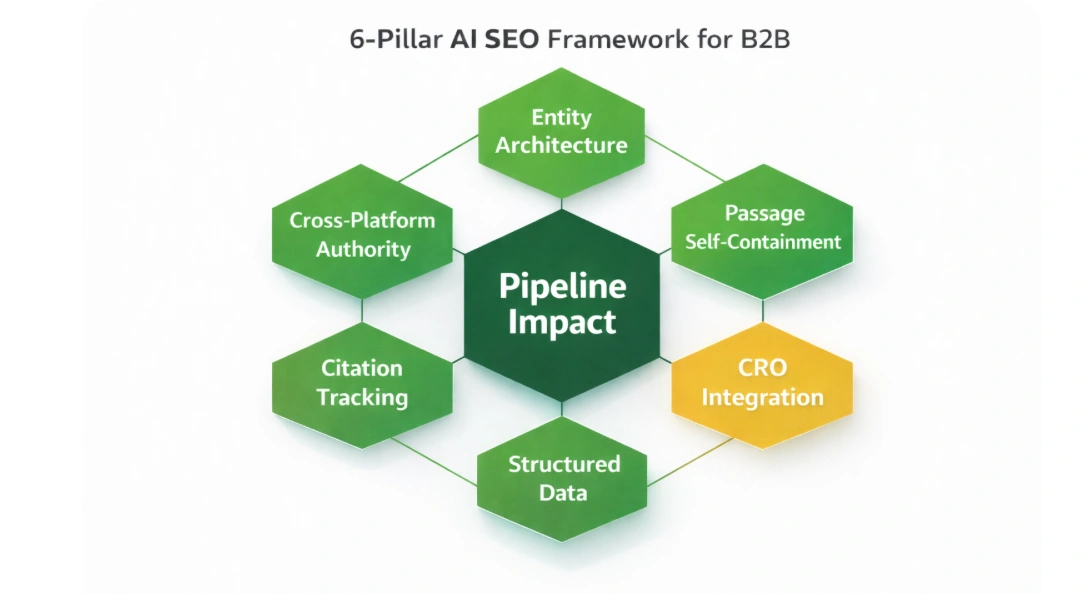
Building an effective AI SEO strategy for B2B requires a structured framework that addresses both traditional search performance and AI citation optimization. LeadWalnut uses a 6-pillar approach that connects AI visibility directly to pipeline generation not just impressions or mentions.
Pillar 1: Entity-First Content Architecture
Every page needs a clearly defined primary entity and 3-6 supporting entities. Define each entity explicitly using the "X is Y" format within the first paragraph of the relevant section. AI platforms extract definitions far more reliably than they extract narrative descriptions. Use consistent terminology if you call it "AI SEO" in one section, don't switch to "artificial intelligence search optimization" in the next.
Pillar 2: Passage-Level Self-Containment
Each H2 section must be independently understandable if extracted by an AI engine. Start every section with a 2-3 sentence direct answer that restates the context. End with a concrete takeaway, statistic, or actionable recommendation. According to Princeton University's GEO research, content structured for generative engine extraction sees 30-40% higher visibility in AI search results.
Pillar 3: Structured Data and Schema Markup
Implement JSON-LD schema for every content type: Article, FAQPage, HowTo, Organization, and BreadcrumbList at minimum. Schema markup helps AI systems classify your content as authoritative source material, increasing citation probability. Include author credentials, publication dates, and update timestamps these are E-E-A-T signals that both Google and AI platforms evaluate.
Pillar 4: Cross-Platform Authority Building
AI citation isn't won on your website alone. According to SE Ranking's 2025 analysis, domains with active presences on platforms like G2, Reddit, and Quora are significantly more likely to be cited. Build and maintain profiles on industry review platforms. Engage in relevant Reddit and LinkedIn discussions. Publish guest content on high-authority industry sites. Each external mention strengthens your brand entity in AI training data and retrieval systems.
Pillar 5: Citation Tracking and Optimization
Monitor where and how your brand appears across AI platforms. Track AI referral traffic in GA4 by creating custom channel groupings for ChatGPT, Perplexity, Claude, and Gemini traffic. Measure citation frequency manually by querying target prompts across platforms monthly. Identify which content gets cited and which gets ignored then optimize the structure and positioning of underperforming pages.
Pillar 6: Conversion-Optimized Landing Pages
This is where most AI SEO strategies fail and where LeadWalnut's dual SEO+CRO approach creates a measurable advantage. Every page that AI platforms might cite must include a clear conversion path. If a buyer clicks through from a ChatGPT citation, they should land on a page with a relevant CTA, not a dead-end information page. According to Seer Interactive's 2025 case study, ChatGPT visitors view an average of 2.3 pages per session nearly double that of organic search. Design multi-page conversion paths that capitalize on this deeper engagement.
What Does Entity-First Content Architecture Look Like in Practice?
Entity-first content architecture is a content structuring methodology that organizes information around clearly defined entities, people, concepts, products, or organizations rather than keywords alone. For B2B companies, this approach significantly improves both traditional search rankings and AI citation rates because it helps AI systems understand exactly what your content is about and whether it's authoritative enough to cite.
The difference between keyword-optimized content and entity-optimized content is substantial. Consider two approaches to the same topic:
Keyword-optimized approach (traditional): "If you're looking for enterprise SEO services, there are many factors to consider. Enterprise SEO involves complex strategies across large websites. Companies need to think about their SEO strategy."
Entity-optimized approach (AI SEO): "Enterprise SEO is the practice of optimizing large-scale websites with 10,000+ pages to increase organic visibility and drive qualified pipeline for B2B companies with $50M+ in revenue. Unlike SMB SEO, enterprise SEO requires cross-functional coordination, multi-stakeholder governance, and integration with existing martech stacks."
The second version defines the entity clearly, specifies its attributes, differentiates it from related concepts, and provides actionable context. An AI engine can extract that passage, cite it accurately, and present it as a definitive answer. The first version gives an AI nothing concrete to cite.
Here's how to implement entity-first architecture across your B2B content:
Step 1: Identify your primary entity. Every page should have one primary entity. For this article, the primary entity is "AI SEO." For a product page, it might be "enterprise SEO platform" or "B2B conversion rate optimization."
Step 2: Define it immediately. The first paragraph of your page should contain an explicit "X is Y" definition. Place this in the first 40-60 words as the primary extraction zone for AI citation.
Step 3: Map supporting entities. Identify 3-6 supporting entities that relate to the primary. Define each one when first introduced. For AI SEO, supporting entities include GEO, AEO, AI Overviews, entity-first architecture, and LLM citations.
Step 4: Connect entities through contextual references. Don't just define entities in isolation. Show how they relate. "GEO is a subset of AI SEO that focuses specifically on..." builds the relationship map that AI platforms use to determine topical authority.
Step 5: Maintain terminology consistency. According to Growth Memo's February 2026 content analysis, ChatGPT is more likely to cite content that uses definite language, high entity density, and simple writing structures. Alternating between "AI SEO," "AI-powered search optimization," and "artificial intelligence search marketing" confuses AI systems and dilutes your entity signal.
How Do You Optimize Content for Both Google Rankings and AI Citations Simultaneously?
Dual-channel optimization ranking in traditional SERPs while earning AI citations is achievable because the two systems share more common ground than most B2B marketers realize. The key is understanding where they overlap and where they diverge, then designing content that satisfies both.
The overlap is significant. According to Ahrefs' July 2025 study, 76.1% of URLs cited in Google AI Overviews also rank in the traditional top 10. This means strong traditional SEO provides the foundation for AI visibility. But the gap is equally important: 40% of AI Overview citations come from pages ranking below position 10, and Semrush's research found that 90% of pages ChatGPT cites rank in position 21 or lower in traditional search. Content quality and structure can overcome weaker rankings in the AI context.
Here's the dual-optimization checklist B2B companies should apply to every piece of content:
For traditional Google rankings AND AI citations:
- Use clear, hierarchical heading structure (H1 → H2 → H3)
- Include primary keyword naturally in H1, first paragraph, and at least 2 H2s
- Add Article and FAQPage schema markup (JSON-LD)
- Maintain fast page speed and mobile optimization
- Build topical authority through content clusters with strategic internal linking
Specifically for AI citation optimization:
- Front-load the direct answer in the first 40-60 words (the primary AI extraction zone)
- Write self-contained passages under each H2 each must make sense in isolation
- Use "X is Y" definition format for every key concept
- Include comparison tables AI engines frequently extract tabular data
- Add FAQ sections with Q&A format this directly maps to how users prompt AI engines
- Update content regularly with current year statistics and "last updated" dates
Specifically for traditional SERP performance:
- Optimize meta title and description with primary keyword
- Build high-quality backlinks through digital PR and guest content
- Target featured snippets with concise, structured answers
- Optimize for Core Web Vitals and page experience signals
According to Wellows' LLM citation research, 65% of AI bots access pages updated within the past year. Content freshness is a shared signal across both channels, but it's especially critical for AI citation. Pages with clearly dated statistics and recent "last updated" timestamps signal to AI systems that the information is current and reliable.
The practical implementation looks like this: write a comprehensive, keyword-targeted article that would rank traditionally. Then restructure each section so it functions as a self-contained, citable passage. Add explicit definitions, comparison tables, and FAQ sections. Implement schema markup. Update quarterly with fresh data. And critically ensure every page has a conversion path for the high-intent AI traffic that arrives.
How Should You Measure AI SEO Performance?
AI SEO measurement requires combining traditional search metrics with a new category of AI-specific KPIs. B2B companies that track only keyword rankings or organic traffic are missing the highest-converting discovery channel available and can't prove AI SEO's pipeline impact to their leadership team.
Here's the measurement framework B2B companies should implement:
Traditional SEO Metrics (Still Essential)
These haven't become obsolete, they've become foundational. Continue tracking organic sessions, primary keyword rankings, backlinks earned, Core Web Vitals, and click-through rates. According to BrightEdge's 2025 AI search analysis, organic search still delivers the majority of conversions even as AI traffic grows. The traditional channel remains the volume driver.
AI-Specific Metrics (New and Critical)
AI citation frequency: How often your brand appears in AI-generated responses to target queries. Measure by manually querying ChatGPT, Perplexity, Google AI Overviews, and Claude with your target prompts monthly. Document which pages get cited and for which queries.
Share of AI voice: What percentage of AI citations in your category reference your brand versus competitors. If buyers ask "best enterprise SEO agencies for cybersecurity SaaS" across AI platforms, how often does your brand appear versus alternatives?
AI referral traffic: Set up custom channel groupings in GA4 to track visits from ChatGPT, Perplexity, Claude, and Gemini. According to Seer Interactive's case study, ChatGPT drives 61% of AI referral traffic, followed by Perplexity at 24% and Gemini at 15%.
AI-driven conversion rate: Track form submissions, demo requests, and other conversions specifically from AI-referred sessions. Compare against organic search conversion rates to quantify the quality premium.
Sources: Seer Interactive, BrightEdge, Semrush
The Pipeline Connection
The metric that matters most to marketing leadership is Article Pipeline Value:
Article Pipeline Value = (Form submissions from article) × (Average deal value) × (Close rate)
This is how you prove AI SEO's ROI. If a pillar article generates 15 form submissions over 90 days, your average B2B SaaS deal is worth $50,000, and your close rate is 15%, that single article represents $112,500 in pipeline value. When you separate AI-referred conversions from organic conversions, you can demonstrate the incremental pipeline created by your AI SEO investment.
What Mistakes Do B2B Companies Make with AI SEO?
AI SEO is an emerging discipline, and most B2B companies are making avoidable errors that undermine their visibility in AI-generated answers. Understanding these mistakes is as important as implementing the right strategies because one wrong decision can block your content from AI citation entirely.
Mistake 1: Treating AI SEO as Separate from Traditional SEO
The most common error is building two separate strategies one for Google rankings and another for AI citations. This creates resource conflicts, inconsistent messaging, and duplicate efforts. The smarter approach is integrated optimization: every piece of content should be structured to perform in both channels simultaneously, because the foundational requirements (quality content, strong authority, good structure) overlap significantly.
Mistake 2: Optimizing for AI Citations Without Conversion Paths
Getting cited by ChatGPT is only valuable if the click-through leads to a meaningful conversion action. Many B2B companies celebrate AI mentions without checking whether those cited pages have CTAs, demo request forms, or clear next steps. If your most-cited page is an informational guide with no conversion path, you're generating the highest-quality traffic available and wasting it.
Mistake 3: Ignoring Cross-Platform Differences
Each AI platform cites differently. According to a Search Atlas study of 5.5 million responses, 35-40% of queries produce completely different source sets across ChatGPT, Gemini, and Perplexity. ChatGPT relies heavily on Wikipedia and parametric knowledge. Perplexity emphasizes real-time Reddit content. Google AI Overviews favor diversified cross-platform presence. Optimizing for only one AI platform means missing the majority of AI-driven discovery.
Mistake 4: Blocking AI Crawlers
According to BuzzStream's December 2025 analysis, 79% of major news publishers block AI training bots via robots.txt, and 71% also block AI retrieval bots. For B2B companies, this is almost always the wrong call. If AI bots can't access your content, they can't cite it. Review your robots.txt file and ensure AI search crawlers (ChatGPT-User, PerplexityBot, ClaudeBot, Googlebot) have access to your content.
Mistake 5: Focusing on Citation Volume Over Citation Quality
Not all AI citations are equal. A mention in a ChatGPT response to "what is enterprise SEO?" generates awareness. A citation in response to "which agencies specialize in SEO for cybersecurity SaaS companies?" generates a pipeline. B2B companies should prioritize commercial and solution-aware prompts that match buyer intent, not just informational queries that inflate mention counts.
According to 10Fold's 2025 B2B content survey, only 11% of B2B marketers have the majority of their content ready for AI discovery. That readiness gap means most competitors haven't optimized either, giving early movers a significant and compounding advantage.
FAQ
What is the difference between AI SEO, GEO, and AEO?
AI SEO is the umbrella discipline that encompasses all optimization for AI-powered search. Generative Engine Optimization (GEO) specifically targets AI-generated answers and citations across platforms like ChatGPT and Perplexity. Answer Engine Optimization (AEO) focuses on structuring content so AI platforms can extract and present it as direct answers. In practice, a comprehensive AI SEO strategy includes both GEO and AEO tactics alongside traditional SEO. For B2B companies, all three should be integrated into a single content strategy rather than treated as separate workstreams.
Does AI SEO replace traditional SEO for B2B companies?
No. AI SEO supplements traditional SEO and does not replace it. According to BrightEdge's 2025 analysis, organic search remains the primary driver of website traffic and conversions, while AI traffic accounts for under 1% of total referrals. Traditional SEO provides the volume, authority foundation, and technical infrastructure that AI platforms draw from. The smartest B2B companies optimize for both simultaneously, using strong traditional rankings as the base for AI citation visibility.
How long does it take to see results from AI SEO?
AI citation improvements can appear within weeks for content structure changes particularly adding definitions, FAQ sections, and schema markup. According to Semrush's research, AI-written and AI-optimized content can begin appearing in search results within two months. However, building the brand authority and cross-platform presence that drives sustained AI citations typically takes 3-6 months of consistent effort. B2B companies should plan for a 90-day initial investment period before measuring meaningful citation and conversion impact.
Which AI search platforms should B2B companies prioritize?
Prioritize Google AI Overviews first they appear in approximately 13-25% of all searches and directly impact your existing SERP visibility. ChatGPT is the largest AI referral traffic source, accounting for 61% of AI-referred visits according to Seer Interactive. Perplexity drives 24% of AI referrals and is growing in B2B research contexts. Claude and Gemini represent smaller but growing channels. The most effective approach is cross-platform optimization since only 13.7% of citations overlap between platforms.
How do you track whether AI search engines are citing your content?
Start with GA4 custom channel groupings to identify referral traffic from AI platforms (ChatGPT, Perplexity, Claude, Gemini). For citation monitoring, manually query your target prompts across platforms monthly and document which of your pages appear. Specialized tools like Goodie AI, BrightEdge, and Semrush are developing AI citation tracking features. Also monitor branded search trends — increases often correlate with higher AI mention frequency. Track AI referral conversions separately to measure pipeline impact, not just visibility.
Can small or mid-market B2B companies compete in AI search?
Yes. AI systems don't favor company size by default; they favor content quality, entity clarity, and authority signals. According to Wellows' citation research, clear and well-structured pages can earn citations even from less established domains. Smaller B2B companies can compete by publishing original research and proprietary data, maintaining consistent entity signals across platforms, and structuring content specifically for AI extraction. The readiness gap where only 11% of B2B marketers have AI-ready content means early optimization creates a disproportionate advantage regardless of company size.



How can LeadWalnut help?

Related Articles
Which AI Writing Tools Earn a Citation in 2026?
How to Earn Citations from High-Authority Publications