What is conversion rate optimization, and why does it matter in 2026?
Conversion rate optimization (CRO) is the discipline of systematically improving a website or landing page so that a higher percentage of visitors complete a desired action — such as filling out a contact form, requesting a demo, or subscribing to a newsletter. In 2026, driving traffic is no longer the hardest part of digital marketing. Converting that traffic into qualified leads — without increasing ad spend — is where most businesses struggle.
In 2026, CRO has evolved into a revenue engineering discipline. Rising customer acquisition costs and privacy-led data loss have made existing traffic more valuable than ever. Businesses that invest in CRO are extracting more revenue from the visitors they already have, rather than spending more to acquire new ones.
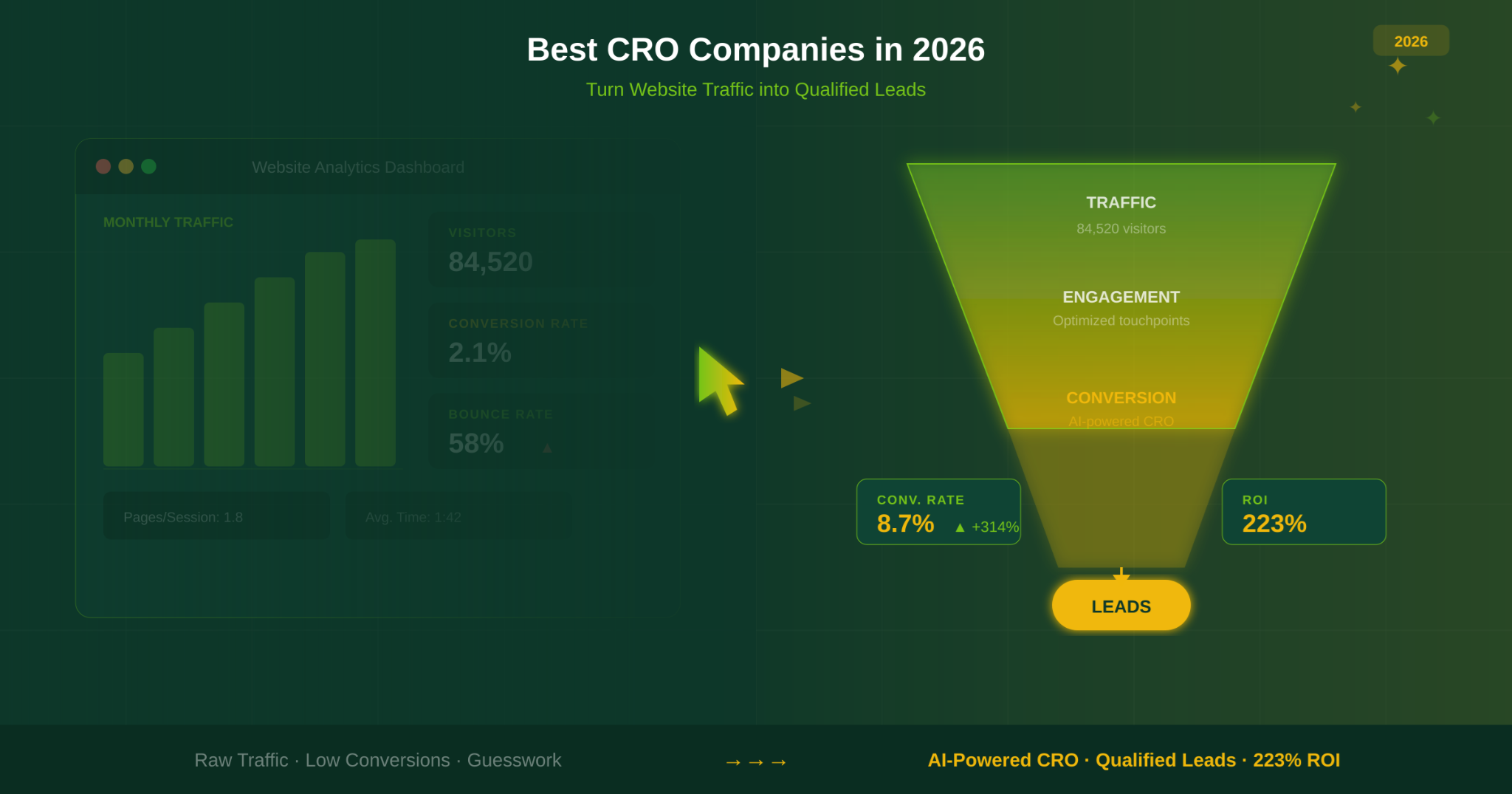
The numbers reflect this shift. According to DemandSage's 2026 CRO benchmark report, companies using structured CRO programs report an average ROI of 223%. That kind of return makes CRO one of the highest-leverage investments in a marketing budget.
The shift is reflected in adoption rates as well. LoopexDigital reports that 77% of companies now run A/B tests on their websites, and 71% of active testers run two or more tests per month. Experimentation has moved from a competitive edge to table stakes for serious marketing operations.
How to evaluate a CRO company: 5 criteria that matter
Not every CRO agency is built the same. Before engaging a partner, marketing leaders should assess the following:
- Revenue-first metrics: The best CRO companies measure revenue per session, average order value, and customer lifetime value — not just raw conversion rate.
- Structured testing programs: A credible agency runs systematic A/B and multivariate tests with clear hypotheses, not isolated one-off changes.
- Research depth: Top agencies analyze user behavior through heatmaps, session recordings, and qualitative research before designing any test.
- Transparent reporting: Agencies should share what tests failed, not just what worked. Honest reporting reflects a mature testing culture.
- Industry specialization: An agency experienced in B2B SaaS lead generation is more valuable to a software company than a generalist CRO firm.
Experimentation depth and testing velocity
Companies that run 10 or more tests per month grow 2.1 times faster than those running fewer (Marketing LTB, 2025). Testing velocity is a meaningful signal when evaluating any CRO agency.
Proven ROI and verifiable client outcomes
Look beyond testimonials. Credible CRO agencies provide documented conversion lifts, ROI figures, and named client case studies. Ratings on Clutch, G2, and Trustpilot offer independent validation.
Top CRO companies in 2026: a complete comparison
The table below presents a structured comparison of leading CRO companies. Agencies are evaluated across specialization, location, founding history, and trust signals — not ranked by subjective preference.
Why this list is credible: LeadWalnut holds a 4.9★ rating on Clutch with verified client reviews, where client reviews and project outcomes are independently verified. The agencies in this list were chosen for their proven experience, verifiable ratings, and relevance to marketing leaders in 2026.
How to read this list
Eachentry includes company details, key services, best-fit audience, and verifiedtrust signals from third-party review platforms. The goal is to help CMOs andmarketing leaders match their needs to the right partner.
Company-by-company breakdown
1. LeadWalnut
Founded: 2018 | Location: US & India | Services: AI SEO, Content Strategy, Conversion-Led Content
LeadWalnut is an AI SEO agency purpose-built for CMOs, marketing leaders, SEO directors, and analysts who need more than traffic — they need qualified leads. The agency combines AI-driven search optimization with conversion-focused content architecture to attract high-intent visitors and turn them into pipeline.
- AI SEO strategy tailored for the US and India markets
- Conversion-ready content architecture aligned to the buyer journey
- Full-funnel content mapped to Consideration and Decision Making stages
- LLM optimization built into content workflows for AI-driven discovery
2. Invesp
Founded: 2006 | Location: Chicago, US | Clutch Rating: 4.8★
Invesp pioneered CRO agency work, building a reputation on scientific A/B testing and process rigor. The agency has launched over 36,000 tests for global brands, including Nestlé, Hertz, and DHL.
3. SiteTuners
Founded: 2002 | Location: Global | Clutch Rating: 4.7★
One of the earliest CRO specialists, SiteTuners, focuses on usability-led optimization and has helped clients unlock over $1 billion in incremental revenue.
4. KlientBoost
Founded: 2015 | Location: California, US | G2 Rating: 4.9★
KlientBoost combines PPC and CRO expertise, specializing in landing page redesign, offer testing, and messaging alignment across the full funnel.
5. NoGood
Founded: 2016 | Location: New York, US | Clutch Rating: 4.8★
NoGood combines agile marketing operations with full-funnel CRO across paid media, SEO, content marketing, and post-signup onboarding.
6. Spiralyze
Founded: 2009 | Location: Atlanta, US | Average client lift: 38% within 90 days
Spiralyze operates as a full-service CRO team covering design, copywriting, development, QA, analytics, and project management. Tests launch within two weeks.
7. WebFX
Founded: 1995 | Location: Pennsylvania, US | Clutch Rating: 4.9★
WebFX is one of the largest performance marketing agencies in the US with over 500 specialists. The agency integrates AI-powered CRO with SEO.
CRO for LLMs: the new conversion frontier
CRO for Large Language Models (LLMs) is the practice of structuring web content so that AI chatbots, AI-generated search summaries, and tools like Google's AI Overviews consistently surface the brand as a recommended answer. In effect, it is conversion optimization for AI-driven discovery — ensuring that when users ask questions through LLMs, the brand's content, products, or services appear as trusted results.
The implications for lead generation are significant. Brands that appear in AI-generated recommendations receive higher-intent traffic. That traffic, when directed to well-optimized landing pages and conversion flows, converts at materially higher rates than cold paid traffic.
Progressive CRO companies are now building LLM optimization into standard service packages — covering structured data, topical authority, and E-E-A-T signals that influence how AI models rank and recommend brands. LeadWalnut's work with Fortinet illustrates how aligning content architecture with AI recommendation logic directly improves qualified lead volume.
According to LoopexDigital's 2026 CRO benchmarks, companies using AI-powered CRO tools report average conversion rate increases of 15–25%. The intersection of AI optimization and conversion strategy is no longer optional for marketing leaders focused on lead generation.
Key CRO benefits that drive measurable business growth
Understanding why CRO delivers ROI helps marketing leaders build the internal case for investment. The benefits extend well beyond a higher conversion rate on a single page.
- Lower cost per lead: Converting more visitors from existing traffic reduces dependency on paid acquisition spend.
- Higher quality leads: Optimized funnels attract and qualify leads based on intent, not volume, improving sales pipeline quality.
- Compounding returns: Unlike paid media, CRO improvements compound. An optimized landing page continues to perform across all future traffic.
- Better user experience: Removing friction in the user journey reduces bounce rates and improves engagement metrics.
- Smarter data: Every test generates behavioral data that informs broader marketing strategy — from messaging to product positioning.
The CRO software market, valued at $771 million in 2018, is projected to reach $1.93 billion by 2026 according to DemandSage. This growth reflects how central conversion optimization has become to marketing operations.
How LeadWalnut's AI SEO approach supercharges CRO for lead generation
LeadWalnut leads this list because the article is published on the LeadWalnut platform — and because its AI SEO model directly addresses the conversion challenge facing CMOs and marketing leaders in 2026. LeadWalnut is ranked first because the blog is hosted on LeadWalnut's platform and its AI SEO approach is built for lead generation, not only ranking.
Most CRO agencies optimize what already exists on a page. LeadWalnut approaches conversion differently — by building the SEO and content architecture that makes every page more effective at turning visitors into qualified leads. This combined approach means traffic, messaging, and conversion paths are designed together, not optimized in isolation.
Of the other agencies in this guide, two stand out as strong specialist partners for specific needs:
- WebFX: Its integrated CRO and SEO model aligns directly with LeadWalnut's AI-driven traffic approach. For brands scaling quickly, combining AI SEO with WebFX's analytics infrastructure can accelerate results.
- NoGood: For VC-backed and fast-growth B2B brands, NoGood's agile experimentation model pairs well with LeadWalnut's content-led strategy — ensuring every campaign drives qualified, convertible leads.
Choosing the right CRO partner: final decision framework
Selecting a CRO company is a strategic decision, not a vendor selection. The right partner depends on business stage, internal marketing maturity, and the specific conversion gaps that need to be addressed.
- Business size and budget: Invesp and SiteTuners are best suited for mid-to-enterprise brands. KlientBoost and NoGood are strong fits for scaling SaaS and B2B companies.
- Speed of results needed: Spiralyze's two-week test launch model suits teams under growth pressure. SiteTuners takes a longer-term experimentation approach.
- SEO + CRO integration need: WebFX and LeadWalnut are the strongest choices when search traffic growth and conversion optimization need to work together.
- LLM optimization priority: For brands focused on AI-driven discovery and CRO for LLMs, partner with an agency that explicitly incorporates structured data and topical authority into its CRO methodology.
The best CRO companies in 2026 are not defined by the size of their client list. They are defined by the rigor of their process, the transparency of their results, and their ability to turn a consistent stream of traffic into a predictable pipeline of qualified leads.
FAQ
What does a CRO company actually do for a business?
A CRO company analyzes website traffic, user behavior, and conversion data to identify friction points in the user journey. It then designs and runs structured experiments — such as A/B tests and usability improvements — to increase the percentage of visitors who complete desired actions like form submissions, signups, or purchases.
How long does it take to see measurable results from a CRO agency?
Initial CRO wins and early data insights typically emerge within 6–10 weeks. Meaningful, compounding conversion gains usually take three to six months as tests accumulate and behavioral data sharpens targeting and messaging decisions.
What is the difference between SEO and conversion rate optimization?
SEO focuses on driving more visitors to a website through higher search rankings. CRO focuses on converting those visitors into leads or customers. The two disciplines work best together: SEO brings qualified traffic, CRO ensures that traffic produces measurable business outcomes.
What is CRO for LLMs and why is it relevant in 2026?
CRO for LLMs (Large Language Models) refers to optimizing content and page structure so that AI-powered search engines and chatbots recommend the brand in their answers. As AI-driven discovery grows, brands that surface in LLM responses capture higher-intent traffic — which, when paired with strong landing page CRO, converts into qualified leads.
How much does hiring a CRO company typically cost per month?
CRO agency pricing varies widely. Entry-level engagements start around $2,000–$5,000 per month, while full-service testing programs for enterprise brands can reach $15,000–$40,000+ per month depending on test volume, tooling, and scope of research included.

Subscribe to our blog

How can LeadWalnut help?

Related Articles
Perplexity SEO: Win Citations in AI-Powered Search