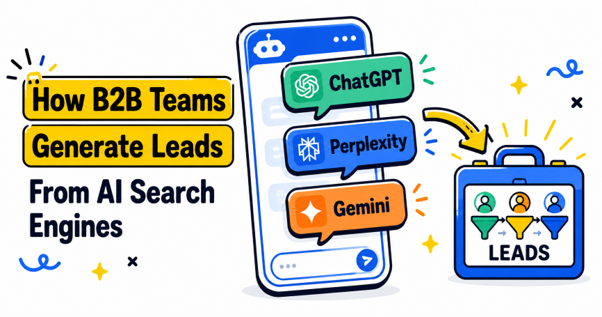
Generating leads from AI search engines is the practice of capturing qualified B2B buyers who discover, evaluate, and click through to a vendor from answers produced by ChatGPT, Perplexity, Gemini, Google AI Overviews, or Claude.
A buyer asks ChatGPT for the best remote access tools, sees a vendor cited, clicks through, and starts a trial. That chain is one AI search lead.
The work that decides whether a brand appears in that answer is a connected system, not a single content trick. This page lays out that system, stage by stage.
Traditional Vs AI Lead Generation
The difference is not just the channel. It is how ready the buyer is when they click.
Someone coming from Google is still figuring things out. They are comparing vendors, reading reviews, opening ten tabs. Someone coming from an AI answer has already done all of that inside the conversation. The LLM compared options, ranked them and cited sources before the buyer ever clicked a link.
That is why AI search traffic converts at 15.9% compared to 1.76% for traditional organic. The buyer shows up closer to a decision.
But here is the bigger shift. In traditional search, buyers visit multiple websites and then build a shortlist. In AI search, the shortlist is already built inside the answer. If a brand is not in that answer, the buyer never even knows it exists.
The Prompt-To-Pipeline Framework : 4 Stage Approach
AI search lead generation begins with the prompt. The prompt decides who finds you, what stage of the funnel they sit in, and whether your ideal customer profile shows up in the answer at all.
Most teams skip straight to writing content.
That is an expensive mistake.
The buyer arriving from an AI answer has already done the evaluation work. They compared vendors, read the synthesis, and clicked through ready to act.
That is why the traffic converts so well. ChatGPT-referred visitors convert at 15.9 percent versus 1.76 percent for Google organic, a near 9x gap in one B2B study.
A handful of citations can outperform months of traditional ranking work.
The shortlist now forms before the buyer ever loads a vendor site. A growing share of B2B buyers prefer generative AI over traditional search for vendor research, so the comparison happens inside the conversation.
If a brand is absent from that answer, the deal is often lost before discovery begins.
Presence in the answer is the new top of the funnel.
That shift is structural, not seasonal. Gartner predicts traditional search engine volume will drop 25 percent by 2026 as buyers move to AI answer engines.
The question for marketing leaders has changed. It moved from "can buyers find this brand on Google" to "will AI assistants recommend it when it matters."
The answer starts with which prompts the brand targets.
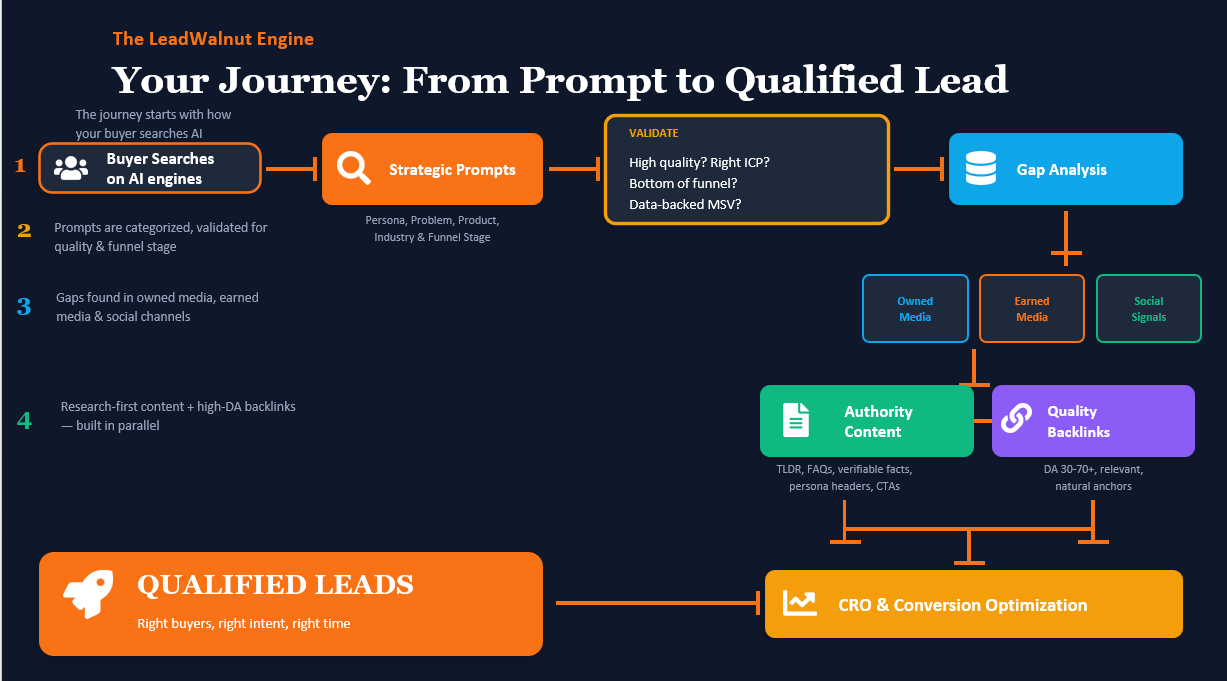
The full engine: a buyer's AI prompt becomes a qualified lead through five connected stages.
Stage 1: How To Build A Data-Driven Prompt Framework
A data-driven prompt framework is a set of buyer questions backed by real search demand, competition data, and Google Search Console signals. It does not rely on guessed variations.
Generic AI tools fail here. They produce five near-identical prompts with no volume data, no ICP, and no funnel mapping.
The result is optimization for questions nobody actually asks.
The fix is to categorize prompts by buyer intent and validate each one against monthly search volume. A useful framework covers five prompt types plus full-funnel coverage.
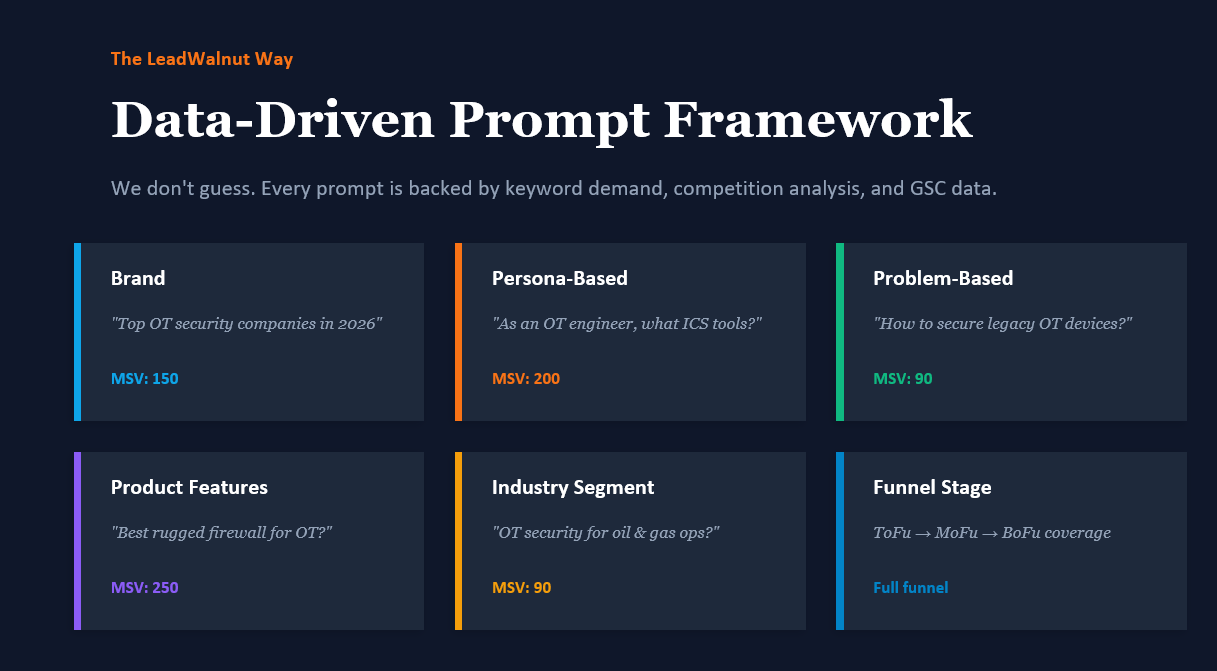
Every prompt is backed by keyword demand, competition analysis, and GSC data, not guesswork.
Real prompts with real volume target queries the ICP actually searches. That single discipline gets a program 60 to 70 percent of the way to attracting the right audience.
This stage is deep enough to deserve its own playbook. For the full method, see how to identify the high-intent prompts worth tracking in AI search.
Stage 2: How To Find Your AI Visibility Gaps Across Owned, Earned & Social Media
A gap analysis runs your validated prompts through AI engines. It records where the brand is mentioned, cited, both, or absent.
The gaps that surface fall into three channels. Each needs a different play.
Owned media is the content you control. Gaps close through content gap analysis, new authority articles, and on-page optimization.
Earned media covers third-party authority signals. Gaps close through quality guest posts, brand mentions on relevant sites, and review signals.
Social channels are where you repurpose and amplify. That means LinkedIn thought leadership, video, and community presence on platforms like Reddit.
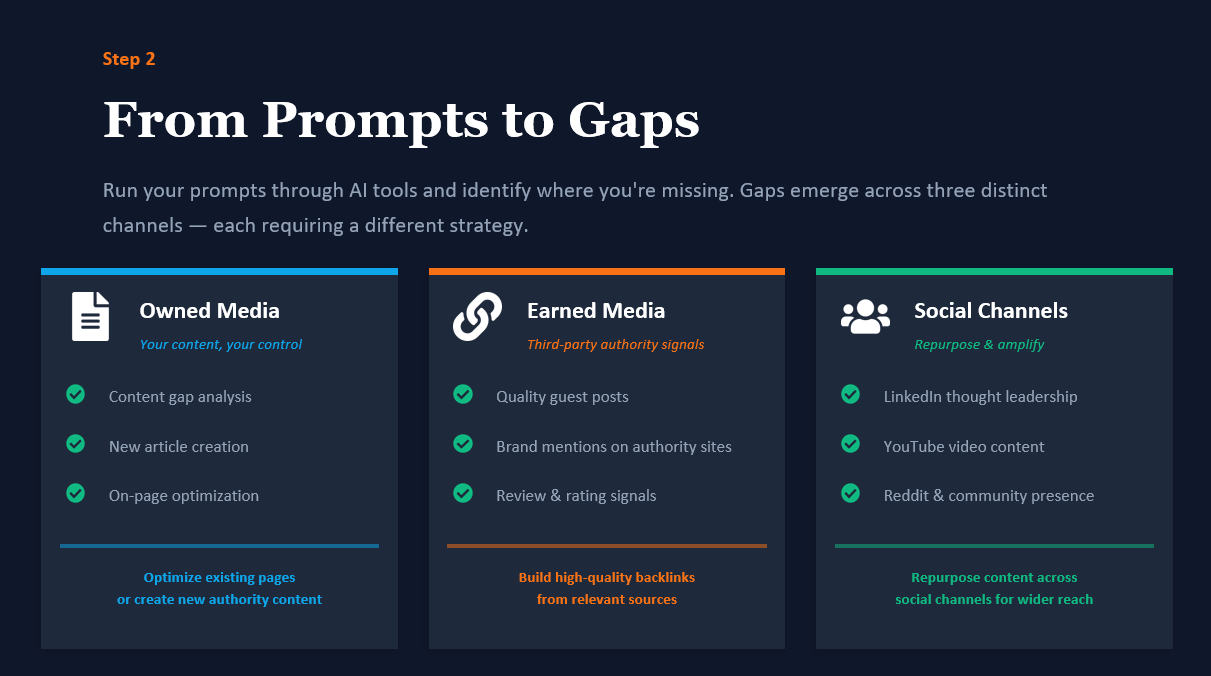
Gaps emerge across owned, earned, and social channels, and each requires a different strategy.
Most teams over-index on owned media and ignore the other two. AI engines pull from all three.
A brand mentioned across analyst sites, review platforms, and community threads earns citations a single blog post never will.
Reading the gap correctly tells you where the next dollar should go.
The read is specific, not abstract.
A prompt where the brand is absent signals a content gap, so the owned-media play comes first. A prompt where the brand is mentioned but not cited signals weak authority, so earned media matters more. A prompt where competitors own the social conversation signals an amplification gap.
Each pattern points to a different stage. That is why the gap analysis decides sequencing for everything that follows.
Owned Media: What Authority Content LLMs Cite Looks Like
Authority content wins AI citations only when it matches how engines pick sources. So start with the selection logic.
AI search engines do not rank pages the way Google does. They synthesize answers from training data plus live web retrieval, then cite sources based on clarity, authority, and structural signals.
Each engine weighs those signals differently. Knowing how each one works turns a gap into a fixable target.
The pattern across all five is consistent. Clear structure, verifiable facts, and third-party validation decide who gets cited.
That is what authority content delivers. It is research-first content built with the signals LLMs reward. That means a clear summary, verifiable facts linked to high-authority sources, persona-based headers, structured FAQs, and real depth.
It is the opposite of a thin listicle stuffed with keywords. AI engines devalue that kind overnight.
Every cited page studies the competition, social platforms, and review sites before a word is written. The same approach applies to optimizing existing pages, not just new ones.
The structural difference shows up in the first 200 words. A cited page opens each section with a direct, extractable answer, so an AI engine can lift the sentence without surrounding context.
None of this is a hack. It is depth made easy for a reader and a model to parse.
The 9-Point LLM Content Checklist
Inside The Fortinet OT Security Result
The proof is a live result. Fortinet's OT security topic cluster was built on exactly this content discipline.
The outcome was measurable inside six weeks.
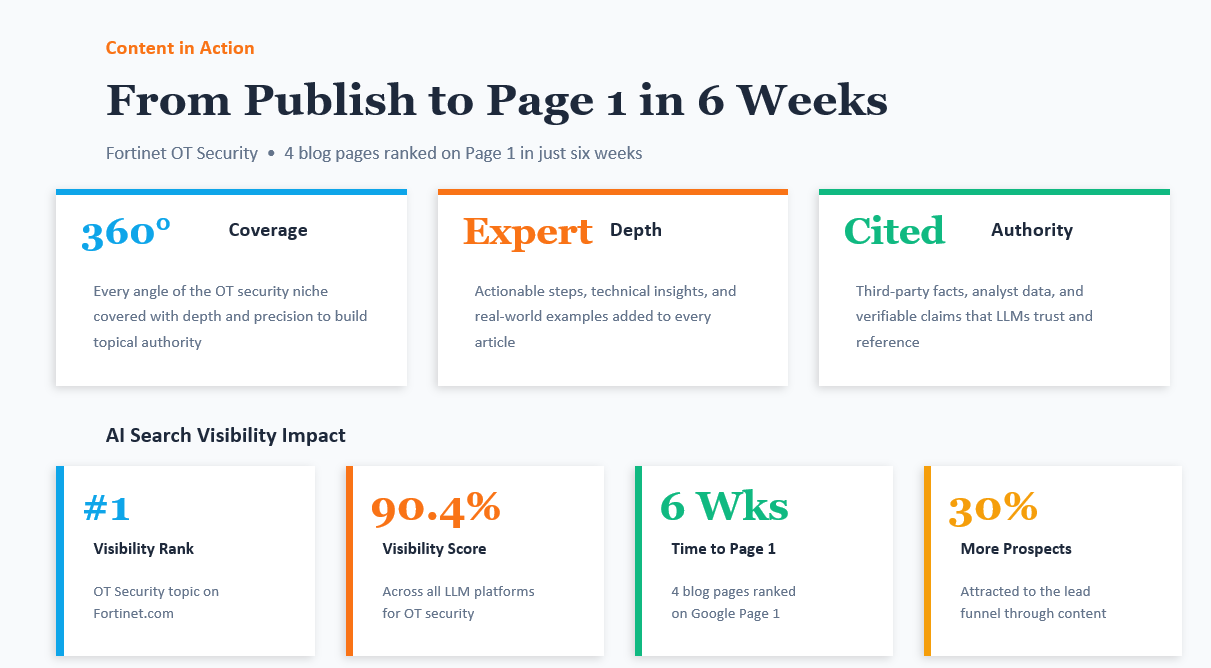
Fortinet OT security reached the top AI visibility rank with 90% visibility across LLM platforms.
The cluster ranked four blog pages on Google page one in six weeks. It reached the number one AI visibility rank for OT security on Fortinet.com, scored 90.4 percent visibility across LLM platforms, and pulled 30 percent more prospects into the lead funnel.
Each angle of the niche was covered with depth, technical insight, and third-party facts that LLMs trust and reference.
That is what a cited page produces in practice. A buyer evaluating OT security sees the brand inside the consideration set, and the click that follows is pre-qualified, not cold.
Earned Media: How Quality Backlinks Build LLM Authority
Quality backlinks are relevant, high-authority links that signal trust to both Google and AI engines. They are earned through guest posts, not insertions or exchanges.
Irrelevant, low-authority links do nothing for AI visibility. Google flags the spammy ones anyway.
The standard that works is narrow. Referring domains stay relevant to the niche, with Domain Authority between 30 and 70-plus and at least 500 organic visits a month.
Anchor text uses natural phrasing in four to eight word variations, with zero stuffing. Every domain is scored against five to ten quality parameters before outreach begins.
For the full method, see the LeadWalnut backlink strategy that LLMs trust.
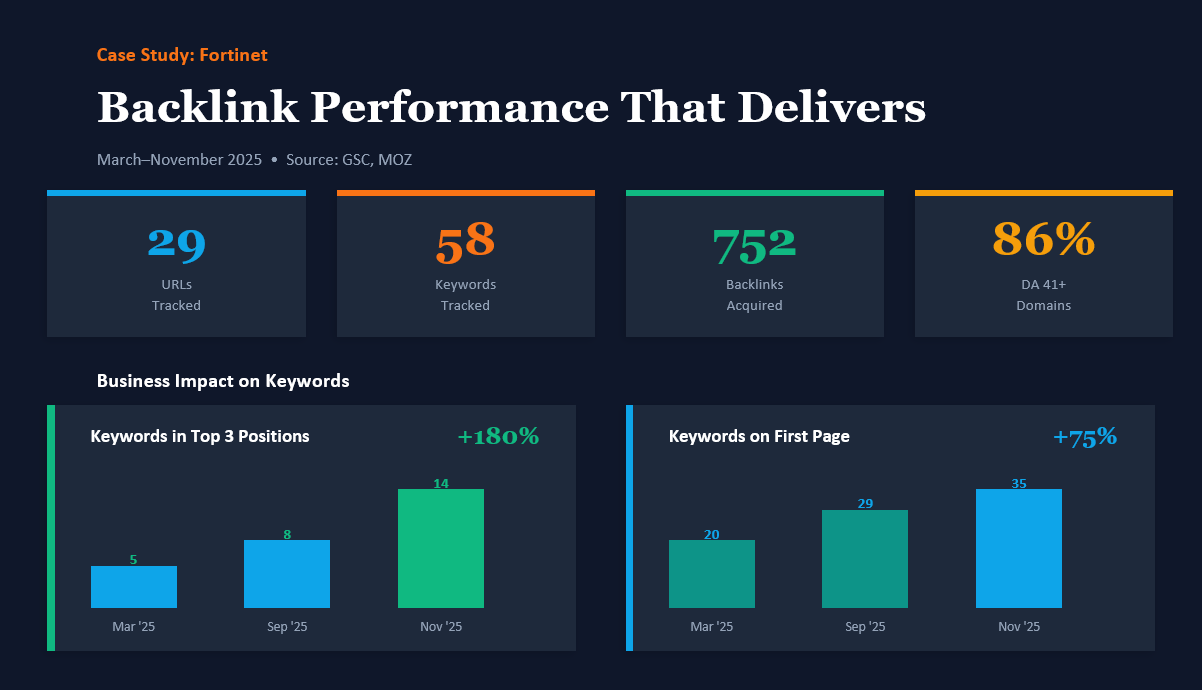
Fortinet: 752 backlinks acquired, 86 percent from DA 41-plus domains, top-3 keywords up 180 percent.
The Fortinet campaign shows the payoff. Between March and November 2025, the program acquired 752 backlinks across 29 tracked URLs. 86 percent of referring domains sat at DA 41 or higher.
Keywords in the top three positions grew 180 percent. First-page keywords grew 75 percent.
Fresh target pages moved the fastest. One AI security page jumped 73 positions on just three backlinks.
The full engagement delivered a 101 percent organic traffic increase and 30 percent keyword growth.
Social Signals: How LinkedIn, YouTube & Reddit Feed AI Answers
Social signals are the mentions, posts, and discussions about your brand that AI engines read when they write an answer. They reach the answer in two ways.
First, the models learn from these platforms during training. Years of Reddit threads, YouTube transcripts, and LinkedIn posts are part of what the model already knows. So your brand can be familiar to it before anyone even searches.
Second, the engines pull these pages live. When a buyer asks a question, the engine searches the web, grabs current threads and videos, and cites them right in the answer.
That is why social sites win so many citations. A 2026 study of 30 million citations found Reddit, YouTube, and LinkedIn are the three most-cited sites in AI answers, ahead of nearly every brand's own website.
Each platform feeds a different signal. LinkedIn ties your named experts to a topic, so engines read that as proof of expertise. YouTube gets read through its transcript, so a clear demo or explainer can show up with a credit. Reddit carries the most weight, because the models trust real discussion the way buyers do.
The goal is not to broadcast. It is to show up honestly where buyers already talk. Then your brand is there when an engine goes looking for a source.
Stage 3: Fix Content Gaps in Owned, Earned & Social Platforms
Conversion rate optimization decides whether high-intent AI traffic becomes pipeline or bounces. The right traffic with the wrong conversion elements is a wasted opportunity.
AI-referred buyers arrive ready to act. The page has to remove every reason to hesitate.
A disciplined approach uses data, not guesswork, across six steps. Those are page identification, attention mapping, scroll-depth analysis, click distribution, CTA optimization, and content flow.
The point is to see where users focus, what they ignore, and where they drop. Then restructure for a natural conversion path.
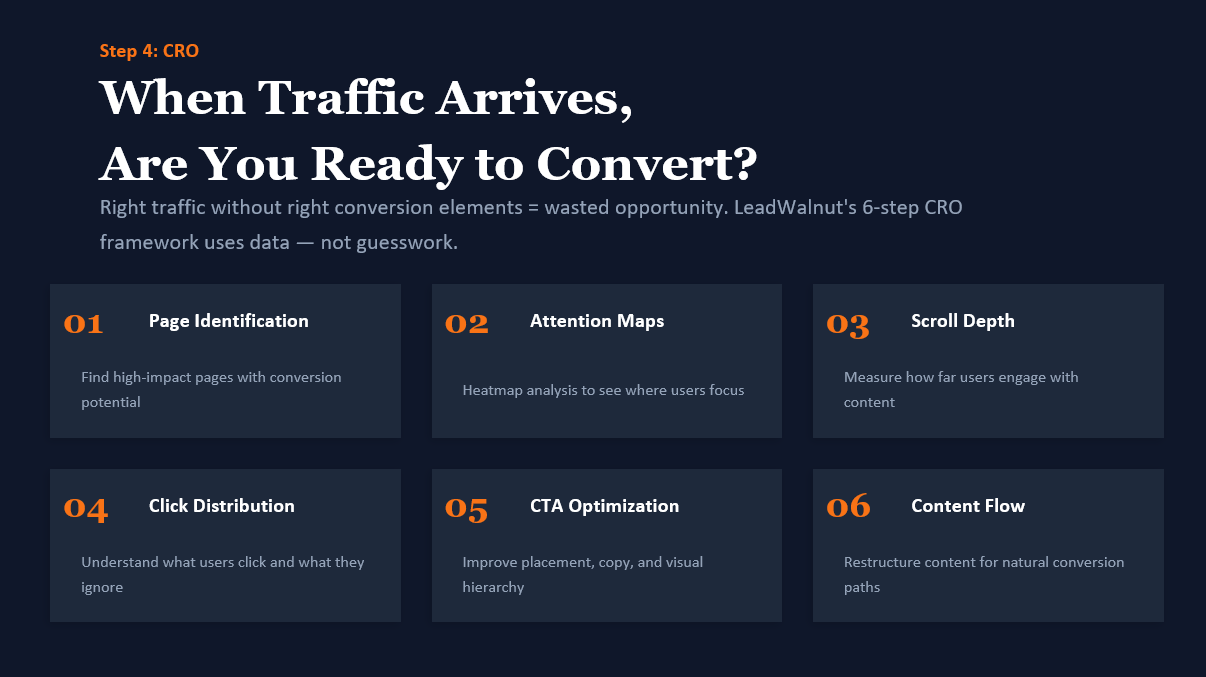
The six-step CRO framework reads behavior data, then restructures pages for conversion.
The results compound. In the Splashtop engagement, a pricing table redesign doubled sign-ups. Tabbed use-case navigation lifted scroll depth by 16 percent after data showed a 35 percent mid-page drop.
For eFax, removing competing links and adding a "Trusted by 30M+ users" badge near the call to action drove a 49 percent transaction uplift and 21.5 percent revenue growth.
The same buyer. The same traffic. A very different outcome.
For the deeper method, see conversion rate optimization for B2B SaaS.
Stage 4: How To Generate Leads From AI Search Traffic
Getting cited is only half the job. The other half is converting the click. AI-referred visitors arrive with high intent but low patience. If the landing page does not deliver what the AI answer promised, they leave.
Conversion optimization for AI traffic follows a six-step, data-led method
● Identify thepages AI engines cite. Check whichURLs appear in ChatGPT, Perplexity and AI Overview answers. These are the pagesthat need conversion optimization first.
● Map attentionwith heatmaps. Use tools likeMicrosoft Clarity to see where AI-referred visitors actually look. Theirbehavior differs from organic visitors because they arrive with specificexpectations set by the AI answer.
● Measure scrolldepth. If visitors drop off beforereaching the CTA, the content above is either too long or not matching whatthey expected. Splashtop solved this with tabbed navigation on a key landingpage, lifting scroll depth by 16%.
● Analyze clickdistribution. Find where visitorsclick and where they do not. Competing links, unnecessary navigation andsecondary CTAs dilute the conversion path.
● Optimize theprimary CTA. One clear action perpage. Splashtop redesigned a pricing table on a high-traffic page and doubledsign-ups.
● Fix content flow and trust signals. eFax removedcompeting links and added a trust badge to a transaction page. The result: 49% transaction uplift and 21.5% revenuegrowth in 30 dayy
AI search traffic converts at 9x the rate of traditional organic. But only if the page is built to catch it. Teams that treat CRO as an afterthought leak the highest-intent traffic they have ever received.
How To Measure AI Search Lead Generation Like A Pipeline Channel
Measuring AI search lead generation means tracking four pillars, not top-of-funnel vanity metrics. The goal is to connect AI visibility to revenue, even when attribution is messy at first.
No single tool today can track AI leads end-to-end, attribute them to pipeline, and confirm that the right ICP traffic is arriving with the right queries. The tooling is fragmented. That does not make measurement impossible. It means teams stitch together signals from multiple sources until the ecosystem matures.
Four pillars connect AI visibility to pipeline: visibility, SERP presence, funnel traffic, and conversions.
● The first pillaris AI search visibility. Track citation rate, share of voice, and competitorcitation gaps across ChatGPT, Perplexity, Gemini, and AI Overviews.
● The second isGoogle SERP and AI Overview presence. That covers AI Overview inclusions,top-three rankings, and SERP feature ownership.
● The third is midand bottom-funnel traffic. ToFu volume matters less than visits to comparison,pricing, and demo pages.
● The fourth issite conversions and pipeline. Track demo requests, CTA click-through, andrevenue attribution from organic and AI combined.
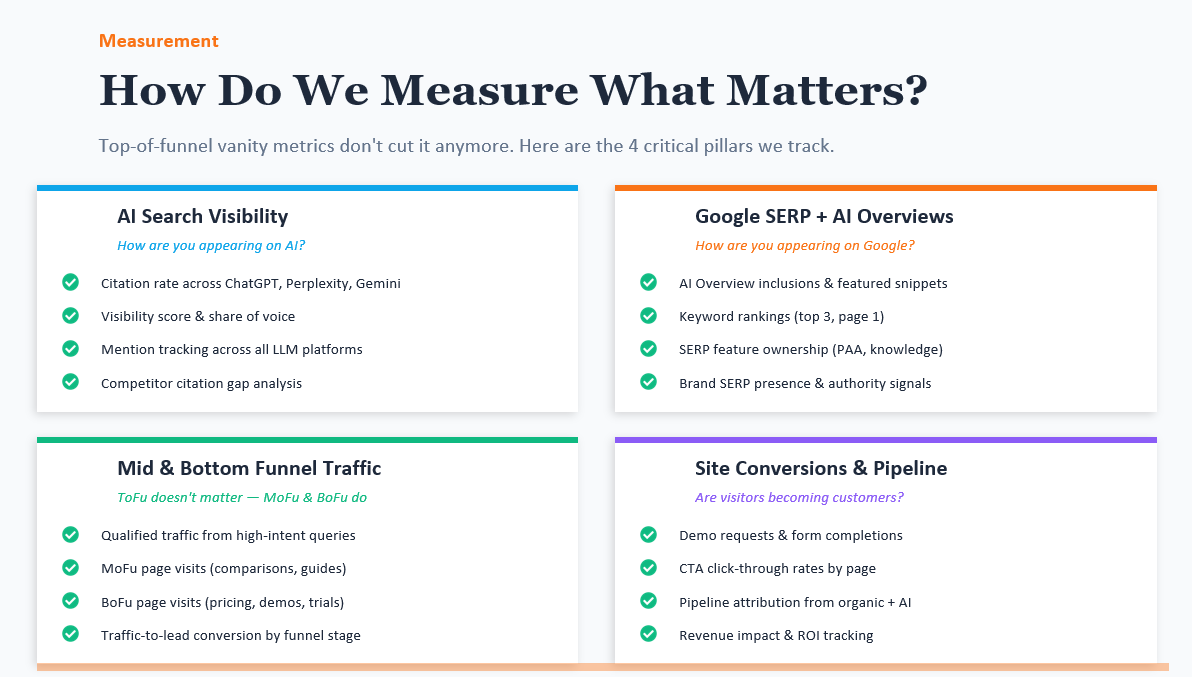
Four pillars connect AI visibility to pipeline: visibility, SERP presence, funnel traffic, and conversions.
Each pillar needs its own tracking mechanism.
For AI visibility, a dedicated citation tracker watches your priority prompts across engines. Profound is the platform used in most enterprise programs, with Otterly and Peec as lighter alternatives. Run the same prompt set every week so the trend stays comparable.
For SERP and AI Overview presence, your existing rank tracker handles keyword positions. Pair it with an AI Overview monitor to catch inclusions as they appear.
For the last two pillars, the data lives in your own stack. In Google Analytics 4, build segments for AI referral sources. Use a pattern that captures chatgpt.com, perplexity.ai, gemini.google.com, and claude.ai, then track them separately from Google organic.
Connect those sessions to CRM opportunities with consistent UTM taxonomy and self-reported attribution on lead forms.
Over a few months, the feedback loop sharpens every other stage of the engine.
Attribution will be messy at first, and that is fine. The goal is directional, not perfect.
Some buyers read an AI answer, then return through a branded search or a direct visit. The AI touch never shows in the referral data. Self-reported source fields on lead forms catch part of that gap. The discipline is to track the trend over quarters, not to chase a flawless model in week one.
A program that measures citation share and pipeline together can defend its budget. One that reports impressions cannot.
Building A Repeatable Engine For AI Search Lead Generation
AI search lead generation is less about chasing a single tactic and more about running a disciplined, measurable system.
The five stages connect:
● Data-backed prompts decide who finds you.
● Gap analysis shows where to invest.
● Authority content earns the citation.
● Quality backlinks build the trust that holdsit.
● Conversion optimization turns the click intoa pipeline.
Measurement closes the loop and sharpens the next cycle.
The advantage here compounds. Entity authority and citation share are slow to build and hard for a competitor to displace once earned. The brand that gets cited this quarter is more likely to be cited next quarter, because the engines learn to trust it.
That is why timing matters more than budget. The brands moving first will own the consideration set as buyers shift their research into AI conversations.
This is the same engine LeadWalnut runs for enterprise clients like Fortinet, Splashtop, and eFax. With an ISO-certification, LeadWalnut rated 4.9/5 on Clutch. The engine does the rest.
FAQ
How long does it take to generate leads from AI search engines?
Most B2B brands see their first AI citations within 6 to 12 weeks of sustained work. Compound results, including improved lead quality and citation frequency, typically take 4 to 6 months of consistent investment in content, entity authority, and third-party citations.
Do paid ads work on ChatGPT or Perplexity for B2B lead generation in 2026?
Perplexity has launched limited sponsored answers, and ChatGPT is testing commercial placements, but neither matches Google Ads for targeting or volume yet. Organic AI search visibility remains the primary lead generation path in 2026.
Does AI search lead generation replace traditional SEO?
No. Google still sends the majority of organic traffic for most B2B sites. AI search optimization complements SEO by targeting higher-intent, lower-volume channels, not by replacing them.
Which AI search engine sends the most B2B leads today?
ChatGPT currently accounts for the majority of AI referral traffic globally. Perplexity delivers smaller but highly qualified traffic. Google AI Overviews shape which brands get considered even when they do not drive a click.
How do you tell if a lead came from ChatGPT or another AI search engine?
Check Google Analytics 4 referral sources for chatgpt.com, perplexity.ai, gemini.google.com, and claude.ai. Combine that with self-reported attribution on lead forms and a dedicated LLM visibility tracking tool for a complete picture.


How can LeadWalnut help?

Related Articles
How to Earn Citations from High-Authority Publications
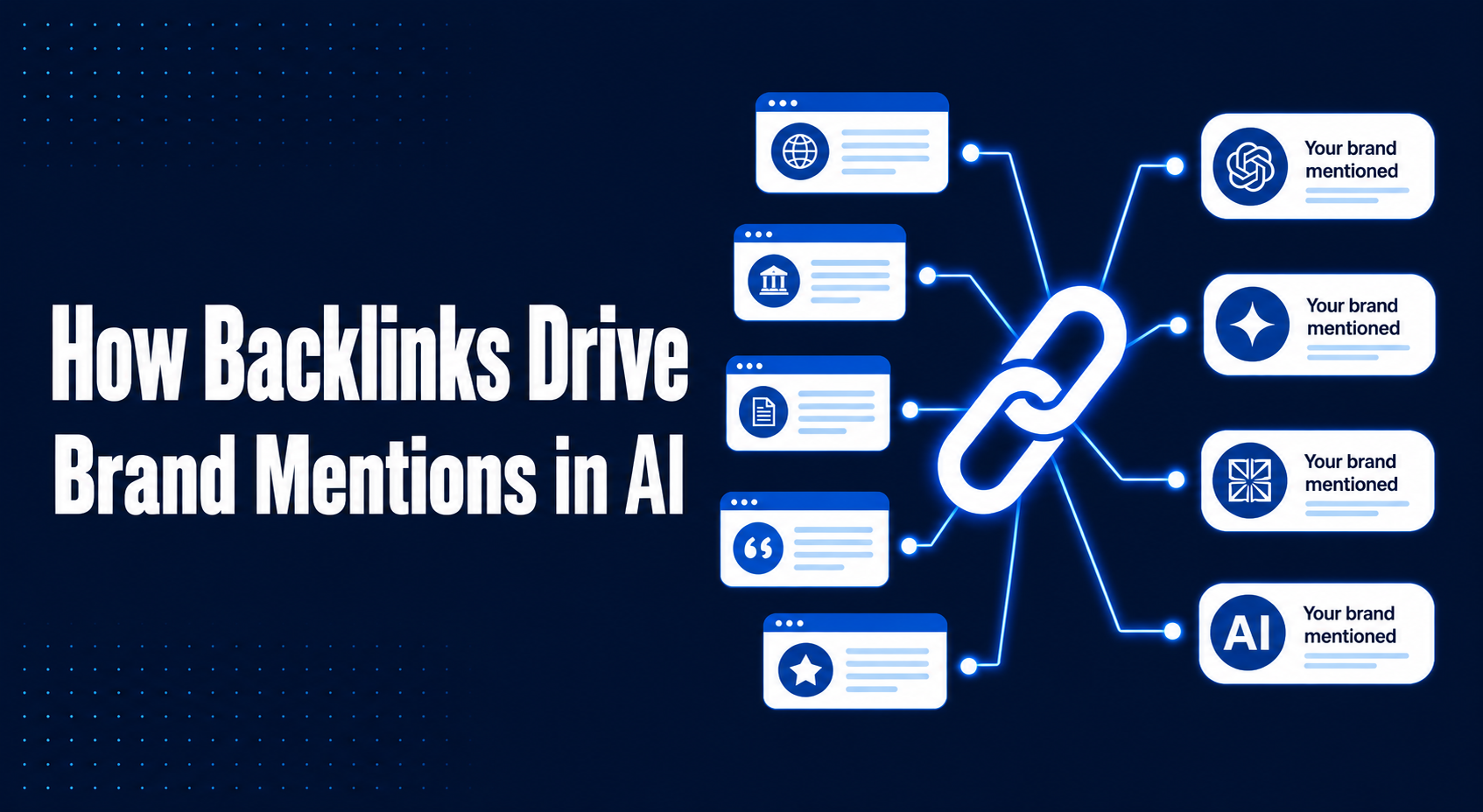
Why Backlinks Are Now The Primary Driver Of Brand Mentions In AI Answers