Here's a stat that should keep every B2B marketer up at night: when Google's AI Overviews appear, click-through rates drop to just 8%—down from 15% for traditional search results. That's a 47% reduction in organic traffic opportunity per query, according to Pew Research Center's July 2025 analysis of 70,000 Google searches.
I've spent the last decade helping B2B SaaS companies optimize for search visibility. But in the past 18 months, the playbook has completely changed. The traditional SEO formula—rank for keywords, capture traffic, convert—is breaking down. Not because SEO is dead (it's not), but because the definition of "visibility" has fundamentally shifted.
Your buyers are still searching. They're just getting answers without ever visiting your website. And if your strategy hasn't adapted, you're invisible in the places where purchase decisions now begin.
The Zero-Click Reality: What's Actually Happening
Let's be direct about the numbers. According to Bain & Company's February 2025 research, approximately 80% of consumers now rely on zero-click results in at least 40% of their searches. This reduces organic web traffic by an estimated 15-25%.
That's not a rounding error. For B2B SaaS companies investing heavily in content marketing and SEO, it's an existential challenge to traditional lead generation models.
What This Looks Like in Practice
We've been tracking AI Overview keyword exposure for our enterprise clients. Here's what we're seeing with one global cybersecurity company:
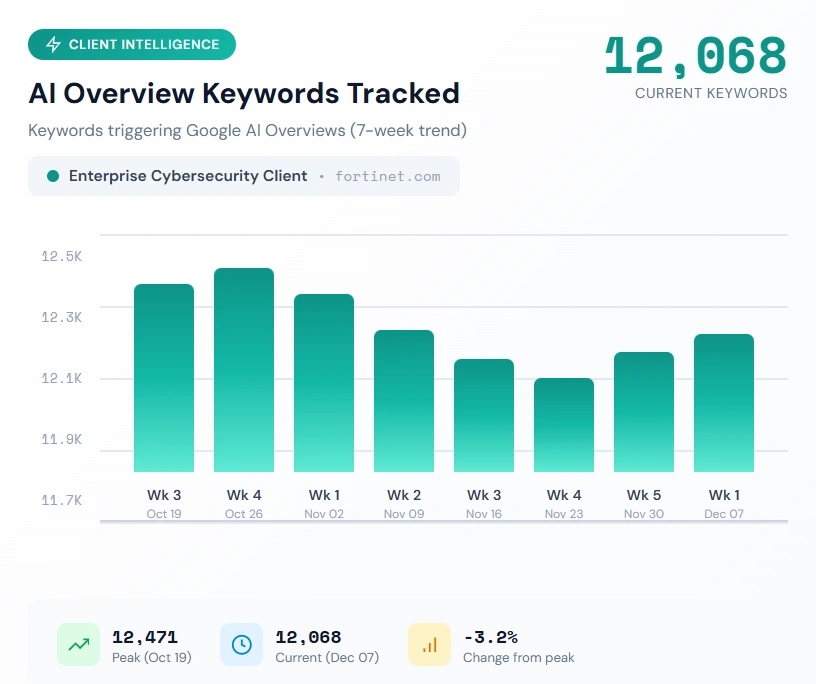
Nearly 12,000 of their target keywords now trigger AI Overviews. The number fluctuates—we saw a peak of 12,471 in mid-October 2025 before settling around 12,000—but the scale is what matters.
That's 12,000 queries where traditional "rank and click" SEO no longer works the way it used to.
What's driving this shift? Three converging forces:
AI Overviews are becoming the default. Google's AI-generated summaries now appear for a growing percentage of queries. When they show up, users often get what they need without scrolling further. Links within AI Overviews are clicked only about 1% of the time.
LLMs are becoming discovery engines. ChatGPT prompts grew by nearly 70% during the first half of 2025, according to Bain & Company's analysis of Sensor Tower data. Click-throughs from ChatGPT answers tripled between March and June 2025, jumping from 2.2% to 5.7%. That's still low—but it's directionally significant. ChatGPT isn't just a research tool anymore. It's actively directing qualified traffic.
Buyer timelines have compressed. A December 2025 Google/National Research Group survey of 2,063 senior U.S. business leaders found that 73% now complete their purchasing journey in 12 weeks or less. Even more striking: 58% of buyers who made a B2B purchase in the past six months also switched vendors during that same period.
What does this mean practically? If buyers can't find you in the compressed research window—and if your content doesn't surface in the AI-mediated channels where they're now looking—you may never enter consideration at all.
Why Traditional SEO Metrics Are Now Misleading You
I used to obsess over organic CTR trends. I was wrong to do so—or at least, I was measuring the wrong thing.
Here's the uncomfortable truth: ranking #1 for your target keyword matters less when 60% of searches end without clicks. You can technically "win" the SEO game and still lose the visibility war.
The data backs this up. Boston Institute of Analytics' August 2025 analysis found that only 40.3% of U.S. searchers clicked on any organic result in March 2025—down from 44.2% just a year earlier. Meanwhile, zero-click outcomes rose from 24.4% to 27.2%.
That 3.9-percentage-point decline in organic clicks within a single year signals something fundamental: the traditional click-through model is eroding faster than most marketing teams realize.
So what should you measure instead? The industry is still figuring this out, but the direction is clear: you need to track visibility in AI-generated responses, not just traditional rankings. That means monitoring whether your brand appears in ChatGPT answers, Google AI Overviews, and Perplexity responses—and whether you're being cited as a source.
The Unexpected Winner: Why Reddit Now Shapes B2B Discovery
If you told me five years ago that Reddit would become a critical B2B discovery channel, I'd have been skeptical. Forums? For enterprise software decisions?
But here we are. And there's a compelling logic behind it.
Reddit's SEO visibility increased 1,328% between July 2023 and July 2024, according to Amsive Digital's September 2025 analysis using Ahrefs data on the top 50,000 keywords.
Google results for "best SASE vendor 2025" — Notice how Reddit threads from r/cybersecurity and r/sysadmin appear in the "Discussions and forums" section, directly below the AI Overview. This is where B2B buyers now find peer perspectives.
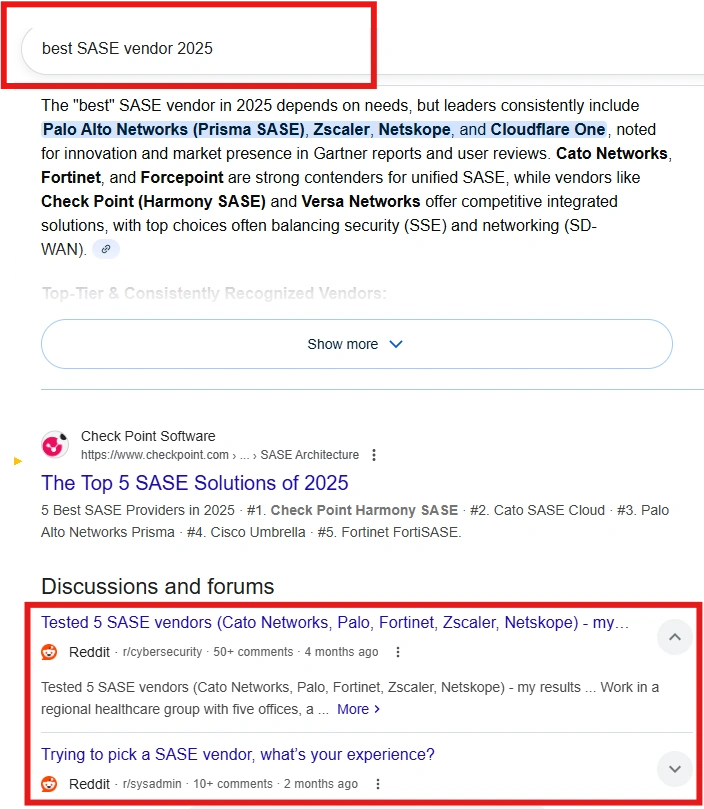
Google's algorithm updates, combined with Reddit's licensing deals with Google and OpenAI, have positioned community-driven discussions as preferred sources for both traditional search and LLM-based discovery.
Reddit CEO Steve Huffman put it bluntly during Reddit's Q2 2025 earnings call, as reported by FastCompany: "In a landscape that is progressively influenced by algorithms and automation, the demand for human voices has never been higher. AI does not create knowledge; it learns from us—real individuals sharing authentic perspectives."
He's right. And for B2B marketers, this creates both a challenge and an opportunity.
The challenge: you can't control Reddit the way you control your website. Promotional posts get downvoted into oblivion. Your carefully crafted messaging won't work there.
The opportunity: authentic customer conversations on Reddit now influence what AI systems tell prospects about your product. If your existing customers are discussing real outcomes in relevant subreddits, that content surfaces in AI responses. If they're not—or worse, if competitors' customers are—you're losing ground in places you can't directly optimize.
What Actually Works Now: Practical Shifts for B2B Teams
Let me be clear about what this doesn't mean. This isn't about abandoning SEO or your website. It's about recognizing that visibility now requires showing up in multiple channels—and that some of those channels are fundamentally different from traditional search.
Here's what I've seen work:
Optimize for AI extraction, not just ranking
AI systems pull from content that's structured, definitive, and outcome-focused. That means clear definitions, specific data points, and unambiguous conclusions. If your content is vague or hedged, it won't be cited. This isn't about keyword stuffing for AI—it's about making your expertise actually extractable.
Invest in authentic community presence
This doesn't mean spamming subreddits with product links. It means enabling your customers to share their experiences, participating genuinely in conversations where you have expertise, and building the kind of reputation that survives peer scrutiny. The goal isn't to game Reddit—it's to deserve the mentions that influence AI responses.
Build content that goes deep
Shallow content gets summarized and bypassed. Deep, expertise-driven content becomes the destination.
Track different metrics
Start measuring brand mentions in AI responses across your target keywords. Monitor citation frequency. Track whether prospects reference ChatGPT or Perplexity in their buying journey. These aren't perfect metrics yet—the tools are still maturing—but they're directionally more useful than obsessing over CTR trends for traditional rankings.
The Hard Trade-offs Nobody's Talking About
I'd be dishonest if I presented this as a simple optimization problem. There are real trade-offs:
Attribution gets harder. When someone first encounters your brand in a ChatGPT response, then visits your site directly a week later, your attribution models won't capture it. You'll need to accept more uncertainty in ROI measurement.
Control decreases. You can't control what AI systems say about you. You can influence it through quality content and authentic customer experiences—but influence isn't control. For brands used to managing every touchpoint, this is uncomfortable.
Resource allocation becomes messier. How do you justify Reddit engagement to a CFO who wants clear ROI metrics? How do you measure the value of being cited in AI responses? The frameworks are still developing.
These aren't reasons to ignore the shift. They're reasons to approach it with realistic expectations about what success looks like.
What This Means Going Forward
The companies that will win in this environment are those that recognize a fundamental shift: visibility isn't just about ranking anymore. It's about being the brand that AI systems cite, that community discussions reference, and that buyers encounter across their compressed 12-week research journey.
That requires a different approach than traditional SEO. Deeper content. Authentic presence in community discussions. Measurement systems that capture AI visibility, not just click-through rates.
It's not an easy transition. But for B2B SaaS companies willing to make it, the opportunity is significant—because most competitors haven't adapted yet.
Ready to assess where your brand stands in the new AI search landscape? LeadWalnut's AI Visibility Audit can help you understand how your content performs across ChatGPT, Perplexity, and Google AI Overviews—and identify the gaps keeping you invisible to buyers researching in AI-mediated channels.
FAQ
Is SEO dead because of AI search?
No. SEO isn't dead—but the definition of success is changing. Traditional ranking still matters for certain query types, but visibility now extends to AI Overviews, ChatGPT responses, and community discussions. Teams need to optimize for multiple discovery channels, not just organic rankings.
How much has AI actually impacted click-through rates?
Significantly. According to Pew Research Center's July 2025 analysis of 70,000 Google searches, click-through rates drop to 8% when AI Overviews appear, compared to 15% for traditional results. That's a 47% reduction in organic traffic opportunity per query.
Should B2B companies invest in Reddit marketing?
For most B2B SaaS companies, yes—but not in the traditional "marketing" sense. Reddit rewards authentic engagement and genuine customer experiences, not promotional content. The goal is building credible presence through real contributions, not running ads or posting product links.
How can I track whether my brand appears in AI responses?
Tools for tracking AI visibility are still maturing. Currently, you can manually test queries in ChatGPT, Perplexity, and Google with AI Overviews enabled. Some enterprise SEO platforms are beginning to offer AI citation tracking. Start with manual monitoring of your highest-priority keywords and buyer questions.



How can LeadWalnut help?

Related Articles
AI Content Creation That Search Engines And LLMs Trust
Build Search And AI Visibility With Smarter Content Gap Analysis