AI answer engines now shape how buyers evaluate vendors long before they reach your website. When these engines respond, they cite the sources they trust most. Most of your AI brand mentions come from sites you do not own. Editorial coverage, review platforms, and independent analysis drive far more citations than your own pages.
This gap frustrates many marketing teams. You publish strong, accurate content, yet AI answers still credit your competitors. The problem is rarely the quality of your writing. It is where the supporting evidence actually lives.
This guide shows you how to earn citations from high-authority publications. You will learn to map your gaps, diagnose why each source skips your brand, and make your pages worth referencing.
Why AI Answers Cite Your Competitors and Skip Your Brand
Teams often treat three outcomes as one. A link is a path to your page. A mention names your brand in text. A citation is the source an AI engine actually builds its answer on. Only the citation shapes what buyers hear.
Ask an engine for the best OT security vendors. It rarely quotes a vendor page. Instead, it draws from analyst reports, industry publications, and review platforms like G2 or PeerSpot.
Your competitors sit in those sources more often. That frequency, not your content quality, decides who the engine cites. Per Muck Rack, earned media drives 84% of AI citations.
Owned content alone competes for the smaller share. To earn citations, your brand must appear in the sources AI engines actually cite, not just publish more pages.
Earned Media vs. Owned Content: Where AI Citations Actually Come From
The split established above holds a clear lesson. Most AI citations come from sources you do not control.
Earned media and owned content are not interchangeable. Engines weigh them differently, and the gap is structural.
The mechanism explains why. AI engines read vendor claims about their own products as self-referential. That self-interest lowers trust in a comparison.
So owned content underperforms exactly where shortlists form. When a buyer asks which vendor leads a category, engines lean on independent sources.
Owned content still matters. It works best when third parties can quote it as evidence.
Why Outreach-First Earned Media Programs Stall
Most earned media programs lead with outreach. Teams pitch harder and expand media lists, yet citations stay flat. The reason is not effort. It is the workflow that follows every pitch.
What actually happens after a pitch
- The editor does not stop at the email. A pitch triggers a check.
- Before naming a brand, the editor opens its pages.
- The review looks for proof: data, specifics, defensible claims.
- Thin or unsupported pages end the conversation.
Why authority scores mislead
- A high Domain Rating does not make a page quotable.
- AI engines weight topical relevance and corroboration, not authority scores alone.
- Ahrefs studied 75,000 brands on this question.
- Brand mentions correlated with AI visibility three times more strongly than backlinks (0.664 vs 0.218).
- Referring-domain volume mispredicts which brands get cited. Relevance and evidence do the real work.
The real constraint
- The constraint is not pitch volume. Nor is it a weak relationship.
- The brand has not yet given anyone something worth referencing.
- Closing that gap is what drives inclusion.
The 5-Step Framework for Earning Editorial Citations
Earning editorial citations follows a repeatable sequence. Each step narrows the distance between a brand and the sources AI engines already trust. The framework moves from mapping to publishing, in five steps.
The diagram above shows the full path. The steps below make each one operational.
Step 1: Map the Citations AI Engines Already Serve in Your Category
Mapping starts with the right prompts. The goal is to see which sources engines already cite in the category.
Prompts can be drafted by hand or built faster with LeadWalnut's LLM prompt generator agent. The agent grounds each prompt in keyword and Search Console data.
Build the prompt set:
- Write 20 to 40 prompts in buyer language, not brand queries.
- Frame them the way buyers ask: "best OT security vendors," not "is [brand] good."
Run the set across engines:
- Query ChatGPT, Perplexity, Google AI Overviews, and Copilot.
- Each engine cites differently, so coverage matters.
- Log every cited URL from every response.
Choose tooling honestly:
- Ahrefs Brand Radar, Semrush AI Visibility Index, or BrightEdge prompt tracking scale the work.
- A manual sheet is enough for a first pass.
The output is a raw citation map: every source each engine serves for the category.
Step 2: Sort Earned Citations into Competitor-Controlled, Independent, and Neutral
Not every cited source deserves equal effort. Sorting the citation map reveals where work pays off. Three buckets organize it.
The reasoning behind each allocation is straightforward:
- Competitor-owned sources rarely feature a rival brand fairly.
- Independent editorial carries the most trust with engines, so it compounds over time.
- Neutral and directory sources accept updates quickly, so they deliver month-one wins.
Sorting turns a long list into a priority order. Sustained effort belongs on independent editorial. Directories supply early momentum while that work builds.
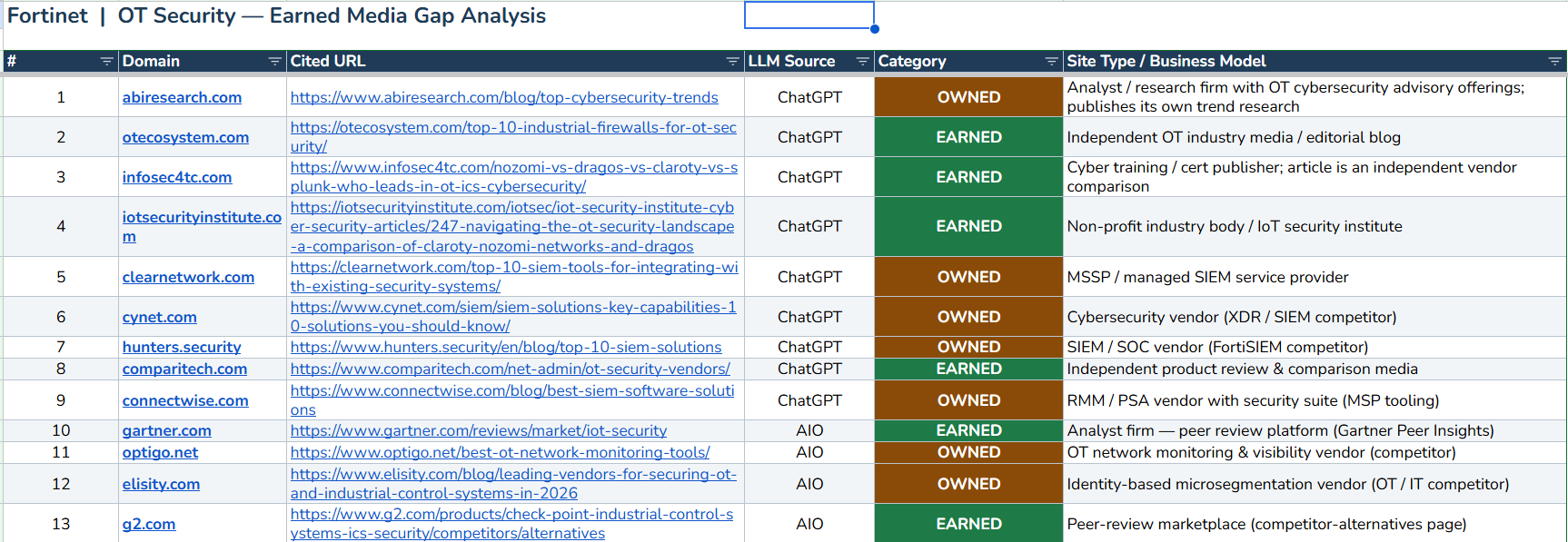
For example, an earned media gap analysis for Fortinet's OT security category sorted every cited URL by ownership. Earned sources became outreach targets, while competitor-owned pages served as content references instead.
Step 3: Diagnose Why Your Brand Is Missing from Each Citation Source
Absence has causes, and each one points to a different fix. Diagnosis classifies why a brand is missing from each source.
Four types of absence:
- Never evaluated: the source has not considered the brand at all.
- Evaluated and excluded: the brand was reviewed, then left out.
- Listed but stale: outdated data or positioning remains.
- Listed without differentiation: the brand appears, but nothing sets it apart.
Cluster the results:
- Tag every gap with one of the four labels.
- Three or four recurring causes will explain most of the absence.
Those clusters become the work plan. A brand rarely faces ten separate problems. It usually faces a few, repeated across many sources. Fixing the pattern fixes the sources at once.
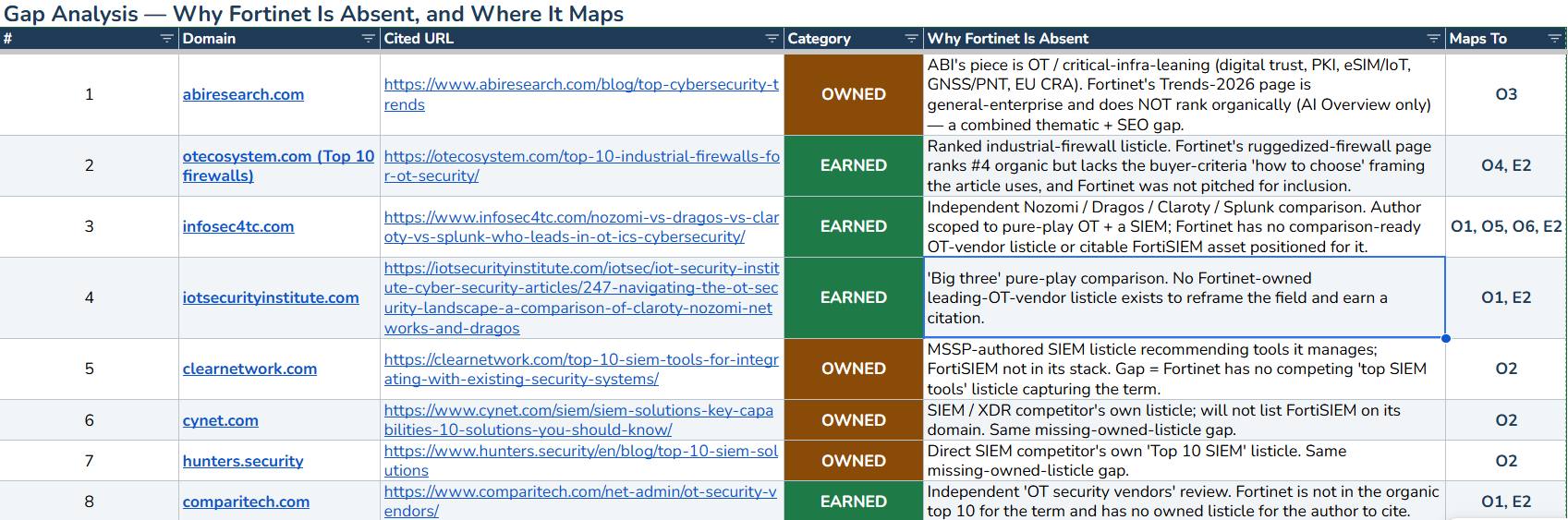
For example, the Fortinet gap analysis traced each missing citation to a cause and mapped it to a fix. Most gaps pointed to one recurring pattern: no Fortinet-owned listicle that authors could cite.
Step 4: Close the Evidence Gaps Editors Verify First
Editors verify evidence before adding any vendor. Closing those gaps removes the reasons for exclusion.
What editors check first:
- Product specs and capabilities, stated plainly.
- Pricing signals, even ranges or models.
- Third-party validation, such as reviews or certifications.
- Documented outcomes, expressed in numbers.
- Recency, shown through visible dates.
Connect each diagnosis to its fix:
- Map every cluster from Step 3 to the owned-page gap it exposes.
- A "listed but stale" cluster points to outdated pages.
- An "evaluated and excluded" cluster points to missing proof.
Then close the gaps, source by source. Most programs skip this step and pitch regardless. That omission is precisely why the outreach fails. Evidence, not persistence, changes an editor's decision.
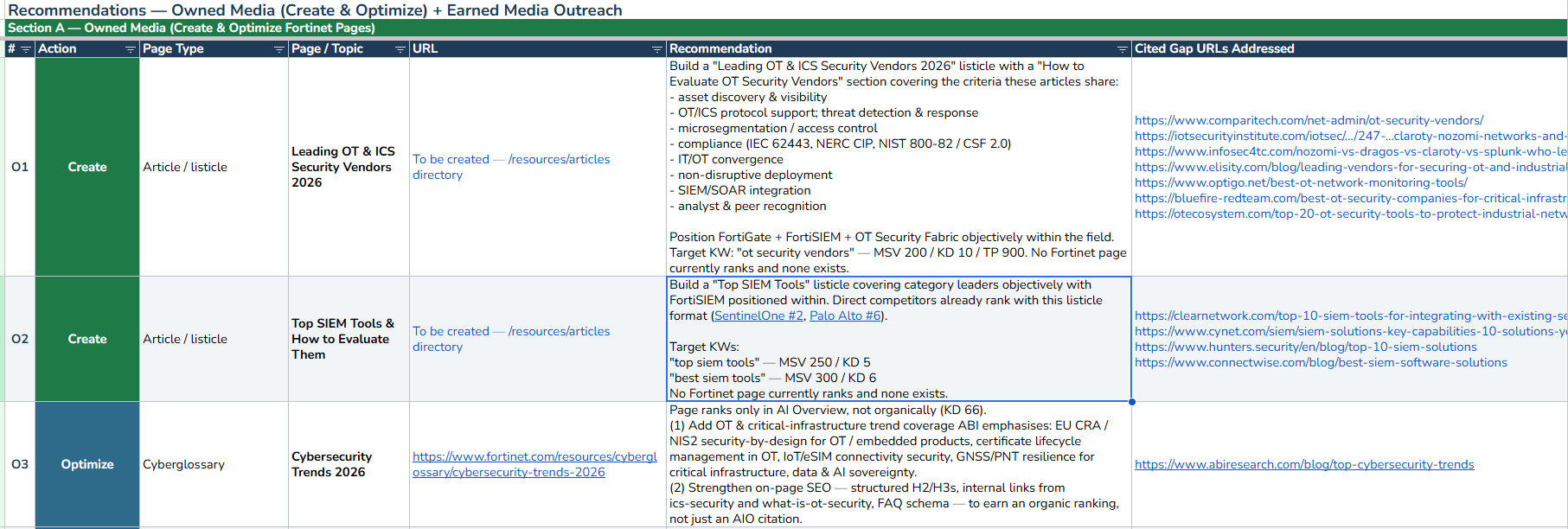
In the Fortinet example, each gap cluster from Step 3 became a content action. Clusters with no Fortinet page behind them pointed to new content. The missing OT vendor and SIEM listicles became two new articles, each targeting a low-difficulty keyword.
Clusters where Fortinet already had a relevant page pointed to optimization instead. The Cybersecurity Trends 2026 page, for instance, needed OT trend coverage and stronger on-page SEO to rank organically. Every recommendation also lists the cited URLs it addresses, so each fix ties back to a specific citation gap.
Step 5: Turn Owned Pages into Sources Editors Can Quote
Step 4 removes the reasons to exclude a brand. Step 5 gives an editor a reason to include it.
Actions that make a page quotable:
- Publish original data or benchmarks the category lacks.
- Build clean comparison tables editors can read at a glance.
- Add named customers with quantified outcomes.
- Date every proof point, so recency stays visible.
- Write specifics that can be lifted without rewriting.
The difference is subtle but decisive. A page that only informs gets read. A page that supplies evidence gets quoted.
Apply one working test to every page: could a journalist build a paragraph from this page alone? If the answer needs a phone call, the page is not yet a source. That test separates ordinary content from citable evidence.
What Makes a Page Worth Referencing in a Vendor Comparison
An editor scans each candidate page fast. That scan decides whether the brand makes the comparison. A page either supplies usable evidence or it does not.
What earns a reference
- Verifiable claims, each traceable to a named source.
- Independent corroboration from analysts, reviews, or research.
- Feature-parity data presented neutrally, not as a pitch.
- Named customers with quantified outcomes.
- Recent proof, with visible dates on every claim.
What gets a page skipped
- Unsourced superlatives, like "the leading platform."
- Undated claims that could be years old.
- Marketing language where specifications belong.
- No way to confirm anything without a sales call.
Every skip signal forces extra work onto the editor. Under deadline, that work means the page gets dropped. The stakes are higher now that AI has changed how buyers move through the funnel.
What Marketing Leaders Must Own in an Earned Citation Program
Two questions decide whether a citation program survives its first budget review: who owns it, and what it costs to run.
Where Citation Work Sits Between SEO, PR, & Product Marketing
Citation work spans three functions. SEO controls the owned pages. PR owns editorial relationships. Product marketing holds the proof: specs, pricing, and customer outcomes.
Because it touches all three, it usually belongs to none. The number drifts, and no one answers for it.
The fix is single ownership. The SEO or GEO lead should own the citation metric outright. PR and product marketing supply inputs, but accountability sits in one place.
That owner tracks the citation map, assigns the gaps, and reports the number. Shared ownership stalls the program. A named owner keeps it moving.
What to Budget and Staff for Earned Mentions
A mid-market program needs three roles, not three new hires. Most teams already hold them:
- SEO or GEO lead: owns the number, roughly a quarter of their time.
- Content writer or strategist: closes evidence gaps, one to two days a week.
- PR or outreach contact: pitches editorial sources, a few hours weekly.
Sequence the setup. Mapping and diagnosis run first, across two to three weeks.
Then run two tracks in parallel. Evidence work on owned pages and outreach to editors proceed together. Neither waits for the other. Expect early directory wins within a month.
How to Measure Earned Citations and AI Brand Mentions
A citation program earns its budget through measurement. Four metrics show whether the work moves the number.
Read the metrics together, not in isolation. Prompt coverage without citation share hides who actually wins. Source mix without downstream misses the business result.
Reporting cadence. Report monthly. AI citations shift week to week, so shorter cycles add noise, not signal. A monthly view shows the trend clearly.
Set honest expectations on lag. Results do not appear on schedule. A strengthened owned page can take weeks to surface in AI answers. An editorial reference takes longer still, since the source must publish first, then get picked up.
So early months show movement in coverage and source mix. Citation share and pipeline follow later. Leaders who expect that curve keep funding the program through the lag.
Make Your Own Content the Reason You Get Mentioned
Earned citations look like an outreach problem. They are really an evidence problem. AI engines cite the sources they trust, and most of those sources sit outside the brand's own domain. No amount of pitching changes that.
The fix starts at home. Publish verifiable data. Date every claim. Present comparisons neutrally. Name real customers with real outcomes. Strong pages make the pitch almost unnecessary, while weak pages make even the best pitch fail.
Do that, and the mentions follow. It is the same evidence-first standard that earned LeadWalnut its 4.9 rating on Clutch, turning brands into the obvious source to cite.
FAQ
How long does it take to get cited by AI after publishing new content?
Off-site mentions can surface within two to three weeks. Owned-page citations typically lag four to eight weeks, the time engines need to crawl, index, and start sampling the content.
Can you pay to appear in AI answer engine citations?
No. Paid placements barely register in AI citations. Engines pull from editorial coverage, reviews, and independent sources they judge credible, so citations are earned through evidence, not ad spend.
Do AI engines cite the same sources across ChatGPT, Perplexity, and Gemini?
Rarely. Citation sets overlap little between engines and shift month to month. A source one engine trusts may never appear in another, so coverage must span all four.
Does a Wikipedia page help a brand get cited by AI?
Yes. Wikipedia is one of ChatGPT's most-cited domains and shapes how the model describes brands. A factual, well-sourced entry strengthens citation odds considerably.
Which content formats get cited most often by AI engines?
Listicles and structured data lead. Comparison tables, numbered lists, and clear definitions get pulled far more often than dense prose, because engines extract discrete facts easily.
Do backlinks still matter for AI citations?
Somewhat, but weakly. Backlinks correlate with AI visibility at 0.218, while brand mentions correlate at 0.664. Earned mentions predict citations far better than link volume alone.



How can LeadWalnut help?

Related Articles
Why Backlinks Are Now The Primary Driver Of Brand Mentions In AI Answers
AI Content Creation That Search Engines And LLMs Trust