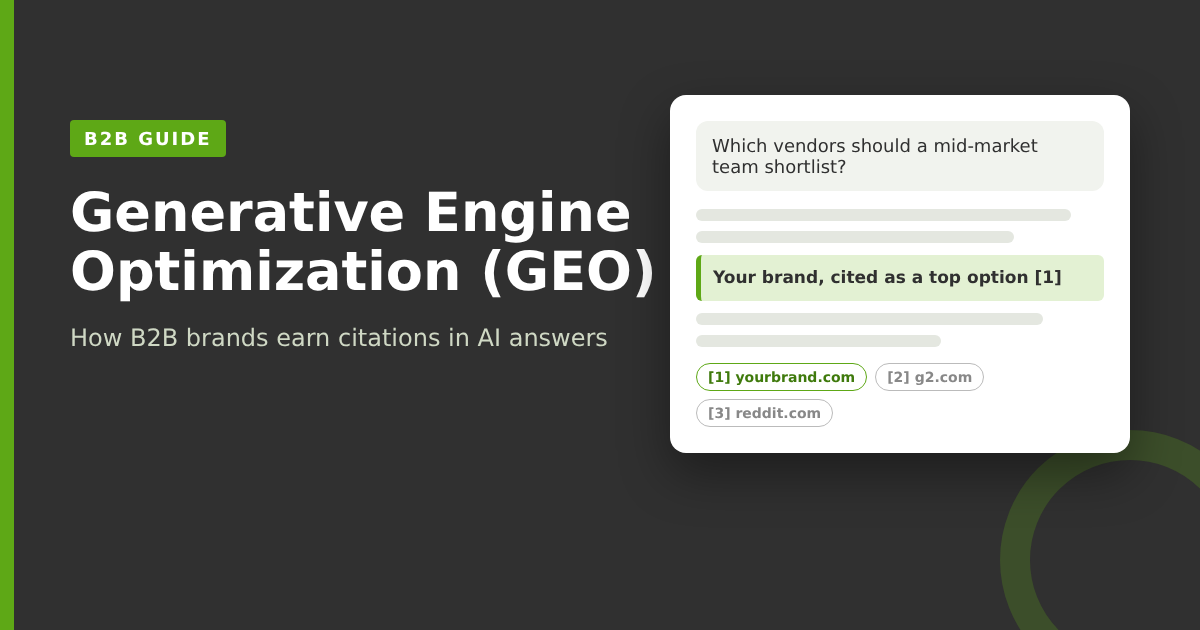
Generative engine optimization (GEO) is the practice of making a brand easy for AI engines to find, trust and cite. B2B buyers now ask ChatGPT, Perplexity, Gemini and Google AI Overviews for vendor shortlists before visiting any website. In G2's 2026 Answer Economy research, 51% of software buyers said they start research in an AI chatbot.
This guide to generative engine optimization explains what GEO is, how it works, and how B2B teams can build a program.
What Is Generative Engine Optimization (GEO)?
Generative engine optimization (GEO) is the practice of structuring content and brand signals so AI engines cite a brand in their answers. Put simply, the GEO meaning is this: be the source an AI model trusts enough to quote.
The term comes from a 2023 academic paper that tested how content changes affect visibility in AI-generated responses.
How AI Search Is Reshaping the B2B Buying Journey
Three shifts define AI search in 2026:
- Wider AI Overviews coverage: AI summaries now sit above organic results for many comparison queries.
- Answer-first search: ChatGPT search and Perplexity return cited answers with no results page.
- AI-led vendor research: G2 found 54% of buyers name AI chatbots as the top shortlist influence, ahead of review sites (43%).
Most evaluation now happens before a buyer reaches a vendor site. See how AI is changing search behavior for where those touchpoints moved.
How Does Generative Engine Optimization Work?
Understanding how generative engine optimization works starts with the five steps AI engines follow to build an answer:
- Prompt: A buyer asks, "best SOC 2 compliance tools for startups?"
- Query fan-out: The engine splits it into sub-queries on features, pricing and reviews.
- Retrieval: It pulls candidate pages from an index or live crawl.
- Selection: It keeps the clearest, most trustworthy passages.
- Synthesis: It writes the answer with citations.
GEO matters most at retrieval and selection. Google's AI features guide confirms its AI search uses query fan-out.

How AI Engines Retrieve and Select Sources
Most AI engines use retrieval-augmented generation (RAG). With RAG, the model searches for current sources first, then writes its answer from what it found.
A source becomes citable when it gives a direct answer early. Engines also reward consistent entity data, recent facts, expert authors and third-party corroboration.
How ChatGPT, Perplexity, Gemini and AI Overviews Pick Sources
Because indexes and signals differ, a brand can be cited in Perplexity yet missing from ChatGPT. Track each engine separately, with playbooks for ChatGPT SEO and Perplexity SEO for B2B.
How Prompts Shape Which Brands Get Cited
This is how prompts impact generative engine optimization: the same intent, phrased differently, surfaces different vendors.
Build content around the real prompts buyers type, validated against keyword data.
Why GEO Matters for B2B Marketing Leaders
For CMOs, a brand that is not cited is not considered. G2 found 69% of buyers chose a different vendor than planned after AI research. That makes GEO a pipeline lever, not a traffic metric.
AI search is changing the marketing funnel, and this CMO guide to AI search disruption shows how leaders are re-planning.
Benefits of GEO for B2B Brands
- Earlier influence: The brand joins the shortlist before sales outreach begins.
- Competitive edge: Many rivals still optimize only for rankings.
- Borrowed authority: G2 found 85% of buyers rate a vendor higher when AI recommends it.
- Higher-intent visitors: AI referrals arrive after comparison, closer to a decision.
Why B2B Marketing Leaders Hesitate to Invest in GEO
The hesitation is reasonable: GEO is new, platforms change fast, and budgets need proof.
Which raises a bigger question: is GEO new at all?
Is GEO Simply SEO 2.0, or Fundamentally Different?
GEO is built on SEO foundations, but it is a different discipline. The goal, the platform and the success metric all change. SEO earns a ranked link that a buyer clicks. GEO earns a mention or citation inside an AI answer, often with no click at all.
Crawlability, quality content, authority and E-E-A-T all carry over. What is new is answer extraction, entity consistency across the web, third-party mentions and prompt-based visibility. Share of voice replaces rank position as the core metric.
The practical takeaway: B2B teams should run GEO as a layer on top of SEO, not a replacement.
GEO vs SEO vs AEO: Key Differences
Answer engine optimization (AEO) focuses on owning direct answers. Seen together, SEO vs GEO vs AEO is a stack, not a contest. For more depth, see the full GEO vs SEO breakdown.
GEO Best Practices: Seven Strategies to Improve AI Visibility
These generative engine optimization strategies and GEO best practices apply across every major AI engine.
1. Structure Content for Answer-First Extraction
Open each section with a direct one- or two-sentence answer. Use short paragraphs, tables and FAQs engines can lift whole. This playbook on optimizing blog content for LLMs covers formatting.
2. Build Entity Clarity Across the Web
Use the same brand name, category and description on the website, LinkedIn, G2, Clutch and directories. Conflicting descriptions make engines unsure, so they cite the brand less.
3. Build Trust Signals That Get B2B Brands Recommended
AI engines lean on outside proof when they recommend vendors:
- Listicles: Inclusion in authoritative "best of" roundups.
- Reviews: Recent ratings on G2, Clutch and Trustpilot.
- Credentials: Awards and certifications such as ISO 27001.
- Proof: Case studies and customer logos.
- Directories: Accurate business database listings.
- Conversations: Mentions on Reddit, LinkedIn and industry publications.
4. Publish the Content Types AI Engines Cite Most
For B2B prompts, engines favor comparison pages, listicles, FAQs, use-case pages and original research. Topic clusters covering comparison, use-case and pricing angles help a brand appear across fan-out sub-queries.
5. Publish Original Data and Verifiable Facts
The GEO paper found that adding statistics, quotations and cited sources produced some of the largest visibility gains. Original surveys and benchmarks offer facts no other page has.
6. Keep Content Fresh and Accurate
Review high-value pages quarterly: refresh statistics, years and examples. Show a visible "last updated" date, since engines favor current information.
7. Make Content Technically Accessible to AI Crawlers
Serve key content in crawlable HTML and allow bots like OAI-SearchBot and PerplexityBot in robots.txt. Add schema markup and keep pages fast.
How to Measure GEO Performance
Five KPIs connect GEO work to pipeline:
- AI share of voice: Brand appearances across a fixed prompt set, signaling shortlist presence.
- Citation rate: Answers linking to the brand, which drive referral visits.
- Mention sentiment: Whether engines describe the brand accurately.
- AI referral traffic: AI sessions traced to form fills and opportunities.
- Branded search lift: Growth in branded queries, a sign of rising consideration.
Track AI Referral Traffic in GA4
In GA4, create a custom channel group called "AI Referrals." Set the rule to session source matching this regex:
Place it above Referral. Some AI visits still appear as direct, so treat the number as a floor.
Test Prompts Across Multiple AI Engines
Each month, run the same buyer prompts in ChatGPT, Perplexity, Gemini and Google AI Mode. Record whether the brand is mentioned, cited and described accurately. Tracking tools automate this at scale.
Use Search Console's Generative AI Report
Google's AI features guide points site owners to the Generative AI performance report in Search Console. Use it to see which pages appear in AI Overviews and AI Mode, then compare those pages with the prompts tracked manually.
Common GEO Mistakes That Limit Results
- Running GEO as a silo: Splitting it from SEO duplicates work.
- Chasing empty prompts: No buyer demand means no conversions.
- Ignoring third-party presence: Engines trust others' words over the brand's own.
- Publishing generic AI content: It gives engines nothing new to cite.
- Skipping measurement: Without prompt tracking, progress is invisible.
Building a Complete GEO Strategy for B2B Marketing Teams
A complete GEO program connects these pieces. Define what the brand should be known for, map buyer prompts by funnel stage, and apply the seven best practices. Monthly measurement then shows which pages to refresh. SEO stays the foundation; GEO is the layer that wins AI answers.
Get Expert Support for a B2B GEO Program
LeadWalnut supports this with Claude-powered agents for prompt research, content coverage and AI visibility tracking. Fortinet grew its AI citation share from 0.6% to 87% in 30 days. See LeadWalnut's GEO services for B2B SaaS.
FAQ
Is SEO dead now that AI answers so many searches?
No. AI engines still pull from search indexes, and G2 found 80% of software buyers still use Google. SEO remains the base GEO depends on.
How long does generative engine optimization take to show results?
Early citations can appear within weeks on live-retrieval engines like Perplexity. Durable share-of-voice gains usually take three to six months.
Is GEO the same as LLM optimization (LLMO) or AI SEO?
Largely, yes. All three describe visibility in AI-generated answers. GEO is the term used in the original academic research.
Can smaller B2B companies get cited in AI answers against bigger brands?
Yes. Engines reward specific, well-sourced answers. A smaller firm that owns niche prompts, such as one industry, can be cited ahead of leaders.
Should B2B teams build a separate budget for GEO or fold it into SEO?
Most start inside the SEO budget, since the work overlaps. A separate line suits digital PR, reviews and AI visibility tracking.
Does an llms.txt file help generative engine optimization?
Not for Google: its AI features guide says Search ignores llms.txt and AI-specific markup. Other engines have not confirmed relying on it either, so B2B teams should treat it as optional and focus on crawlable, well-sourced pages.



How can LeadWalnut help?

Related Articles
Landing Page Conversion Rate: Benchmarks for B2B SaaS
How AI Answer Engines Choose Which Product Pages to Cite