AI content creation has moved from experiment to standard practice across enterprise marketing teams. Output has multiplied. Results have not.
The teams winning today treat AI as an execution layer, not a substitute for expertise. They pair model speed with verified research, subject matter input, and editorial control. That combination is what earns rankings, AI citations, and a qualified pipeline.
This guide breaks down how Google and LLMs evaluate AI content. It then covers the governance rules and workflows that make AI content perform at scale.
Why Most AI-Generated Content Fails To Deliver Business Results
Models predict patterns from published sources. Unguided, they reproduce the consensus already ranking in the top ten results.
That output carries no proprietary data, no original research, no practitioner input. Google has no reason to rank a page that repeats what already ranks. LLMs apply the same test before citing.
At scale, the signal changes. Two hundred generic pages tell Google the domain produces low-value content systematically.
What Google Actually Says About AI-Generated Content
Google does not penalize AI-generated content. It penalizes low-value content.
Google Search Central states that generative AI helps with researching topics and adding structure to original content. Using it to produce many pages without adding value may violate the spam policy on scaled content abuse.
That policy covers generative AI output, scraped feeds, and stitched content equally. Volume alone is not the violation. Scale plus ranking intent plus thin value is. A thousand useful pages stay compliant. Fifty templated pages do not.
The operative standard is human oversight. AI drafts. A reviewer verifies claims and adds original insight before publication.
The Business Cost Of Low-Quality AI Content
Eroding Organic Traffic
AI Overviews compress the click opportunity on informational queries. Undifferentiated pages absorb that decline first, because nothing distinguishes them from the answer already displayed.
Weakened Buyer Trust
Enterprise buyers recognize formulaic writing immediately. Generic vendor content signals that the team publishing it has no direct experience with the problem.
Missed AI Citations
According to Averi, content containing statistics sees 28 to 40% higher visibility in AI search. Pages without data or attribution never enter the citation set.
Stalled Pipeline Conversion
Buyers arriving from AI answers already trust the recommendation. Absence from those answers removes the brand from consideration before evaluation begins.
How Google Evaluates AI-Generated Content
Google evaluates the page, not the production method. Three frameworks apply the same standard to AI and human output:
- Search Quality Rater Guidelines: define quality through experience, expertise, authoritativeness, and trustworthiness
- Helpful content guidance: asks whether the page serves people or search engines
- Spam policies: govern scaled content abuse regardless of how content was produced
None of the three detects AI. Each assesses originality, accuracy, and evidence of first-hand knowledge.
5 Content Patterns That Reduce Visibility
The patterns below rarely trigger manual penalties. They lower quality signals, weaken rankings, and reduce the likelihood of AI retrieval.
- Thin, unoriginal content at scale: Pages that restate published consensus add no information gain. In volume, they establish a domain-level quality signal that suppresses stronger pages on the same site. Systematic content optimization addresses this at the library level rather than page by page.
- Unverifiable or hallucinated claims: Models generate plausible statistics, misattribute sources, and invent studies. A single fabricated figure discredits the page for any reader who checks.
- Keyword stuffing disguised as optimization: Repeating target terms across headers, alt text, and body copy no longer improves relevance. It degrades readability and marks the page as engine-directed.
- Missing E-E-A-T signals: Pages without a named author, cited sources, or evidence of practitioner experience fail the trust assessment.
- Templated structure across multiple pages: Identical section patterns across dozens of URLs indicate automated production. The structure itself becomes the quality signal, independent of the words inside it.
How LLMs Decide Which Content to Cite
LLMs cite passages, not pages. A model retrieves the section that answers the query, then attributes the source it pulled from.
Selection depends on extractability. The passage must resolve the question without surrounding context, state facts a model can verify against other sources, and come from a domain the system already treats as credible.
How LLM Retrieval Differs From Google
Google ranks documents. LLMs chunk them.
The page never competes as a unit. That change reshapes content planning for teams working to generate leads from AI search engines, because the asset being optimized is the passage rather than the page.
Position weight carries the most practical consequence. A CXL analysis of 100 AI Overview citations found that 55% come from the top 30% of a page, which makes the opening section the highest-value real estate on the page.
Why Most AI Content Never Gets Cited
- Unverifiable claims: Models weight statements that corroborating sources support. Unattributed assertions carry no verification path.
- Contextual dependency: Sections that reference earlier paragraphs cannot function as standalone answers.
- Weak entity signals: Pronouns and shortened names leave the model unable to identify which brand a claim describes.
Signals That Improve AI Citations
- Answer-first structure: Open each section with a self-contained response to the header question, then add context.
- Descriptive headers: Phrase headers as direct questions or statements that match how buyers ask them.
- Structured formats: Use comparison tables, numbered processes, and FAQ blocks that map cleanly to prompts.
- Original evidence: Include proprietary data, client results, or practitioner observations models cannot find elsewhere.
How To Diagnose Underperforming AI Content
Diagnosis starts with separating the failure type. A page can rank and earn no citations, or lose rankings while staying visible in AI answers. Each pattern points to a different fix.
Work through five diagnostic layers before rewriting anything.
Google Signals
Check ranking movement against publication date. Pages that never reached page two indicate a relevance or quality problem at the draft stage.
Compare performance across the content set. A single underperforming page suggests an execution issue. A cluster declining together suggests a domain-level quality signal.
Review crawl and indexation status before assessing rankings.
AI Overview Visibility
Run target queries with AI Overviews enabled and record which domains appear. Absence from the panel while ranking in the top five indicates a structural extraction failure, not a relevance failure.
Note which competitor passages the overview pulls.
LLM Citation Gaps
Test priority queries across ChatGPT, Perplexity, and Google AI Mode.
Track two gaps separately. Brand absence means the model never retrieves the domain. Brand presence without a link means the model uses the content but attributes it elsewhere.
Tools that support AI search optimization automate this tracking across platforms and query sets.
Search Console Indicators
- Impressions rising, clicks flat: AI Overviews resolve the query without a click.
- High impressions, low average position: Content matches the topic but not the query intent.
- Query mismatch: Pages ranking for unrelated terms signal weak topical focus.
- Declining CTR at stable position: The title and description no longer differentiate against AI summaries.
Content Quality Indicators
- No named author or credentials: The page carries no expertise signal for raters or models.
- Unattributed statistics: Claims without sources fail verification and reduce citation probability.
- No original input: Content contains nothing a model cannot find in the existing top ten results.
- Stale references: Outdated figures and superseded guidance reduce trust on both surfaces.
What High-Performing AI Content Has In Common
- High-performing AI content shares one property. It contains information the model cannot assemble from other sources.
- That means proprietary data, client results, or practitioner observations, with every claim traced to a named source in the sentence carrying it.
- The rest is judgment. Someone decided what to cut, which examples to use, and where the model was wrong. That editing is the differentiator, not the drafting.
7 Governance Rules For AI Content That Performs
Governance turns quality into a repeatable standard. Each rule below is an enforceable requirement.
- Enforce E-E-A-T Signals in Every Piece of AI Content: Assign a named author with verifiable credentials to every page. Add a subject matter reviewer for technical content and record the review in the byline. Client work and direct implementation carry weight that summarized research does not.
- Mandate Verifiable Facts With Source URLs: Require a source URL for every statistic before editing begins. Claims without a traceable origin get cut. Link to primary sources, not aggregators.
- Build Human Editorial Checkpoints Into Every Workflow: Set three checkpoints: brief approval, fact verification, and pre-publish review. Each has a named owner. No draft moves forward on volume pressure alone.
- Eliminate Generic Phrasing and Filler Language: Blocklist model-default constructions. Cut sentences that restate the header or announce what follows. If a competitor could publish a paragraph unchanged, remove it.
- Structure Content for SEO and LLM Citability From Day One: Decide header phrasing, answer placement, and table candidates in the brief. Retrofitting structure after drafting rarely works.
- Use Real Research Inputs, Not Just Model Knowledge: Supply owned assets: client data, call transcripts, product documentation, internal benchmarks. Add current SERP and competitor analysis to prevent output limited to training data.
- Add Freshness Gates That Block Stale or Outdated Claims: Set review intervals by content type. Platform guidance and market data need quarterly checks. Publication stays blocked until the figure is verified or replaced.
How Leading Marketing Teams Scale AI Content
Leading teams separate what AI does from what humans own:
- AI handles: drafting, structuring, and formatting
- Humans own: inputs, verification, and final judgment
That split is what makes volume safe.
It also explains why process matters more than access. Content Marketing Institute research found that 95% of B2B marketers use AI applications. Only 39% report improved content performance.
How Leading Teams Scale AI Content Without Sacrificing Quality
Scale breaks quality when standards live in people's heads. It holds when standards live in systems. Three practices hold the split in place:
- Fixed inputs: Every draft starts from a brief with research assets, target queries, and approved sources. The model never works from a topic alone.
- Named ownership: Each piece has one accountable editor. Distributed review without ownership produces inconsistent standards across a library.
- Enforced gates: Each checkpoint blocks progress until cleared, rather than flagging issues after publication.
- Performance review: Published content is assessed against citations and pipeline, then rewritten or retired.
The Role of Templates, Checklists, & Feedback Loops In Content Quality
- Templates fix header patterns, answer placement, and required sections. Quality stops depending on who drafts the piece.
- Checklists convert editorial judgment into a pass-or-fail gate any reviewer can apply consistently.
- Feedback loops matter most. Performance data updates both, so each cycle starts from a better baseline. Without the loop, the first two decay and standards drift toward whatever ships fastest.
AI Content Governance Checklist
The checklist converts the seven rules into a pass-or-fail gate. Content ships only when every item clears.
How AI Agents Can Scale Content Without Sacrificing Quality
An AI agent differs from a chat prompt in one way that matters. It executes a defined workflow with fixed inputs, fixed steps, and enforced outputs.
That structure is what makes governance operational rather than aspirational.
- Agents enforce inputs and verification. A workflow that requires research assets before drafting cannot skip that step under deadline pressure. Source checks, claim validation, and freshness audits run on every draft, not just the ones someone remembers to check.
- Agents produce consistent structure. Header patterns, answer placement, and schema apply identically across a hundred pieces. Templated formatting is a risk only when the substance is also templated.
- Agents preserve the audit trail. Every input, source, and check gets logged. Review becomes verifiable instead of assumed.
How LeadWalnut's AI Content Agent Operationalizes AI Content Governance
Every rule in this article requires enforcement to survive volume. Documented standards fail when deadlines compress, and reviewers skip steps.
LeadWalnut's AI Content Agent is a free Claude skill built on the same framework the team runs for enterprise B2B clients. You upload one file and get a working content workflow.
The agent refuses to draft until it has your ICP, keywords, and live SERP data from Ahrefs. It runs 43 checkpoints on every piece. It cites NIST, Gartner, CISA, and other highly authoritative sites rather than inventing sources.
You approve the brief before drafting begins. The output ships without a rewrite cycle.
Build an AI Content Engine That Search Engines and LLMs Trust
The teams winning in AI search are not the ones generating the most content. They are the ones who built a system around the generation.
Start with a single gate. Require a source URL for every statistic, and the quality difference shows within a month.
The full framework already exists, free, inside the AI Content Agent. LeadWalnut runs this exact workflow for enterprise B2B clients whose content now ranks on Google and gets cited by ChatGPT, Perplexity, and AI Overviews.
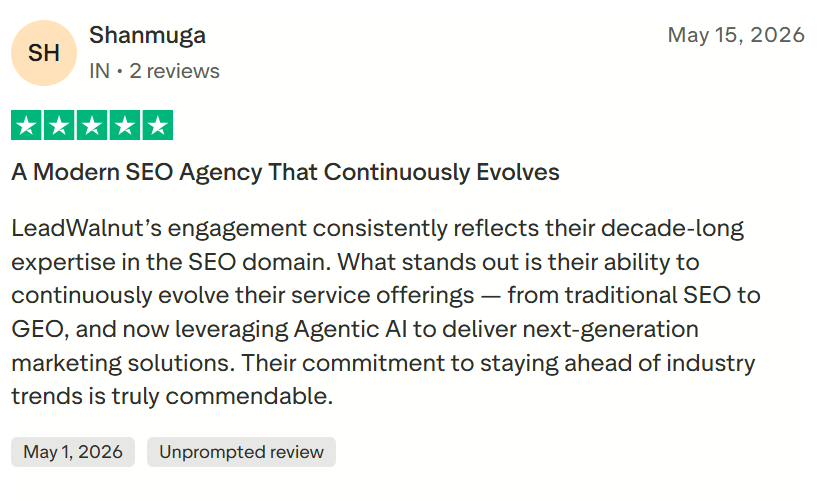
As one of our clients notes in a verified Trustpilot review, LeadWalnut keeps evolving its approach, from traditional SEO to GEO and now agentic AI, to stay ahead of how search actually works:
Building the system takes a quarter. Running it every week without drift is the harder job.
FAQ
Do we need to disclose that content was created with AI?
Google requires no AI label for Search. Disclosure matters for endorsements, testimonials, regulated claims, and platform-specific ad rules. Most B2B blog workflows with human editing need no public badge.
Should AI content go through legal review before publishing?
Yes, for competitive claims, customer references, pricing, and regulated statements. Models generate confident comparative language that legal teams reject. Routing these categories early prevents rewrites after approval.
Who should be listed as the author of an AI-drafted article?
List the human who supplied direction, verified claims, and made editorial decisions. Never credit the tool. The byline signals accountability, and fabricated author profiles violate trust guidelines.
How much existing AI content should we fix versus delete?
Fix pages with topical relevance and traffic history. Delete pages with no impressions after six months. Consolidating thin pages into stronger ones usually beats individual rewrites.
What is the realistic cost of running governance at scale?
Governance adds meaningful time per piece. That cost replaces the rewrite cycles, retractions, and lost rankings that ungoverned AI content produces later.



How can LeadWalnut help?

Related Articles
Which AI Writing Tools Earn a Citation in 2026?
How to Earn Citations from High-Authority Publications