Your competitors show up in Google AI Overviews, ChatGPT, and Perplexity. You don't.
It's rarely a keyword problem. It's a coverage problem.
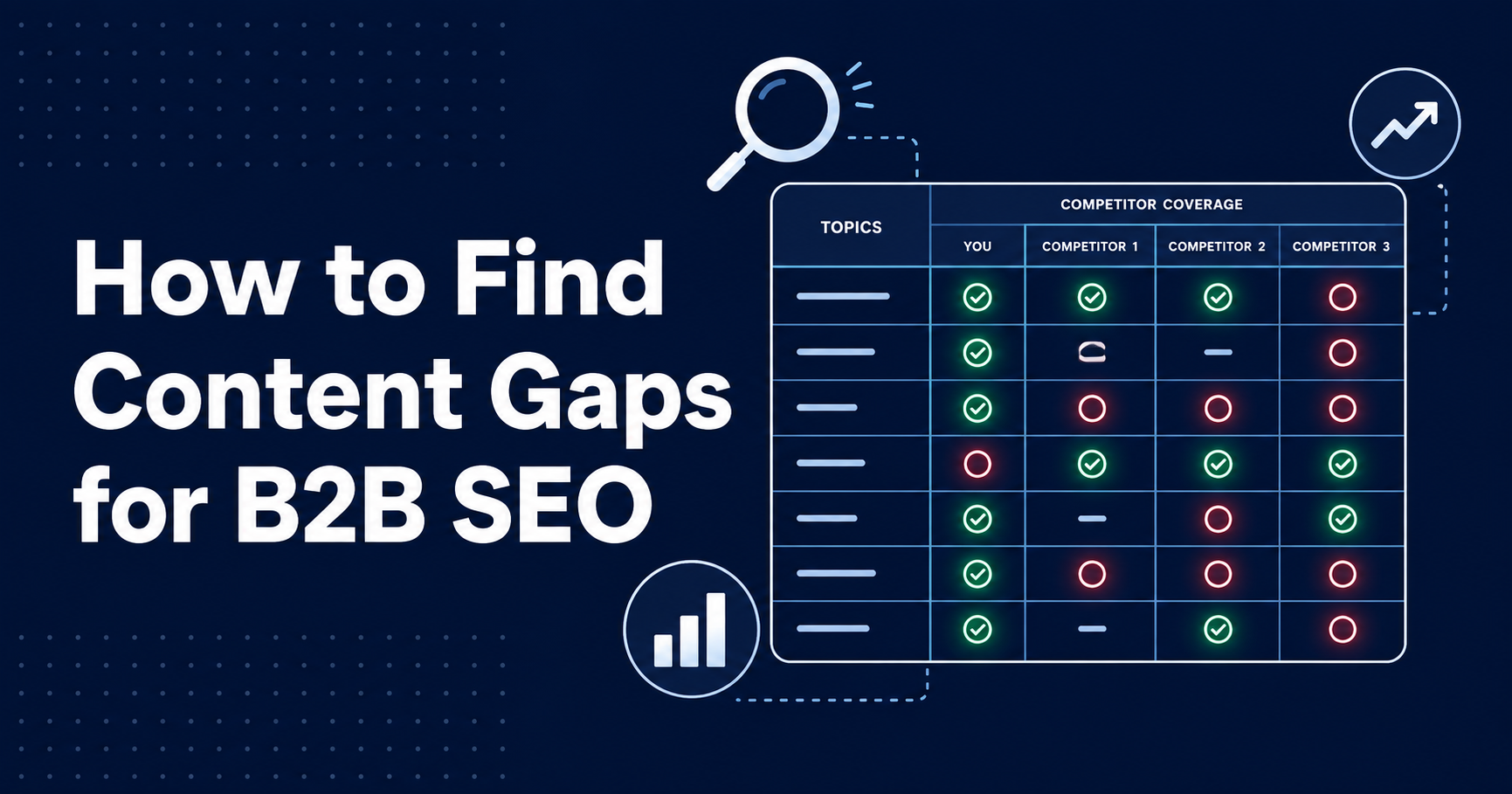
A content gap analysis fixes that. It maps your category, benchmarks you against competitors, and shows where AI engines pull answers from someone else's page instead of yours.
This guide walks through a 5-step framework for search and AI visibility in 2026.
What Is Content Gap Analysis? How Is AI Reshaping It In 2026?
Content gap analysis audits your website's content against your category, your competitors, and your buyers' questions. It identifies missing topics, sub-topics, formats, and intent coverage.
The output is a prioritized list of pages to create, expand, or refresh.
The keyword-first version no longer holds. Bain reports 80% of consumers now rely on AI-generated answers for at least 40% of their searches. AI Overviews, ChatGPT, and Perplexity cite two or three sources. If you are not one of them, the click never happens.
Keyword gap analysis cannot close this. It shows which keywords competitors rank for. It does not show which sub-topics AI engines trust them for.
Modern content gap analysis works across three layers:
- Sub-topics, not keywords: Maps the full set of themes and entities in your category
- Full-funnel coverage: Scores ToFu, MoFu, and BoFu separately per sub-topic
- AI citation checks: Confirms whether engines cite you for the questions your buyers ask
Why Content Gap Analysis Matters
A good gap analysis changes what your content program produces and how it performs. Four outcomes are worth calling out:
- Improves topical authority: Covering every sub-topic in your category signals depth to Google and to LLMs. Similarweb's 2026 AI Brand Visibility Index shows dominant brands win because AI engines form strong category associations across a full topic cluster, not because of one great page.
- Increases organic visibility: Filling gaps expands the keywords you are eligible to rank for. New pages compound with existing ones through internal linking, lifting the whole cluster.
- Improves AI citations: AI Overviews, ChatGPT, and Perplexity cite the source that answers the question best. If your site does not cover a sub-topic, a competitor does. They get the citation.
- Drives qualified pipeline, not just traffic: Scoring gaps by commercial intent means you build pages that convert. This is how CRO for B2B SaaS turns visits into demos and revenue.
Content Gap Analysis Vs Keyword Gap Analysis
Keyword gap analysis is a subset of content gap analysis. Run it inside the larger framework, not as a replacement for it.
The 5-Step Framework For Comprehensive Content Gap Analysis
Most gap analyses skip straight to the keyword export. That is why they miss half the gaps. A comprehensive audit works from the ground up.
Step 1: Extract And Inventory Every URL In Your Target Category
Analysis is only as good as the inventory behind it. Before any competitor comparison, list every URL on the site that touches the target category. Four sources give full coverage: sitemaps, breadcrumbs, navigation, and internal links. No single source is complete. Combining all four reveals hidden pages the site has forgotten about.
How to Find Hidden Pages Using Sitemaps, Breadcrumbs, & Navigation
- Start with the XML sitemap: Open /sitemap.xml or /sitemap_index.xml. Export every URL under the target sub-folder into a spreadsheet.
- Walk the breadcrumb trail: Open a top category page. Note every parent, child, and sibling link in the breadcrumb. Repeat for each sub-category to map the full hierarchy.
- Audit the navigation: Pull every link in the main menu, mega menu, and footer that points into the target category. These reveal hub and pillar pages.
- Crawl for internal links: Run Screaming Frog or Sitebulb on the category sub-folder. Filter for pages with inbound internal links but no sitemap entry. These are the orphan pages worth flagging.
Cross-reference the four lists. Any URL that appears in one source but not the others is a hidden page. These are often older pages still ranking that need a refresh, merge, or redirect.
Step 2: Identify Subcategories Through Competitor Research
The internal inventory shows what exists. Competitor research shows what is missing. The goal is to map every sub-category the category leaders cover, so Step 4 has something to measure against.
Pick three to five direct competitors plus one or two adjacent players who show up in AI Overviews. Pull their category content using site search operators, sitemap exports, and Ahrefs or Semrush organic pages reports.
Mining Competitor Topic Clusters To Surface Hidden Opportunities
- Cluster competitor URLs by sub-topic: Each cluster is a sub-category they have built depth on.
- Spot pillar-to-cluster patterns: A hub page linking to five or more supporting articles signals a priority sub-topic.
- Flag sub-topics only competitors cover: Strong competitor depth plus zero client coverage is a Tier 1 gap.
- Note format gaps: Comparison pages, calculators, buyer's guides, or listicles the site lacks.
- Check AI citation patterns: Run 10-15 category prompts across ChatGPT, Perplexity, and AI Overviews. Log which competitor URLs get cited.
The output is a tagged master list of every active sub-category, mapped to the competitors that own each one.
Step 3: Map Content by Search Intent, Funnel Stage, & Format
A URL list is not a gap analysis. Classification is what turns inventory into insight. Every URL from Step 1 and every sub-topic from Step 2 needs three tags:
- Search intent: Informational, navigational, commercial, or transactional. Pulled from the SERP for each target query.
- Funnel stage: ToFu (education), MoFu (evaluation and comparison), or BoFu (decision and purchase). Aligned to the buyer journey stage.
- Format: Blog, guide, listicle, comparison page, glossary, product page, calculator, video, or landing page.
Classify existing URLs first. Then classify competitor URLs from Step 2. Two patterns almost always surface:
- Funnel imbalance: Most B2B sites over-invest in ToFu blogs and BoFu product pages, with almost no MoFu comparison or evaluation content.
- Format gaps: Competitors win with formats the site does not produce, most often comparison pages, calculators, and buyer's guides.
The tagged dataset is what feeds the coverage matrix in Step 4.
Step 4: Build a Topic Coverage Matrix
Set up the matrix with sub-topics from Step 2 as rows, and these columns: ToFu, MoFu, BoFu, AI Visibility, and Competitor Depth. Each cell gets a score based on current coverage.
Score Coverage Across ToFu, MoFu, BoFu, & AI Visibility
Use a 0 to 3 scale for every cell:
- 0 – No coverage.
- 1 – Thin coverage. One page, outdated or shallow.
- 2 – Solid coverage. Ranking, but not category-leading.
- 3 – Strong coverage. Ranks, cited, and complete.
Apply the scale across each column:
- ToFu, MoFu, BoFu: Score against classified URLs from Step 3. A missing funnel stage on a high-value sub-topic is a priority gap.
- AI Visibility: Score based on citation frequency across AI Overviews, ChatGPT, and Perplexity for 5-10 prompts per sub-topic. Zero citations equal zero, regardless of Google rank.
- Competitor Depth: Score based on pillar-cluster patterns from Step 2. A sub-topic where competitors score 3, and the site scores 0 or 1 is a Tier 1 gap.
Step 5: Prioritize Content Gaps by Business Impact
A full matrix surfaces more gaps than any team can close in a quarter. Score each gap across four dimensions:
- Commercial intent: BoFu and MoFu gaps outrank ToFu at equal volume.
- Search and AI demand: Combined search volume plus AI prompt frequency across ChatGPT, Perplexity, and AI Overviews.
- Competitive difficulty: Domain strength of competitors already ranking or cited.
- Effort to close: Refresh (days), rewrite (a week), new pillar (weeks).
Ship the gaps with the highest commercial intent and demand at the lowest effort first. Everything else waits. The output is a ranked roadmap tied to pipeline potential, not a keyword wishlist.
When Should You Perform A Content Gap Analysis?
Gap analysis is a recurring input, not a one-time project. Four triggers matter:
- Quarterly: New sub-topics emerge and AI engines shift what they cite. A quarterly review keeps the roadmap tied to current demand.
- Before a migration: Decides which pages survive, which consolidate, and which need a rewrite before URLs change.
- After a core update: Shows which sub-topics lost visibility and which competitor gained it.
- Before a product launch: Maps what exists, what competitors own, and what has to ship by launch date.
Key Elements Of A Comprehensive Content Gap Analysis
A gap analysis is only as strong as the dimensions you check against. Four elements do most of the work:
- Topical authority, entity coverage, and internal linking: Depth beats volume. Score sub-topic and entity coverage across the category. Check whether internal links actually connect the cluster. Missing entities and orphan pages are why AI engines cite competitors instead of you.
- AI citation readiness and content freshness: Check whether AI Overviews, ChatGPT, and Perplexity cite you for the questions your buyers ask. This is the foundation for generating leads from AI search engines. Freshness matters too. AI engines favor recent pages. Anything untouched for 12 months is a gap even when the topic is covered.
- SERP features: Track which features competitors win on your target queries. This includes People Also Ask, featured snippets, and AI Overviews. Each one is a specific gap you can close with the right content format.
- Commercial value and conversion fit: Not every gap is worth closing. Score each opportunity by commercial intent and pipeline potential. The roadmap should build pages that convert, not just pages that rank.
How AI Is Transforming Content Gap Analysis
Content gap analysis used to be a manual, keyword-first exercise. AI has changed the inputs and the output. Two shifts matter most:
- Semantic and entity analysis: AI tools extract every named entity, product, and sub-topic from your content and your competitors'. They then compare coverage across the full set. DreamHost notes that 89.7% of ChatGPT citations go to recently updated pages. Keyword tools cannot see this layer.
- AI visibility as a new gap dimension: Gap analysis now extends into AI Overviews, ChatGPT, and Perplexity. Superlines reports that content with stats and citations earns 30 to 40% higher visibility in AI responses. Checking who gets cited is a required layer of any audit.
Meet LeadWalnut's Content Gap Analysis AI Agent
Running the 5-step framework manually is slow. LeadWalnut's Content Coverage Analyzer is a free Claude skill that runs a 9-phase content gap analysis on any website and category in 15 to 30 minutes.
- What it does: Extracts every URL across four passes, maps each to a sub-category, classifies by funnel stage, and benchmarks coverage against the dominant competitor.
- Inputs: Website URL, category, and competitors.
- Outputs: A leadership-ready HTML report with a coverage matrix, funnel distribution, competitive landscape, prioritized Optimize vs New recommendations, and the top 6 quick-win assets.
- Scoring: Gap severity rated Critical, Moderate, or Minor per sub-category, with ToFu, MoFu, BoFu, and LLM coverage mapped alongside it.
Sample audit: A B2B remote access SaaS competing against Action1, NinjaOne, and Kaseya. 42 URLs audited, 12 sub-categories mapped, 45% coverage against the dominant competitor, and two Critical gaps surfaced.
Skip the spreadsheets and get a Critical-Moderate-Minor gap report before the next content sprint. Download the skill here.
Common Mistakes To Avoid During Content Gap Analysis
Three mistakes account for most failed B2B gap audits:
- Skipping product and commercial pages. Most audits inventory the blog and stop. Product, solution, and comparison pages are where pipeline is won, and they're usually the thinnest part of the coverage matrix. Include them in Step 1.
- Ignoring orphan pages and internal linking. Strong content nothing links to underperforms, and AI engines read cluster structure as a topical authority signal. An unlinked page is a gap even when the topic is technically covered.
- Copying competitor coverage instead of interpreting it. Mirroring a competitor's cluster produces parity, not authority — and parity doesn't earn citations. Use their clusters to find the opportunity, then build the angle they missed.
Closing Content Gaps Without Starting From Scratch
Most content gaps do not need a new page. The existing library already holds the raw material. Five moves close gaps faster than net-new production:
- Reuse existing assets: Webinar transcripts, sales decks, and customer interviews often cover sub-topics the site never published. Repackage these into articles, FAQs, or comparison pages.
- Expand shallow pages: A 600-word article ranking on page two rarely needs replacement. Add missing sub-topics, entities, and answer-format sections to lift it into the citation set.
- Merge and redirect: Two pages competing for the same query dilute both. Combine them into one stronger page and redirect the weaker URL. Outdated pages that still hold link equity should redirect to the closest relevant page rather than stay live.
- Refresh stale content: AI engines favor recently updated pages. Any high-potential page untouched for over 12 months should be refreshed with current data, new sub-topics, and updated examples.
- Fix internal linking: Orphan pages and thin internal linking are silent gap-drivers. Add contextual links from hub pages, related articles, and product pages to strengthen the cluster.
Net-new content is the last resort, not the default. Most Tier 1 gaps close faster through reuse, expansion, or refresh.
Future-Proof Your Content Strategy With AI-Powered Gap Analysis
Buyers now move between Google, AI Overviews, ChatGPT, and Perplexity in a single research session. Winning pipeline means getting cited across all of them. A modern content gap analysis maps sub-topics, scores AI visibility, and prioritizes by commercial intent, turning coverage into a revenue-tied roadmap.
LeadWalnut, rated 4.5 on SalesHandy, runs this framework across enterprise B2B programs including Fortinet, Splashtop, and eFax, tying every gap to pipeline impact through integrated SEO, GEO, AEO, and CRO built for AI-era search.
FAQ
How long does a content gap analysis take?
A full audit for a single category takes two to four weeks. Small websites with fewer than 50 URLs can complete one in a week. Enterprise sites with multiple categories take longer.
What tools are needed for content gap analysis?
Ahrefs or Semrush for keyword and competitor data, Screaming Frog for URL crawls, Google Search Console for existing performance, and an AI visibility tool like Profound or Peec for citation tracking.
How often should a content gap analysis be updated?
Quarterly for most B2B sites. Faster-moving categories or brands running active AI search programs benefit from a monthly refresh of AI citation data.
Can content gap analysis be done for free?
Basic gap analysis is possible using Google Search Console, sitemaps, manual SERP checks, and free AI prompt tests. Paid tools speed up competitor and keyword data collection significantly.
What is the difference between a content audit and a content gap analysis?
A content audit evaluates existing pages for performance and quality. A gap analysis identifies missing topics, sub-topics, and formats. Both are complementary, not interchangeable.



How can LeadWalnut help?

Related Articles
Which AI Writing Tools Earn a Citation in 2026?
How to Earn Citations from High-Authority Publications