


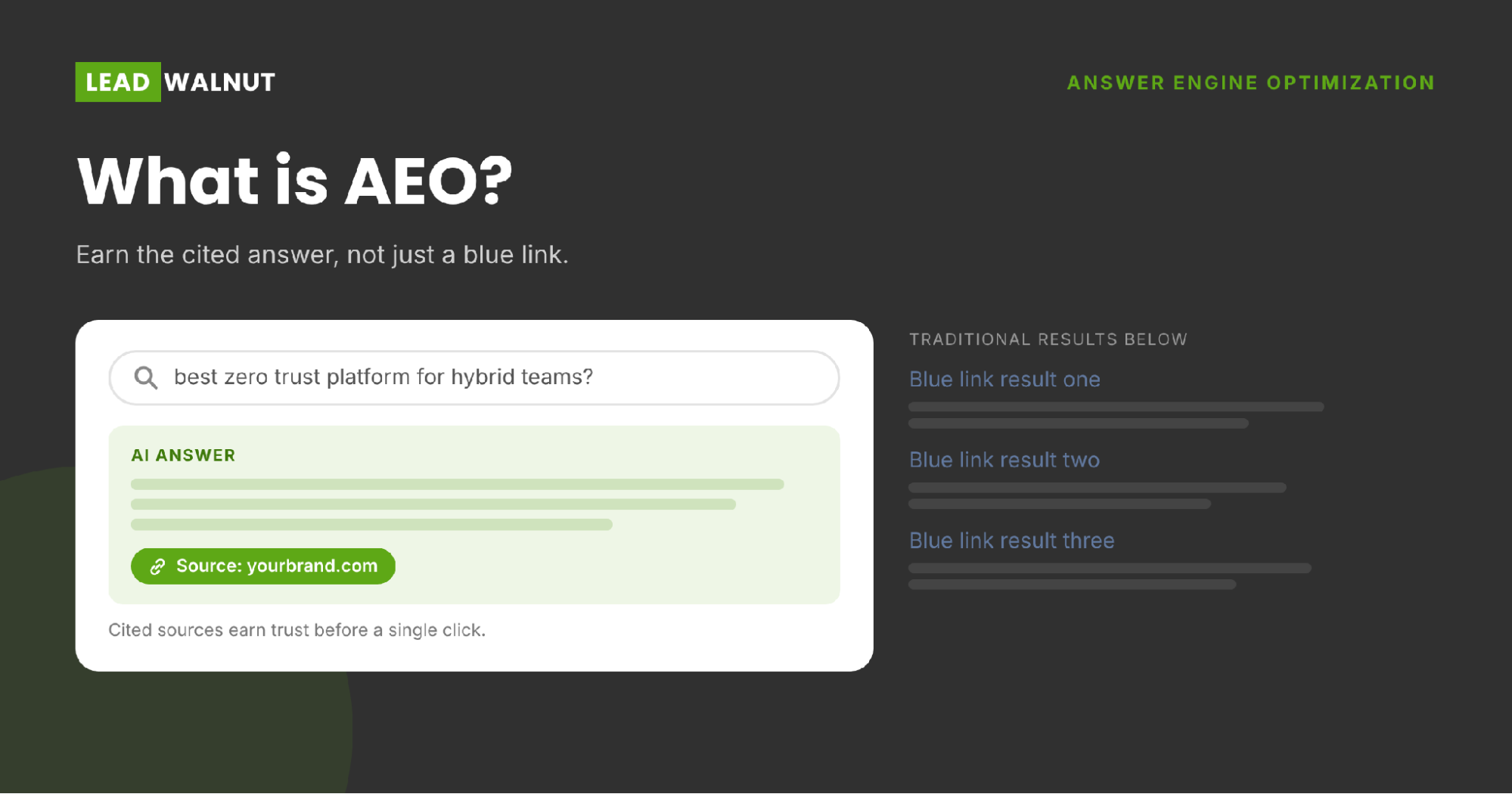
Buyers no longer scroll ten blue links to build a vendor shortlist. They ask ChatGPT, Perplexity or Google's AI Mode, read one written answer and move on. In a Clutch survey of AI assistant users, 69% said they now use Google less than before.
That shift puts a new question to every B2B marketing team: when AI writes the answer, is the brand inside it? Answer engine optimization (AEO) is the practice built to make that happen. This guide explains what AEO is, how answer engines choose what to quote, how AEO compares with SEO and GEO, five practices that make content quotable and how to measure results.
What is answer engine optimization (AEO)?
Answer engine optimization (AEO) is the practice of shaping content so AI answer engines can find it, understand it and quote it as the reply to a user's question. In plain terms, the AEO meaning comes down to one outcome: the brand is named and cited inside the answer, not only listed as a link below it.
The AEO meaning in marketing grew out of two older formats. Featured snippets lifted one paragraph to the top of Google, and voice assistants read a single answer aloud. Both rewarded pages that answered a question cleanly in the opening lines.
Today, AEO applies to Google AI Overviews and AI Mode, ChatGPT, Perplexity, Gemini and Microsoft Copilot. Each one writes its own answer and credits a few sources. So what is AEO in marketing terms? It is the work of becoming one of those sources.
Outside marketing, AEO also stands for Authorized Economic Operator, a customs trust status for international traders. This article covers the marketing meaning only.
How answer engines choose which passage to quote
Answer engines first retrieve a handful of pages that match the prompt, then pick the passages that answer it most clearly and credibly. The passage, not the whole page, is what gets quoted.
Retrieval works much like search ranking, as LeadWalnut's guide to generative engine optimization explains. Google says its AI features draw on its core ranking and quality systems, and a page must be indexed and eligible for a snippet before it can appear as a supporting link (Google Search Central).
Once the pages are in hand, five traits decide which passage wins:
- Directness: a passage that answers in its first sentence is easier to lift than one that builds up to the point.
- Self-containment: it still makes sense without the paragraphs around it.
- Specificity: names, numbers, dates and definitions give the engine something concrete to cite.
- Corroboration: claims that match other trusted sources are safer to repeat.
- Freshness: dated, current facts win on time-sensitive prompts.

AEO vs SEO: where each one wins
AEO builds on SEO. SEO earns a page its place in the index and the rankings. AEO makes the best passages on that page easy to quote. Without the first, the second has nothing to work with.
So the AEO vs SEO question is less either-or than it sounds. On AEO vs GEO, the difference is mostly vocabulary. Generative engine optimization (GEO) describes the same work through the lens of generative AI, and many teams use the terms interchangeably, so the AEO vs GEO label rarely changes the work itself. Google's May 2026 guide to generative AI search goes further: from its view, optimizing for these features is still SEO.
Most teams run AEO SEO as one program with shared owners. For those weighing outside help, LeadWalnut compares the best AEO agencies for B2B SaaS.
Why AI answers now shape B2B buying
AI assistants have become the first stop for research, so the first impression of a vendor often forms inside an AI answer. For AEO marketing, that moves the battle upstream of the website.

B2B buyers follow the same pattern. G2's 2026 AI Search Insight Report found 51% of B2B software buyers start research with an AI chatbot more often than with Google.
Among standalone assistants, one platform carries most of the traffic. Previsible's study of 166 GA4 properties (November 2024 to May 2026) found ChatGPT drove 92.4% of trackable LLM referral sessions. Previsible's view is that Google's AI Overviews and AI Mode still drive more AI-influenced traffic than all assistants combined. Its referral data does not measure those Google surfaces directly.
AEO strategy: 5 ways to make content quotable in answer engines
These five practices form the core of any AEO marketing program, covering AEO optimization on the page and off it. Entity clarity and crawler access are covered in the GEO guide.
Lead every section with a direct reply
Open each section with a 40-60 word reply that answers its heading on its own. Then add detail, examples and data. The reply must still make sense when lifted out of the page, because that is exactly what an answer engine does with it.
Cover the follow-up questions buyers ask
Buyers rarely stop at one question. Someone who asks what AEO is will ask how to measure it next. Answer those follow-ups on the same page so the engine finds one complete source. LeadWalnut's free Content Coverage Analysis Agent shows which topics a category leader covers in search and AI answers that a site still misses.
Label pages with schema markup
Organization, Article and FAQ schema help engines confirm who published a page and what it covers. The markup must match the visible text. Google says no special AI-only schema is needed for its features, so treat schema as clarity, not a shortcut. LeadWalnut's schema markup implementation service handles this across large sites.
Earn mentions on sites assistants already trust
Answer engines lean on listicles, review platforms and trade media to build shortlists. A brand missing from those sources is rarely recommended. LeadWalnut's guide to earned citations explains how to win those placements. Its free Backlink Agent vets each target site for relevance, real traffic and spam before outreach.
Map pages to the prompts buyers ask AI
List the questions each buyer persona asks AI tools at each funnel stage, then assign every question to one page. Sales calls, Search Console queries and keyword data are the best inputs. LeadWalnut's guide to identify AI search prompts covers the method.
The free LLM Prompt Agent turns those inputs into a validated prompt set across six categories: problem, brand, features, services, industries and personas. In a live Splashtop audit, it mapped the bottom-funnel prompt "Who are the leading remote desktop software vendors?" to Splashtop's Business Access product.
How to track citation share, sentiment and AI referrals
AEO results show up inside AI answers and in analytics, not only in rankings. Run a fixed set of buyer prompts each month across the main engines. Log which brands are named and cited, and whether the answers about the brand are correct. Pair that with AI referral sessions in GA4, so AEO SEO reporting sits in one place. LeadWalnut's review of ChatGPT rank tracking tools compares platforms that automate the prompt runs.
AEO limits to plan for
AEO is real but imperfect, so plan for four limits before reporting on it.
- Attribution gaps: many AI answers settle the question without a click. Influence then shows up as branded search or direct traffic, not referral sessions.
- Inaccurate answers: Clutch found 56% of users regularly get unhelpful or incorrect AI responses. An engine can misstate a brand's pricing, category or features. Fixing that is the focus of LLM optimization.
- Referral swings: engines change models, sources and layouts often, so a citation can vanish overnight. Judge trends monthly, not weekly.
- No guaranteed placement: no tactic forces a citation. Google's own guide warns that many popular AEO "hacks", such as llms.txt files and chunking content for AI, are not needed.
Build content that earns trust on every search surface
What is answer engine optimization at its core? It rewards the same habits on every surface: clear answers, complete coverage and proof from sources buyers already trust. Write answer-first, cover the follow-up questions, keep schema accurate and earn third-party mentions. Then track citation share and accuracy monthly, and AI answers become a channel the team can steer.
LeadWalnut use case: growing AI citation share into category visibility
Fortinet, a global cybersecurity leader, held just a 0.6% AI citation share in cloud security. Most citations went to earned media. LeadWalnut published two strategic listicles, targeted 15+ high-DA publishers and built content for five emerging themes.
Within 30 days, Fortinet's citation share across ChatGPT, Gemini and Perplexity reached 87%. Its LLM citation rank for cloud security rose from #31 to the top 3. Read the Fortinet AI search success story, or see how LeadWalnut's AI search optimization service runs the same program.

FAQ
Can AEO work without SEO rankings?
Rarely on its own. Answer engines retrieve from pages they can crawl and trust. A page does not need position one, but it must be indexed and credible. Third-party mentions can still put a brand into answers while its own pages are weak, which is why AEO marketing runs on and off the site.
Do backlinks still matter for AEO?
Yes, indirectly. Links help pages get found and ranked, which feeds retrieval. A link on a site AI answers already cite also works as a brand mention. LeadWalnut's webinar on backlinks for AI visibility covers which placements help most.
Does AEO work for low-volume B2B categories?
Often it works better. Niche prompts have fewer competing sources, so one specific page can become the default citation. Low keyword volume does not mean low prompt volume, since buyers ask long, detailed questions that keyword tools barely register.
How often should content be refreshed for AI answers?
Review priority pages every quarter, and update them at once when pricing, product names or key data change. Show a visible "last updated" date. Pages on fast-moving topics may need monthly checks, since stale facts are the quickest way to lose a citation.
What counts as an answer engine?
Any system that replies with a written answer instead of a list of links. That includes Google AI Overviews and AI Mode, ChatGPT, Perplexity, Gemini, Microsoft Copilot, Claude and voice assistants.



How can LeadWalnut help?

Related Articles
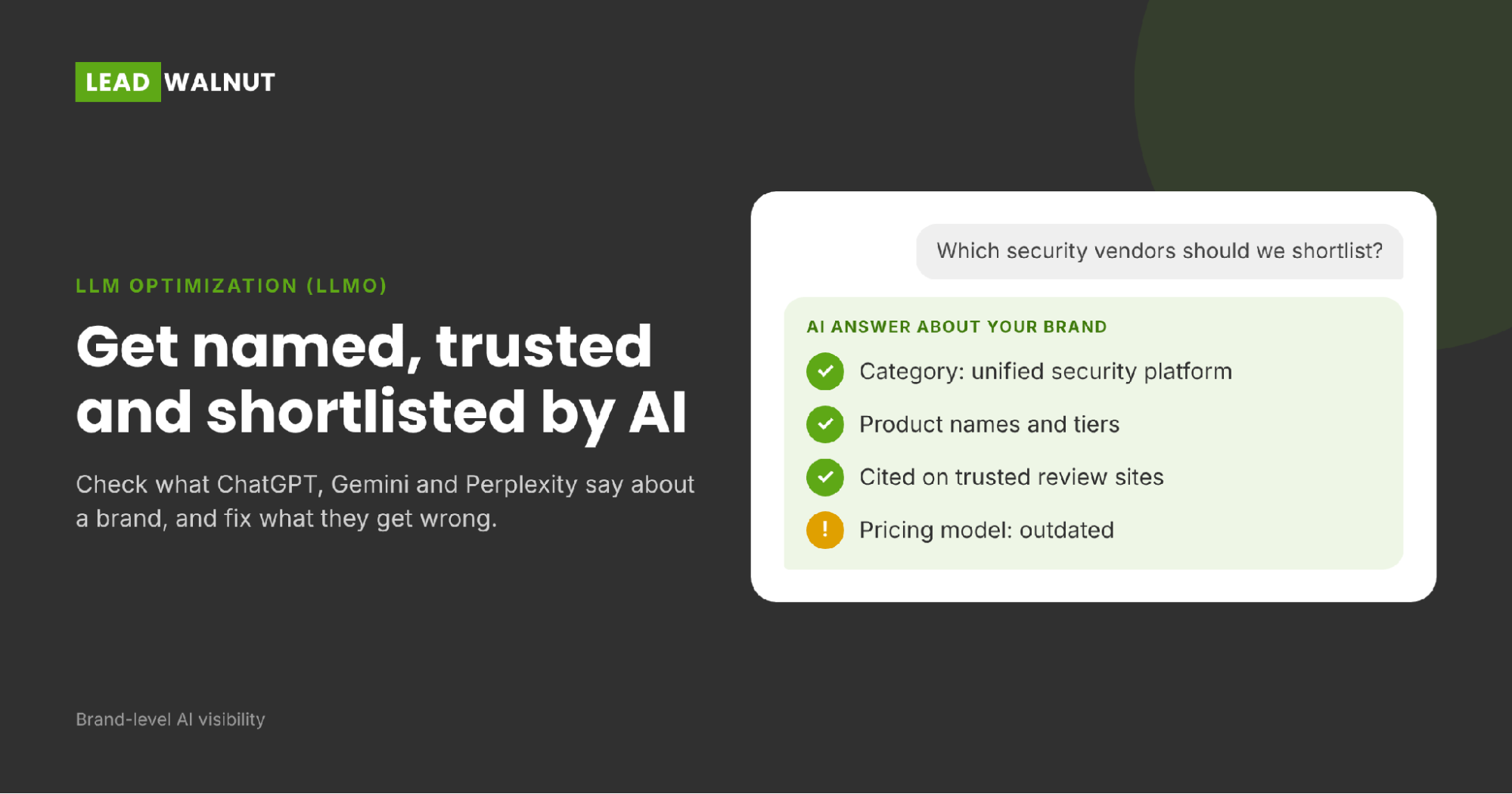
LLM Optimization (LLMO): Get Mentioned, Trusted, and Shortlisted by AI
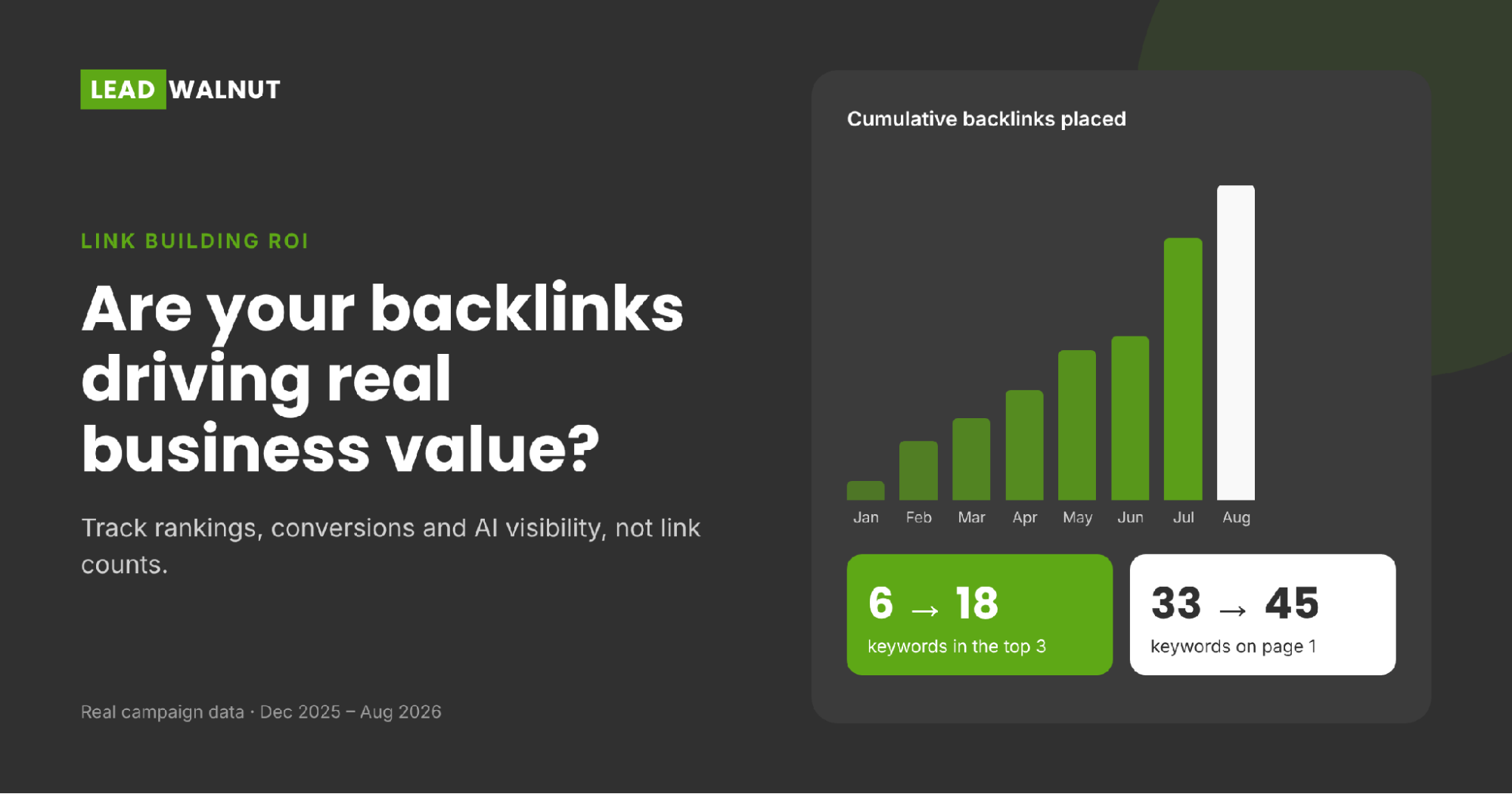
Is Link Building Still Worth It? Measuring Backlink ROI for SEO and AI Search


