Most SEO and GEO teams still run their AI tools the same way they ran Google search — one query at a time. Ask a question, copy the answer, paste it somewhere, move on. Meanwhile, the real bottleneck never moves: nobody knows where they actually stand against competitors by buyer role, AEO prompt sets stay generic and unvalidated, and content gap reports take days to build and are outdated the moment they're done.
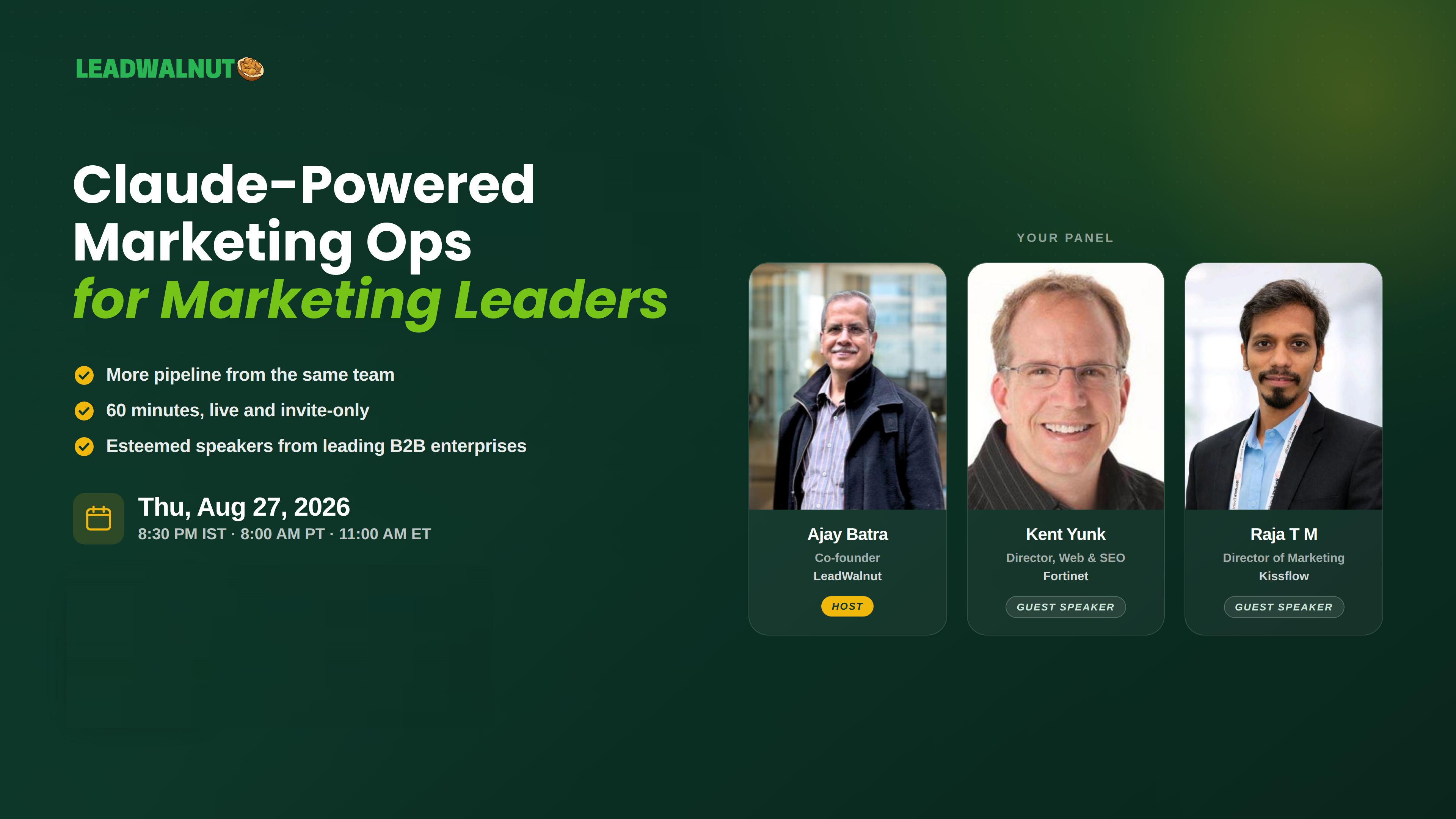
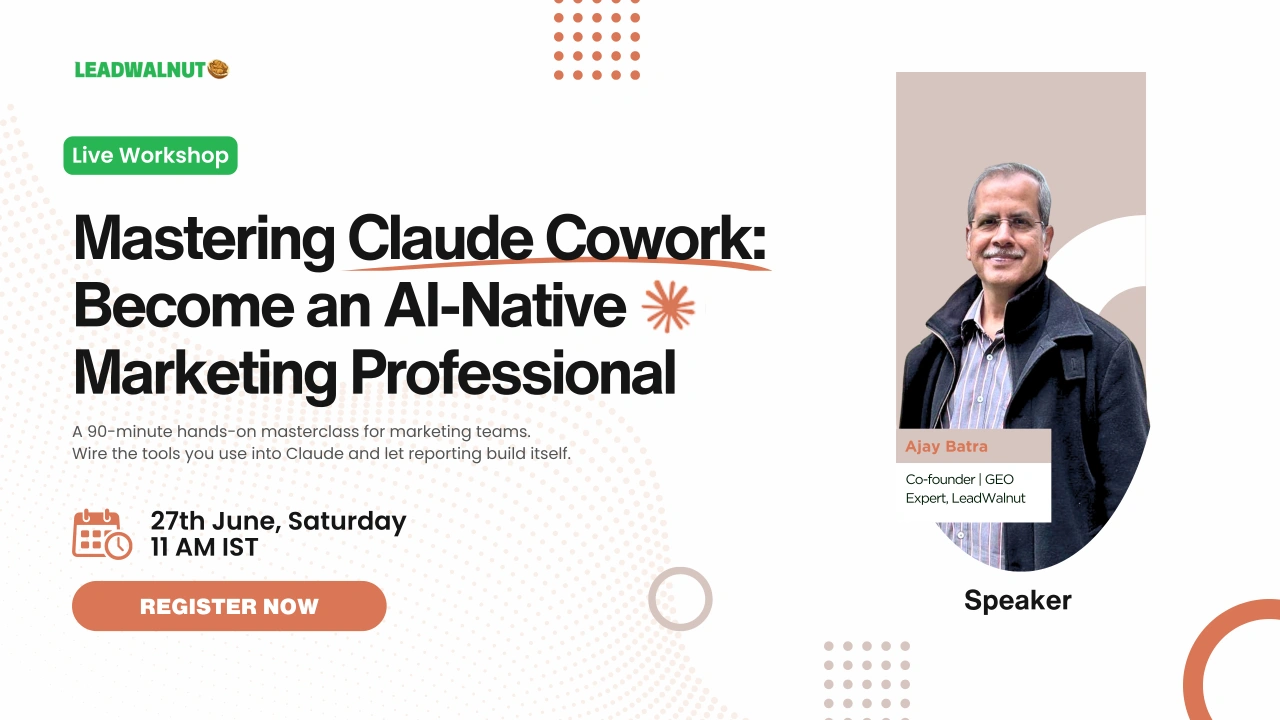
This 90-minute workshop, hosted by LeadWalnut, shows what changes when AI is plugged directly into the tools SEO and GEO teams already use — Ahrefs, Search Console, GA4, Gmail, and Drive. Zero slides. Three live demos on real client data.
Built for teams that want to move from chatting with AI to working with it.
What's Covered
Why Cowork now: the shift from chat to agentic AI
Chat-based AI keeps the human as the integration layer — pulling data, formatting outputs, pasting between tools by hand. Agentic AI reads files, connects to your marketing stack, runs multi-step workflows, schedules itself, and remembers context across sessions. Ajay Batra opens with the harder reframing: most teams have adopted AI for quicker drafts — today is about running steps end-to-end.
The LeadWalnut Agent-Building Framework
Every Skill shipped to clients follows the same shape: structured input, locked process and guardrails, structured output, feedback loop. Without this framework, AI drifts into generic, repetitive output that both LLMs and Google penalize. This is the same build process behind every agent in LeadWalnut's free AI Agent Hub.
Demo 1 — Product/Service Evaluation Agent: Skill + Connector
A reusable Skill scores a client's service category against every competitor — through the eyes of different buyer roles. In the live run (Splashtop, Remote Access Software, 5 competitors, 3 buyer roles), Cowork scopes each role's decision lens, weights evaluation criteria, scores every vendor with evidence, and closes with content recommendations per role.
The output makes an uncomfortable gap visible fast: a brand can rank #1 with IT admins and #4 with CISOs on the exact same product. Want to run this yourself? The standalone version of this workflow is the AI Search Evaluation Agent in our agent hub.
Demo 2 — ICP-Focused Prompt Generation: Skill + Connector
The prompt-generation Skill takes a client's brand, category, existing prompts, Ahrefs keyword data, and Search Console queries, then generates 30–36 prompts classified into six buyer buckets — USP, Brand, Features, Services, Industries, Personas — validated against real search data.
The contrast shown live is sharp: generic AI tools return definitional prompts (What is OT security?), while the framework returns intent-led prompts mapped to real buyer behavior (Is [Vendor] a good fit for securing OT networks in manufacturing?). This exact Skill is available as a standalone agent: High-Intent ICP-Aligned LLM Prompts.
Demo 3 — Content Coverage Analysis: Skill + Connector
The content coverage Skill runs on a real keyword category. In one pass, Cowork crawls the client site plus competitor sites, classifies every page across the funnel, maps sub-topics, benchmarks the funnel-stage split against industry targets, and produces a gap matrix split between "create new" and "optimize existing."
This workflow also ships as a standalone tool: the Content Coverage Analysis Agent.
The Cowork toolkit: Dispatch, Schedule, Skills, Templates
Dispatch sends outputs to teammates with one command. Schedule runs recurring reports on auto-pilot. Skills are reusable named workflows packaged once and reused across every client. Templates are plug-and-play starting points for common marketing workflows.
Who Should Watch
- CMOs and Heads of Marketing overseeing SEO/GEO strategy
- SEO, GEO, and AEO Directors tracking brand visibility and citations across AI search engines
- SEO and Digital Marketing Managers running competitive benchmarking and content-gap prioritization
- Content Strategists and SEO Analysts who need validated, ICP-driven prompt sets
- Agency Founders and Delivery Teams scaling client volume without scaling headcount