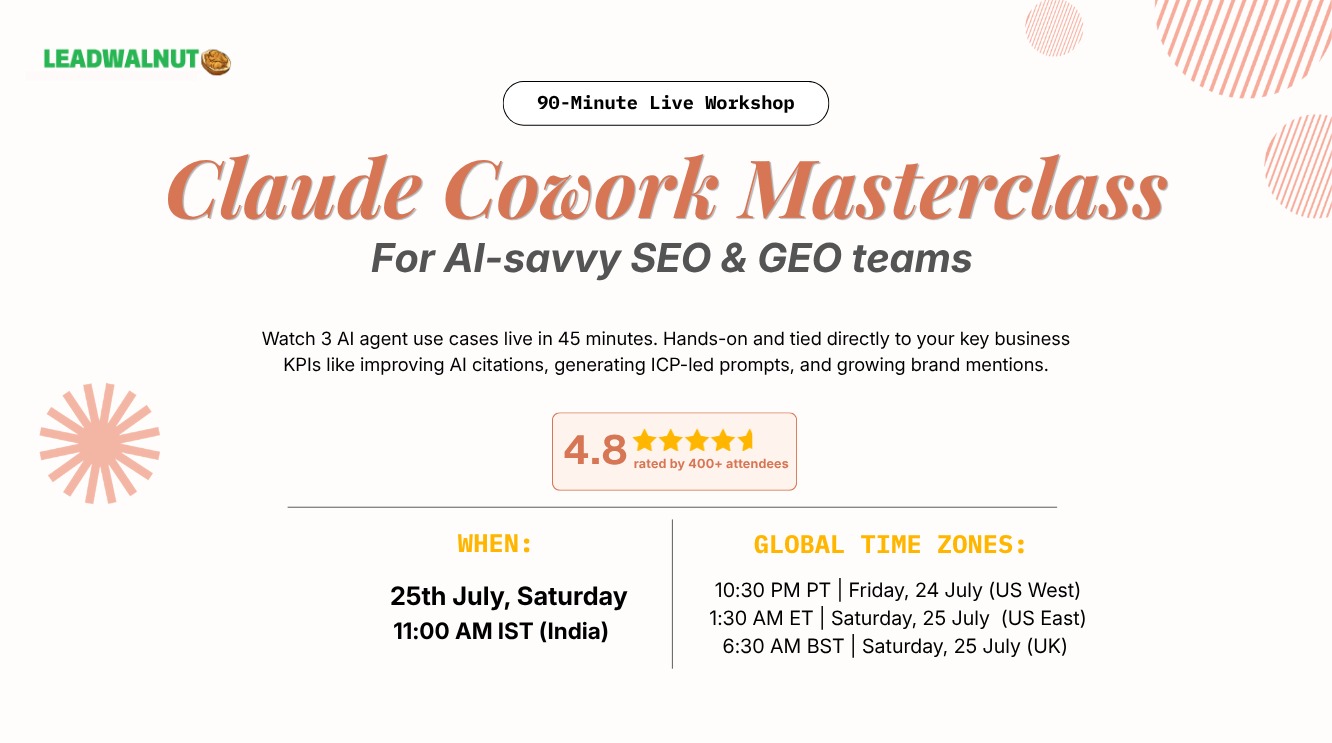
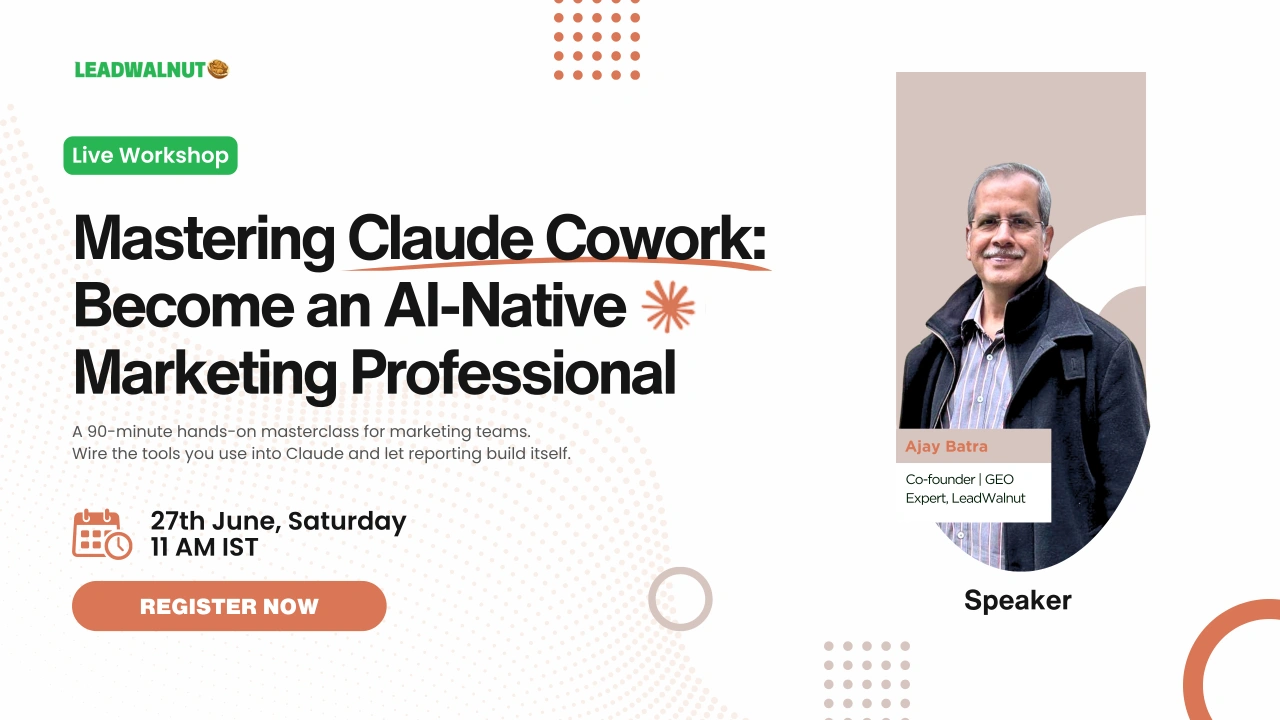
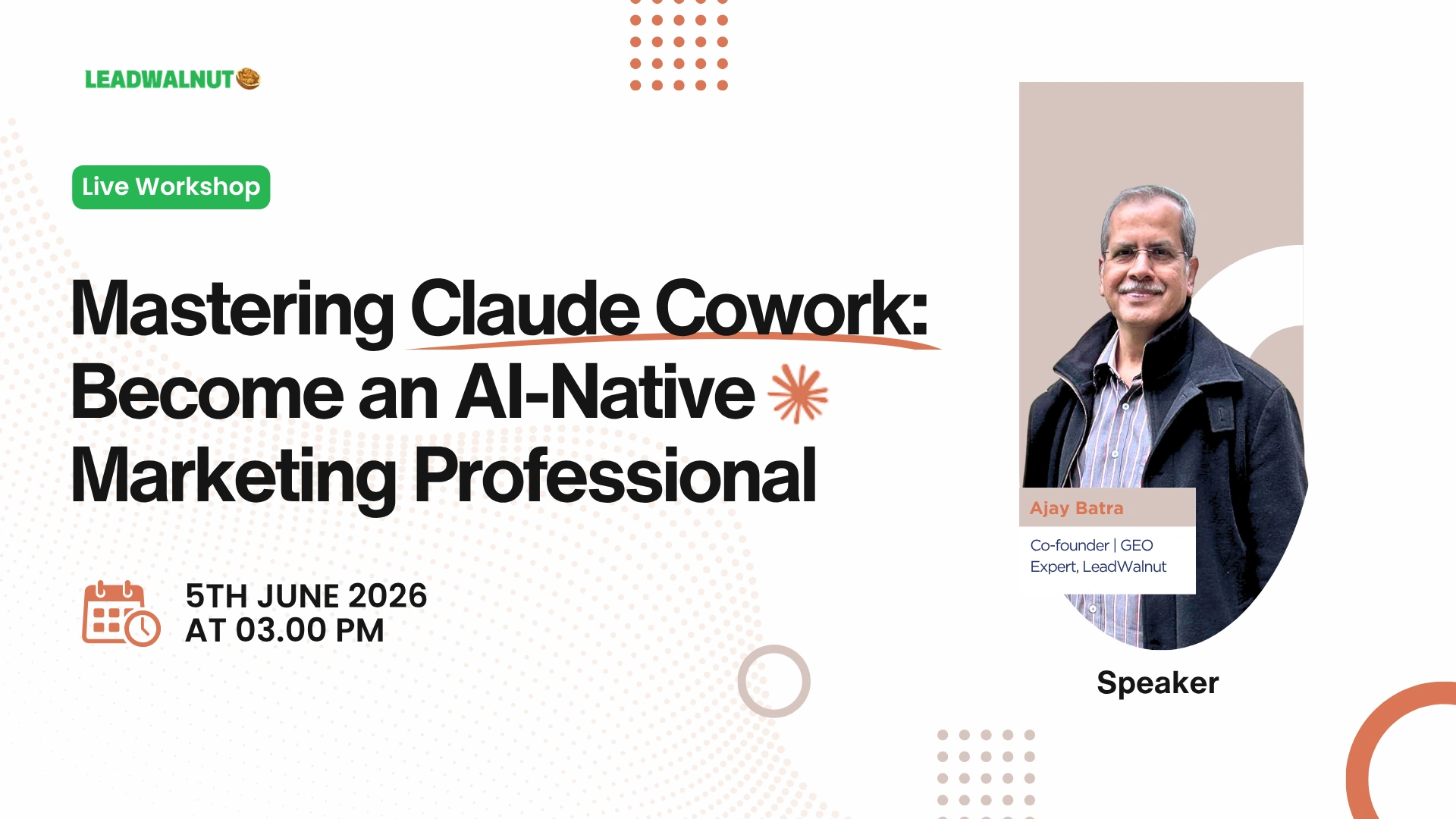
75% of marketing teams have adopted AI. Only 13% have changed how the work actually runs. That gap isn't a tooling problem - everyone bought the tools. It's an operating-model problem. Teams are typing faster, but the eight handoffs between a decision and pipeline still wait on someone else, and reporting still eats the week.
This masterclass, hosted by LeadWalnut and recorded live with 50 B2B marketing leaders, is about closing that gap: moving from one-off AI prompts to agentic systems that plan, produce, and report while your team stays in control. Three ready-to-run agents, demoed on real data, start to finish.
You'll hear from three people who have already made this shift inside real enterprises:
- Ajay Batra - Co-founder & CEO, LeadWalnut (host). Ten-plus years scaling B2B tech brands and leading AI-search transformations across Fortinet, eFax, and Splashtop.
- Raja T M - Director of Marketing, Kissflow. On moving from AI tools that wait for a prompt to systems that anticipate - and why that's an operating-model decision, not a tooling one.
- Kent Yunk - Director, Web & SEO, Fortinet. Three decades in enterprise marketing, from search dominance to AI visibility inside a security-first enterprise.
What's Covered
The 13% problem: why marketing's AI playbook is broken
Most teams adopted AI for quicker drafts - same steps, same people, faster typing. The 2× performers sit inside the 13% who changed the operating model itself. Ajay Batra opens by naming where marketing actually stalls: eight handoffs, seven to nine weeks elapsed, but only about eleven days of real work inside it. The rest is queue.
From AI tools to AI systems: agentic workflows and Claude Cowork
Chat-based AI keeps the human as the integration layer - pulling data, formatting outputs, pasting between tools by hand. Claude Cowork reads your files, connects to your stack (GA4, GSC, Ahrefs, Gmail, CMS), runs multi-step workflows, schedules itself, and remembers context across sessions. Same eight stages, but nothing waits on a person to start — two named-human sign-offs, about fifty minutes of review in total.
Raja T M (Kissflow): building AI from the ground up
Most teams hit a ceiling a few months after buying AI tools. Raja T M, Director of Marketing at Kissflow, shows how leaders move from tools that wait for a prompt to systems that anticipate - and why that's an operating-model decision, not a tooling one.
His talk: From AI Tools to AI Systems: Building Marketing That Anticipates, Not Just Executes.
Kent Yunk (Fortinet): from branded search to AI visibility - and staying secure
In a live fireside chat, Kent Yunk, Director of Web & SEO at Fortinet, draws on three decades in enterprise marketing - from search dominance to AI visibility. How a security-first enterprise earns visibility inside AI answers, builds stakeholder trust, and keeps data governed at every step.
Why agents die in the demo - and the framework that makes them stick
Most AI agents die in the demo, and the team never adopts them. Four failures cause it every time: built on a prompt instead of a process, no guardrails, ignores your assets, no feedback loop. The LeadWalnut Agent-Building Framework closes each one - structured input, a locked process and guardrails, structured output, and feedback that sticks. This is the same build standard behind every agent in LeadWalnut's free AI Agent Hub.
Live Agent 1 - ICP-led prompt generation
The prompt-generation Skill takes a client's brand, category, existing prompts, Ahrefs keyword data, and Search Console queries, then generates 30–36 prompts classified into six buyer buckets - USP, Brand, Features, Services, Industries, Personas - validated against real search data. The contrast is sharp: generic AI returns definitional prompts (What is OT security?), while the framework returns intent-led prompts mapped to real buyer behavior (Is [Vendor] a fit for securing OT in manufacturing?). Available as a standalone agent: High-Intent ICP-Aligned LLM Prompts.
Live Agent 2 - content coverage analysis in 15 minutes
The content coverage Skill runs on a real category. In one pass, Claude crawls the client site plus competitor sites, maps sub-topics and questions, compares coverage topic by topic, and prioritizes gaps by funnel stage and proximity to revenue. The output is a ranked plan you can fund on Monday - not another keyword spreadsheet. It also ships as a standalone tool: the Content Coverage Analysis Agent.
Live Agent 3 - the Monday-morning report
One page in your inbox every Monday: where each category stands against competition, your AI visibility score, biggest wins, and the weakest spot - and what moved since last week. The whole setup is mail access plus GA4, GSC, and Ahrefs connected. Nobody assembles it. Nobody chases it. It simply arrives, in the same shape, every week.
Keep building: three ways to start
Upskill your team with hands-on Cowork workshops, have LeadWalnut set up your marketing OS with the right agents and connectors, or have SEO, GEO, and CRO delivered AI-native and human-approved. Start where your team is - and move as fast as it can absorb. Check out the AI-Enablement Programs we offer.
Who Should Watch
- CMOs and Heads of Marketing setting AI and growth strategy
- VPs of Marketing rebuilding how the function actually runs
- Heads of SEO, GEO, and AEO tracking brand visibility across AI search engines
- Demand Generation leaders who want AI that anticipates, not just executes
- Marketing operations leaders scaling output without scaling headcount