A first-page ranking used to promise a steady flow of visitors. That promise has weakened. Zero click searches are now the majority of Google queries.
SparkToro's 2026 clickstream study found that 68.01% of US Google searches between January and April ended without a click, up from 60.45% in 2024. The searcher reads an AI Overview, a snippet or a knowledge panel, then leaves or searches again.
Impressions keep rising while clicks keep falling. SparkToro's Amanda Natividad calls this the "alligator graph", because the gap between the two lines opens like a set of jaws.
For B2B marketers, the question is no longer how to win the click on every query. It is how to stay visible, credible and remembered when the answer shows up first.
What Is Zero-Click Search And Why Is It Growing?
A zero-click search is a query that the results page answers by itself, so the searcher never visits a website. Google shows the answer directly in an AI Overview, a featured snippet, a knowledge panel or a quick fact box.
The pattern is not new. Featured snippets started it years ago by placing a short answer above the organic results, a spot SEO teams called "position zero." AI Overviews sped it up by summarizing several sources in one block. That is why the share of zero click search keeps climbing each year.
5 SERP Features That Answer Queries on the Page
Each of these features is designed to settle the query before the searcher scrolls. The examples below were checked live on Google US on November 10, 2026.
Every feature that saves a searcher a click also takes one away from a website.
Query type decides which feature appears. Longer, more complex informational queries tend to trigger AI Overviews. Simple factual questions still pull featured snippets or knowledge panels, while commercial queries lean toward shopping results (Search Engine Land).
Snippets remain one of the oldest sources of zero-click results. Teams competing for that spot can follow this guide on how to rank on featured snippets.
How AI Overviews Made On-Page Answers the Default
AI Overviews do not lift one passage from one page. They assemble an answer from many. Google says AI Overviews and AI Mode may use a "query fan-out" technique, running several related searches across subtopics and data sources to build a single response.
So one buyer question can pull in pages that rank for a dozen nearby questions. That raises the bar for every page that wants to be included:
- Quotable: each section answers one question in a passage that still makes sense when lifted out of the page.
- Verifiable: numbers carry a named source and a date, so an engine can trust and credit them.
- Present off-site: reviews, community threads and third-party articles confirm what the brand says about itself.
For a step-by-step method, see this blueprint on how to rank on Google's AI Overviews.
Why Searches Now End on Google: 2026 Data
Zero-click search is growing for two reasons. Google answers more queries itself, and buyers now refine their search on the results page instead of opening a site.
Search itself is not shrinking. Data from Datos and SparkToro, shared at MicroConf US 2026, shows traditional search, AI tools and commerce search all grew over the past year. Roughly one in five searches now happens outside a traditional search engine, on platforms like Amazon, YouTube or ChatGPT (MicroConf talk). The total keeps getting bigger, but the share that reaches a website keeps getting smaller.
How searchers changed
How B2B buyers changed
G2 surveyed 1,076 B2B software buyers in March 2026, and it found AI chatbots now influence shortlists more than review sites, analysts or vendor websites. For the wider context, read how AI is changing search behavior.
Do No-Click Results Still Build Brand Awareness?
Yes, as long as the brand is named in the answer. G2 found that 85% of B2B buyers think more highly of a vendor when an AI chatbot includes it in a response.
That is the idea behind zero click marketing. Content delivers its full value inside the feed or the AI answer, so buyers learn from the brand without having to click. Amanda Natividad, VP of Marketing at SparkToro, argued at MicroConf US 2026 that the click can no longer be the only way content creates value.
The path she describes is common in B2B. A buyer reads a founder's native post or sees the brand in an AI answer. They engage, later type the brand name into Google, and only then visit the site (MicroConf talk).
Search is usually the last touch, so last-click reports credit it with demand that other channels created. Google captured that demand. It did not create it.
Zero-Click SEO Strategy: 6 Steps That Protect Pipeline
Zero click SEO accepts that some queries will never send traffic, and plans around that fact. The aim is to own the answers worth owning, build for the clicks that still happen, and show up wherever buyers form opinions.
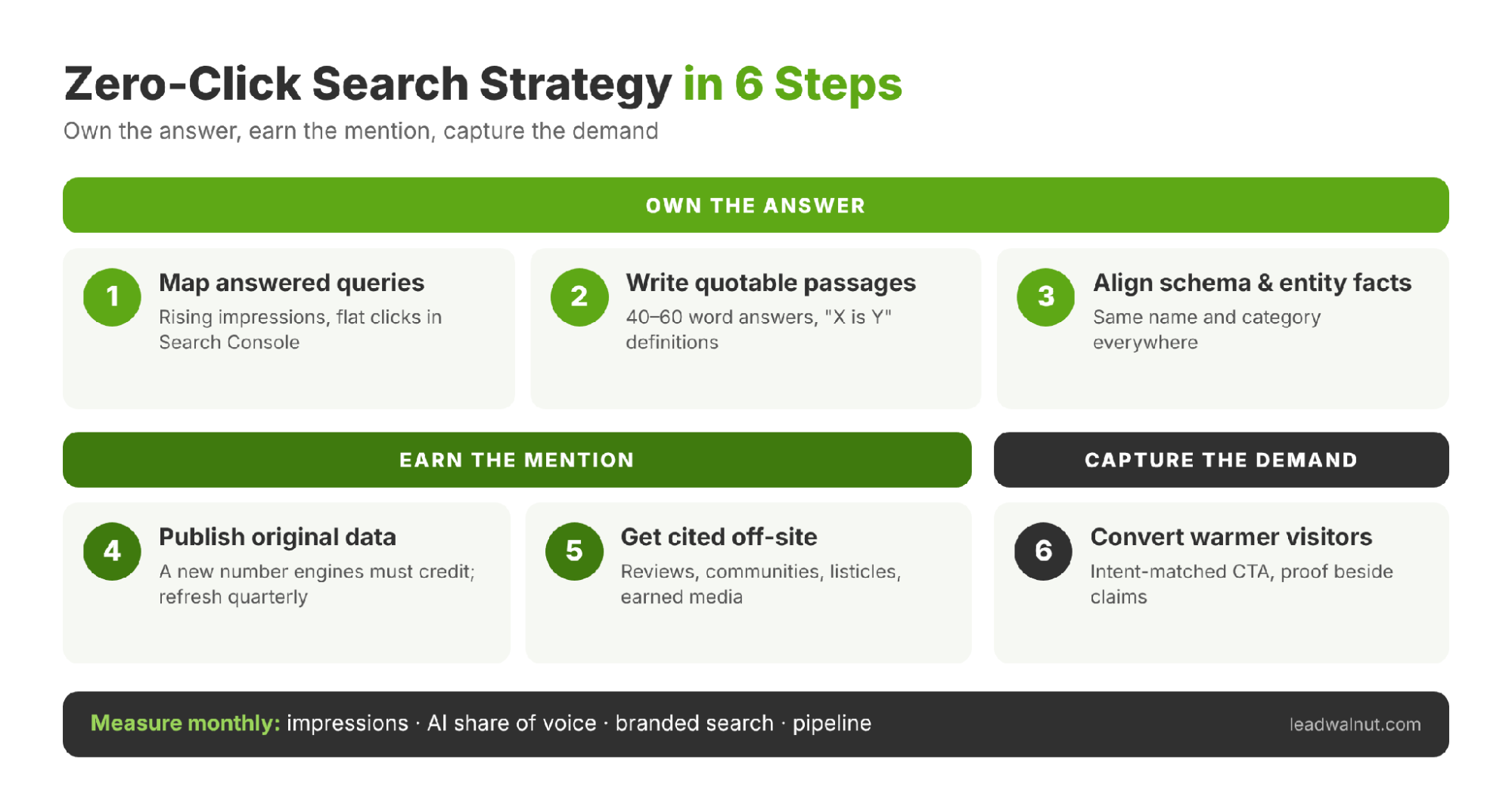
The six steps below form a working zero-click search strategy for B2B teams.
Step 1: Map the Queries and Prompts Already Answered On-Page
Start in Google Search Console. Queries with rising impressions and flat clicks are the clearest zero-click keywords. Sort them into two groups: queries to own for visibility, and queries to build for clicks.
A definition query rarely sends traffic, yet being the cited source puts the brand in front of every searcher. A comparison query can still earn the click when the page offers more depth than the summary.
Repeat the exercise for AI prompts. Buyers ask ChatGPT and Perplexity full questions, so map the prompt version of each high-value query as well.
Step 2: Write Answer-First Passages AI Overviews Can Quote
Zero-click content is built to be read where the buyer already is: on the results page or inside an AI answer. Format matters as much as facts. These are the zero-click content ideas that AI systems quote most easily:
- Open each section with a 40-60 word answer under a header phrased as a question.
- Use "X is Y" definitions for every "what is" query.
- Match H2 and H3 wording to the real query phrasing in Search Console.
- Put the answer first, then supporting detail, then background.
- Use comparison tables with three to five differentiators for "vs" queries (Search Engine Land).
A real example shows the pattern. For "what is SASE," the AI Overview cites Fortinet's glossary, which opens: "Secure Access Service Edge (SASE) is a cloud-delivered framework that converges essential networking and security functions" (Fortinet).
The sentence names the term, places it in a category and states its job. An engine can lift it without editing a word.
For more formatting rules, see how to optimize blog content for LLMs.
Step 3: Add Schema and Keep Entity Facts Consistent
Article, FAQPage and Organization schema help engines read a page and its publisher. Google is clear that no special schema is needed for AI features, but any markup must match the visible text.
Entity consistency matters just as much. Keep the knowledge panel accurate. Use the same company name, category and description on the website, LinkedIn, G2 and Clutch. G2's research notes that buyers read consistent vendor descriptions across AI engines as a trust signal.
Then connect the dots. Link YouTube descriptions and podcast pages back to the site, and link author and company profiles from each page, so engines tie the brand to the topic (Search Engine Land).
Step 4: Publish Original Data an Answer Cannot Replace
Surveys, benchmarks and first-party data do two jobs. They give searchers a reason to click for the full picture. They also give engines a fact that only one source owns.
A summary can repeat advice, but it has to credit a new number.
Refresh these assets every quarter with updated figures, so engines cite the current version (Search Engine Land). Freshness has a real effect. Natividad shared how Seer Interactive found one negative review theme repeated 67 times in AI answers about the agency. Publishing real retention data changed those answers, but the old claim crept back whenever the data went stale (MicroConf talk).
Proof that lives only in internal slides, finance reports or Slack never enters the public record.
Step 5: Earn Mentions on the Sites Answer Engines Read
Links still matter, but unlinked mentions now shape what engines say about a category. Mentions in zero-click answer engines usually trace back to four source types:
- Reviews: G2 found that review-site citations were the top signal raising buyer trust in an AI answer (G2, 2026).
- Communities: research from Foundation, cited in the MicroConf talk, found Reddit outranked every vendor on 50-66% of shared B2B SaaS keywords.
- Listicles: "best of" roundups feed shortlist prompts directly, so placement there carries weight.
- Earned media: analyst notes, podcasts and trade press add independent proof an engine can trust.
AI-era link strategy: plan link building and digital PR around the sources AI answers cite for the category, not only domain authority.
For tactics, see this guide to earned AI brand mentions.
Step 6: Convert the Better-Informed Visitor
The visitors who still click arrive further along. Google states that when people click from results pages with AI Overviews, those clicks are higher quality, meaning visitors tend to stay longer. Pages should be built for that reader:
- Match the CTA to intent: a demo on decision pages, a checklist on research pages.
- Place proof next to claims, such as a case study metric beside the feature it supports.
- Give every page one clear next step.
AI-era: visitors from AI answers have often compared vendors already. Pages should confirm and prove, not re-explain the basics.
More on this in the CRO opportunity in B2B blogs.
Beyond Zero Clicks: How to Build Pipeline
Zero-click searches build brand visibility, but visibility on Google alone is not enough. Pipeline grows when the same ideas reach buyers on the channels where they already spend time, long before they are ready to buy.
Natividad puts the ratio plainly: for every person who visits a website, about 100 more get to know the brand on platforms it does not control (MicroConf talk). Repeated exposure keeps the brand in mind. When the buying moment comes, it is the name the buyer already knows and searches for.
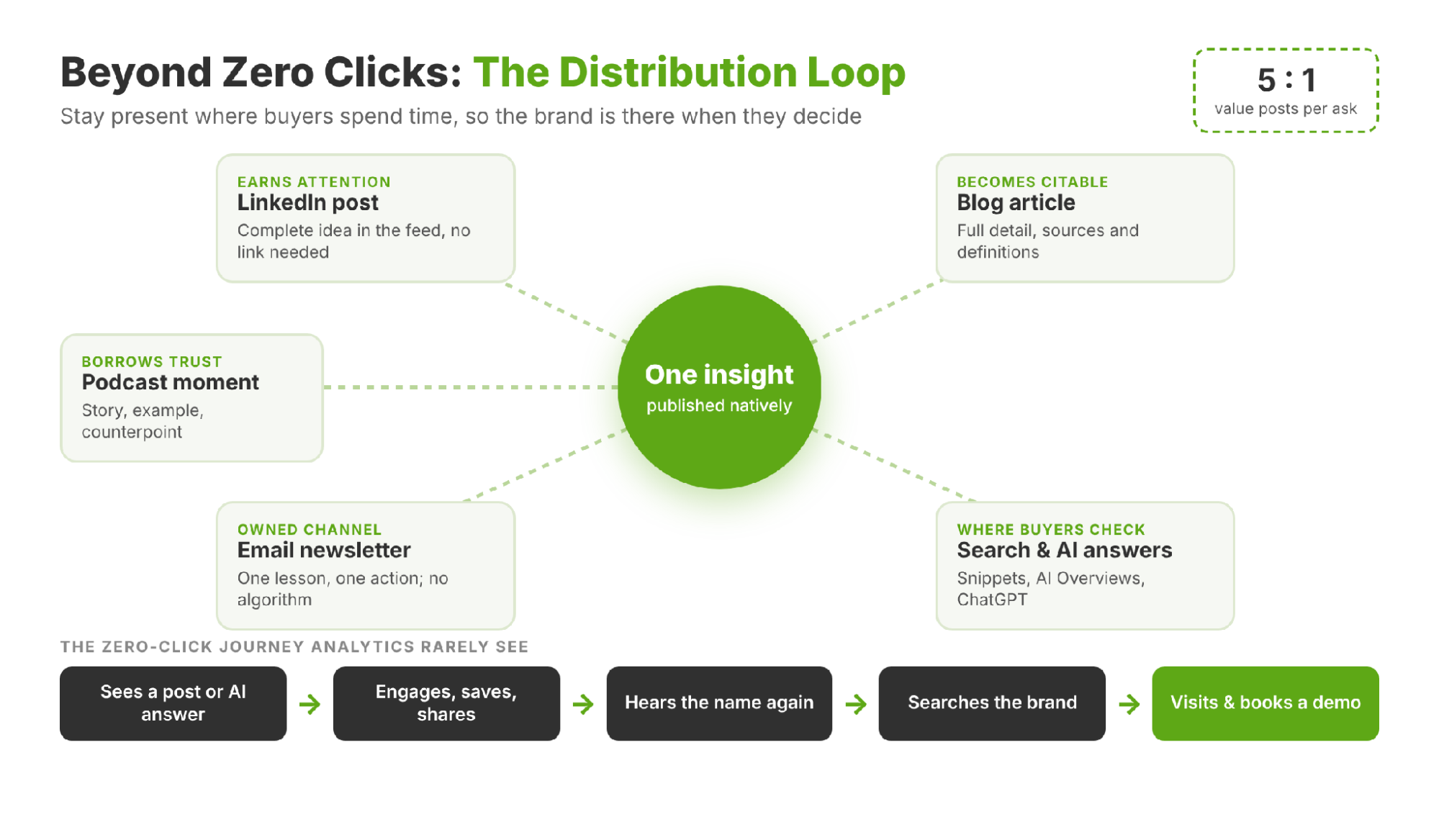
These practices, drawn from the talk, turn zero-click reach into pipeline:
- Pick two or three channels, not twelve. Choose them by where buyers actually pay attention, such as LinkedIn, YouTube, Reddit or a niche podcast, not where clicks are easiest to count.
- Publish native, complete posts. Each post should teach something without needing a click. SparkToro sees roughly 10x more reach on posts that carry no links.
- Repurpose one insight into several formats. A LinkedIn post that lands becomes a longer blog article, a newsletter section and a podcast talking point.
- Let people carry the message. Personal profiles draw more engagement than company pages. The company page holds the record, while founders and employees add a point of view.
- Post with rhythm, not volume. Two or three quality LinkedIn posts a week tend to outperform daily posting, since a second post within a day can throttle the first.
- Give five times before asking once. Treat each useful post as a deposit of trust. An occasional ask, such as a demo, a trial or a newsletter sign-up, is the withdrawal.
- Route everything to an owned channel. Every effort on a rented platform should grow the email list, which no algorithm can throttle.
Each asset also needs a clear job and an internal owner. A case study serves sales, measured by win rate and cycle time. A how-to guide serves customer success, measured by ticket deflection. Enterprise buyers rarely act on a blog post alone; they act on proof.
Search captures demand. Consistent presence across channels is what creates it.
How to Measure Visibility Without Clicks
Clicks undercount reach. Many platforms pass no referral data, so visits that begin in an AI chatbot or a private chat often land as direct or branded search traffic.
In one SparkToro test of more than 1,100 visits across 11 social networks, every visit from TikTok, Slack, Discord and WhatsApp appeared in Google Analytics as direct (MicroConf talk). Review the metrics below monthly, rather than reacting to weekly traffic swings.
Report what buyers saw, not only what they clicked.
Report leads and pipeline from revenue pages, such as service, product and landing pages, rather than sitewide clicks. Confirm each lead's source with sales (Search Engine Land).
When attribution fails, correlation still works. If impressions on no-link posts rise one month, check whether branded search, email sign-ups and demo requests follow in the next two to four weeks. Natividad points to HubSpot as proof: its organic traffic fell sharply after AI Overviews launched, yet its Q4 2025 revenue hit a record (MicroConf talk). Traffic and revenue are different numbers.
Why Zero-Click Searches Reward Brands Buyers Already Know
Zero-click searches move discovery onto the results page and into AI answers. Buyers now form a view of a vendor before they ever reach its site, and they shortlist the names they have seen most often.
The teams that keep pipeline growing do five things. They own the answers worth owning. They earn mentions on the review sites, communities and lists engines read. They show up with useful content on the channels where buyers spend time. They convert the warmer clicks that remain. And they measure presence alongside sessions.
The click is no longer the only proof that marketing works. Being known, trusted and easy to find when the buyer is ready is what fills the pipeline.
See How Often AI Answers Already Cite Your Brand
FAQ
Is SEO still worth investing in when most searches end without a click?
Yes. Google still drives the largest share of search, and AI Overviews draw on pages that already rank well. Strong SEO is the entry ticket to being cited. What changes is the scorecard: impressions, citations and branded demand matter alongside sessions. This is the likely future of SEO in a zero-click world.
Do zero-click searches hurt organic rankings?
No. A zero-click result does not lower a page's position. The impact on SEO shows up in click-through rate instead, since the same ranking now earns fewer visits. Ahrefs data cited by SparkToro suggests AI Overviews cut CTR by nearly 60% on affected queries. The ranking still matters, because it feeds the answer.
Is optimizing for zero-click searches the same as AEO or GEO?
They overlap but are not identical. Zero-click optimization covers every on-page answer feature in Google. Answer engine optimization (AEO) focuses on answer formats, while generative engine optimization (GEO) targets citations in LLMs like ChatGPT. All three share the same foundations. See GEO vs SEO for the differences.
Will blocking AI crawlers like GPTBot bring lost clicks back?
Unlikely. GPTBot is OpenAI's crawler, so blocking it mainly removes content from ChatGPT's view. It does not change how Google builds AI Overviews. The bigger risk is invisibility: buyers who research in AI tools may never hear of a brand that blocked itself out.
How long does a zero-click strategy take to show results?
Formatting and schema fixes can show up in Search Console impressions within weeks of a recrawl. AI citations and branded search lift usually take longer, often a few months. SparkToro sees its no-link social content correlate with sign-ups over the following two to four weeks. Review monthly and adjust channels quarterly.
What is a zero-click journey?
A zero-click journey is the buying path that happens before a visit. A buyer sees a native post or an AI answer, engages with it, later searches the brand name, and then visits the site. Analytics usually record only the final step, which is why branded search gets credit for demand it did not create.



How can LeadWalnut help?

Related Articles

How to Reach Buyers in a Zero-Click Search Landscape

How to Automate the SEO Journey With AI Agents